Chinese President Xi Jinping and Russian President Vladimir Putin sat down for talks in Shenzhen on Wednesday, one day before they are due to join US President Donald Trump for the first three-way summit of the three leaders.
The bilateral meeting took place on the sidelines of the Asia-Pacific Economic Cooperation (APEC) summit in the southern Chinese tech hub. It was the leaders’ fifth meeting this year, and Xi noted during the talks that it was his 50th meeting with Putin since 2013, counting in-person sessions and video calls.
By the end of Wednesday, all three men were in the same city. Trump arrived in Shenzhen later in the day, where Xi greeted him at the airport — the first time the Chinese leader has welcomed any visiting head of state at the airport since becoming president. The three leaders are scheduled to meet on Thursday, November 19, in what Beijing has described as a meeting of “groundbreaking significance.”
A Fifth Meeting This Year — and the 50th Since 2013
Putin landed in Shenzhen just before 2 a.m. on Wednesday and was received on the tarmac by Cai Qi, the fifth-ranking official in China’s Communist Party. The two leaders began their talks around midday, according to Chinese and Russian news agencies.
Kremlin foreign policy aide Yuri Ushakov said Putin and Xi discussed the trilateral meeting with Trump, and that their expanded-format talks focused mainly on economic partnership, including energy, finance, high technology and artificial intelligence. The Kremlin’s programme for the visit said Putin would also brief Xi on his recent contacts with Washington, including the latest round of talks involving Russia, Ukraine and the United States in Abu Dhabi on November 10.
The two leaders then joined Trump and other leaders at the APEC summit venue for handshakes, a group photo and a banquet — a carefully staged show of unity before Thursday’s closed-door session.
What Is on the Table in Shenzhen
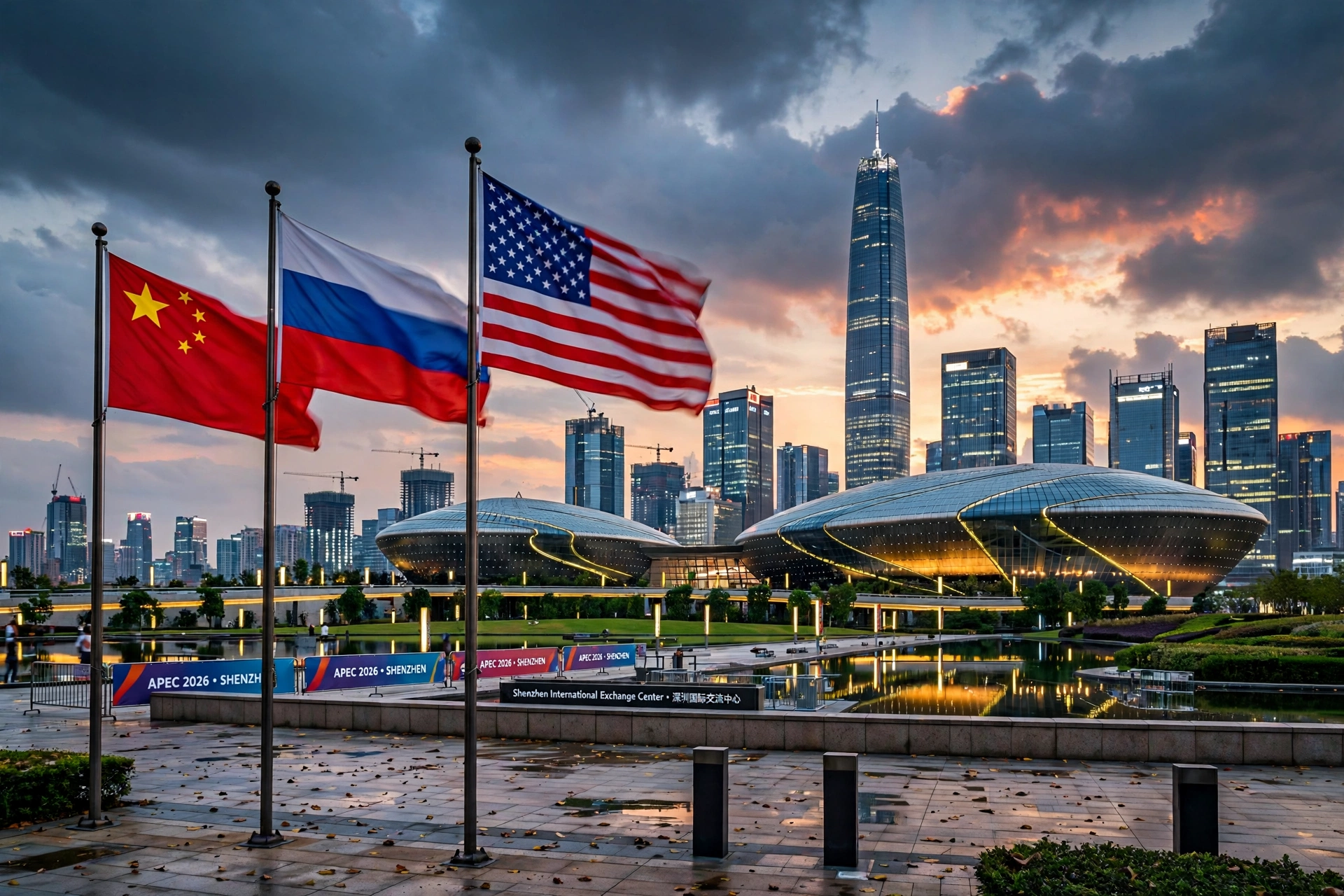
The three-way meeting is expected to run for about one hour, according to Kremlin spokesman Dmitry Peskov, quoted by Russian news agencies. The agenda, as described by officials from all three sides, is unusually broad: Russia’s war in Ukraine, the US war in Iran, trade, artificial intelligence and nuclear weapons.
The White House has said the talks are expected to focus on curbing the spread of nuclear weapons, against the backdrop of the two wars. Trump has said he plans to raise limits on nuclear arsenals and an end to the war in Ukraine. The timing gives the summit added weight: the US war in Iran has escalated sharply in recent days, with the US sinking of five Iranian oil tankers and Iran’s drone strikes on US radar in Bahrain, while in Ukraine the Kerch Bridge linking Russia to Crimea was partly destroyed in a Ukrainian attack.
A separate one-on-one meeting between Trump and Putin is also planned, according to a US official and senior Russian officials quoted by Russian news agencies, though they said no full-scale bilateral negotiations were planned. Trump has also floated the possibility of meeting North Korean leader Kim Jong Un while in China, but that has not been confirmed.
Trade Barbs Before the Handshakes
Before any of the leaders sat down together, Xi and Putin used their APEC speeches to deliver pointed messages about Western trade policy. Reuters reported that Xi pledged to stand up against trade protectionism and urged support for what he called “free and open trade,” casting China as a stable partner on the global stage.
“We must firmly uphold the rules-based multilateral trading system with the World Trade Organization at its core, support free and open trade and investment,” Xi told an audience of business executives. He added that China will lower tariffs and further open up its markets, while continuing to invest in its industrial complex and new technologies.
Putin followed Xi on stage with a sharper attack on Western sanctions imposed over Russia’s war in Ukraine. He described Western powers as “former hegemons,” said Europe was in a “humiliating decline,” and argued that sanctions had backfired. “While sanctions, tariffs, and export restrictions may still exert a certain deterrent effect, they are incapable of halting growth — let alone crushing the economies of competitors,” he said.
The trade tension is real and immediate. Washington has announced further restrictions on China’s access to advanced AI chips from companies such as Nvidia, which could complicate a fragile trade truce with Beijing. China has pledged to retaliate. Western trade partners have also criticised China for running annual trade surpluses exceeding $1 trillion, while Beijing says its growth model is appropriate for an economy still catching up with the world’s richest.
An Airport Welcome — and a Cold Shoulder for Japan
Trump’s arrival in Shenzhen carried its own symbolism. Xi greeted him at the airport, and the two briefly hugged and exchanged words before walking to their motorcades. “China is a country of etiquette and has a tradition of reciprocating courtesy,” Xi was quoted as saying by state news agency Xinhua, adding that he looked forward to discussing China-US relations, Asia-Pacific cooperation and the global landscape.
The gesture reciprocated Trump’s welcome for Xi at Joint Base Andrews in September, when the two leaders last met. Trump said every meeting with Xi has been “very pleasant,” according to Xinhua.
Not every leader received the same treatment. Japanese Prime Minister Sanae Takaichi landed without any welcoming ceremony, while leaders from Australia, Canada and South Korea were met by dancers and soldiers hoisting rifles. Her visit comes amid a rift between Beijing and Tokyo that began a year ago, after she said Japan could deploy its military if a Chinese move on Taiwan also threatened Japanese territory. On Tuesday, Taiwan and Japan flagged incursions by Russian aircraft into their airspace.
Trump’s Asia trip has also included a stop in Manila, where he vowed to deepen defence cooperation with the Philippines amid its growing friction with Beijing over disputed features in the South China Sea. The trip is his first since his Republican Party’s defeat in the midterm elections this month.
Why Kyiv and Europe Are Watching Nervously
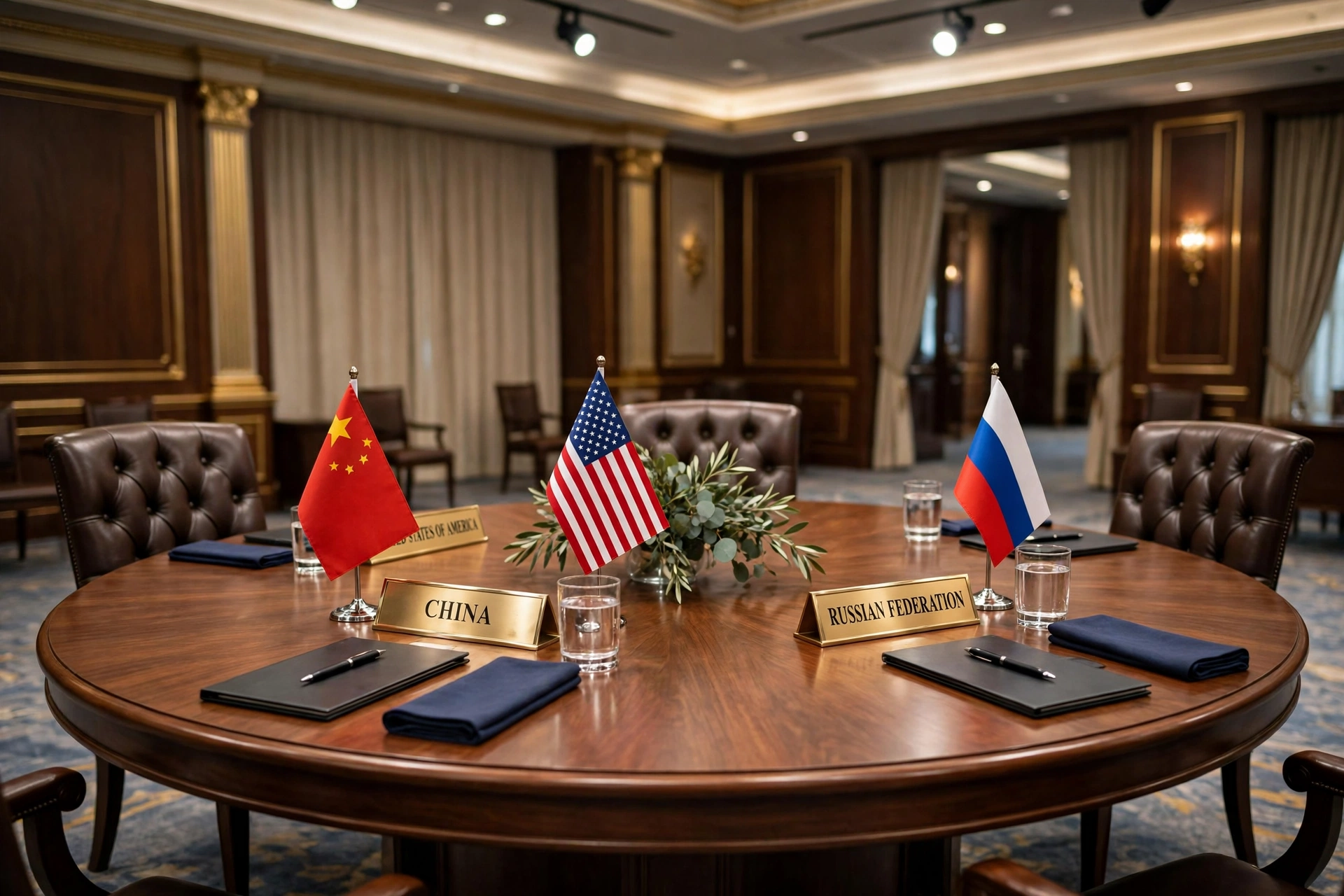
The Shenzhen trilateral has drawn comparisons with the 1945 Yalta Conference, when the US, Britain and the Soviet Union formalised spheres of influence and set the stage for the post-Second World War order. The comparison has unnerved capitals in Europe and Asia, which fear the world’s greatest military powers could settle Ukraine’s future — and other questions — without them.
The Kremlin this week dismissed the Yalta comparisons as “games of political scientists,” but said the meeting would have a major impact on global affairs. Beijing said the trilateral will promote world peace, and its Foreign Ministry said the three leaders would hold “in-depth exchanges on safeguarding world peace and promoting strategic stability in major-power relations.”
An analysis in The Conversation argued that the summit signals a broader shift away from multilateral institutions toward direct diplomacy among a small number of major powers, with Europe and other middle powers increasingly on the sidelines. It noted that Russia and the US just concluded a third round of peace talks this year in Abu Dhabi toward ending the Ukraine war — with Ukraine part of the discussions, but European negotiators not present.
Putin himself struck an optimistic note. He described the world as “turbulent” but said disagreements can be addressed by “sitting at the table.” “I therefore expect big potential benefit from the upcoming trilateral meeting,” he said.
What Happens Next
All eyes are now on Thursday’s session in Shenzhen. Analysts do not expect a breakthrough: the White House has cautioned that no agreement is expected, and the one-hour format leaves little room for detailed negotiation. The first evidence of progress would be a shared account of what was discussed and any agreed next steps.
BSC News reported that Trump and Xi are due to meet again at the G20 summit in Miami in December, suggesting the Shenzhen encounter is the start of a longer sequence of great-power diplomacy rather than a one-off event. For Ukraine, Iran and the rest of the world, the question is whether three leaders in one room can do what months of lower-level talks have not: find a path out of two wars and a trade standoff at the same time.
Frequently Asked Questions
When is the Trump-Xi-Putin trilateral meeting?
The three leaders are scheduled to meet on Thursday, November 19, 2026, in Shenzhen, China, on the sidelines of the APEC summit. About one hour has been allocated for the three-way session.
What will the three leaders discuss?
According to officials, the agenda includes Russia’s war in Ukraine, the US war in Iran, trade, artificial intelligence and nuclear weapons. The White House has emphasised curbing the spread of nuclear weapons.
Why is the summit being compared to Yalta?
The 1945 Yalta Conference saw the US, Britain and the Soviet Union divide the world into spheres of influence. Critics fear the Shenzhen meeting could see the three great powers make decisions affecting smaller countries without them present. The Kremlin has dismissed the comparison.
Have the three leaders ever met like this before?
No. Sources describe Thursday’s session as the first-ever trilateral meeting of the leaders of China, Russia and the United States. Xi and Putin have met 50 times since 2013, and Trump has met both men separately, but never all three together.