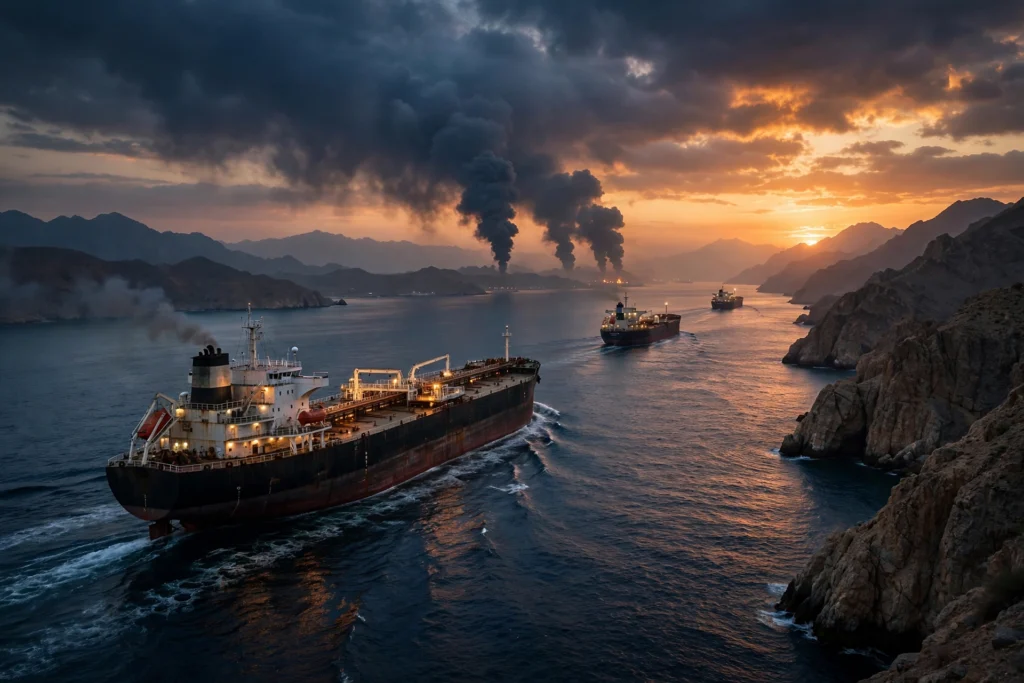
The war between the United States and Iran escalated sharply overnight, with American forces destroying five Iranian oil tankers and Tehran answering within hours by firing ballistic missiles at a US base in Jordan. It is the most serious exchange of the conflict in months, and it has pushed oil prices toward $100 a barrel and raised fresh fears of a wider regional war.
US Central Command (CENTCOM) said its forces struck and destroyed five oil carriers linked to Iran’s Islamic Revolutionary Guard Corps (IRGC) on Tuesday, after the Guard twice tried to target an American warship with ballistic missiles over the previous two days. The warship evaded both attacks, CENTCOM said, and crews aboard the tankers were ordered to abandon their vessels before the strikes.
Five Tankers Destroyed in the Gulf of Oman
Four of the tankers — the M/T Kaviz, M/T Charminar, M/T Horizon 1 and M/T Riesco — were hit in the Gulf of Oman. A fifth, the M/T Derya, was struck near Kharg Island, Iran’s main crude oil export terminal in the Persian Gulf. CENTCOM described the ships as part of a network funding the IRGC through oil smuggling, and said the operation was a direct response to the attempted attacks on the US Navy vessel.
Iranian state media confirmed that five tankers were targeted, and the IRGC acknowledged the losses. The strikes follow Iranian drone attacks on US sites in Bahrain earlier in the week and an earlier tanker incident in the Strait of Hormuz, in a pattern of tit-for-tat attacks that has steadily intensified. With three more tankers struck over the weekend, the US has now hit eight Iranian oil carriers in a matter of days as it tries to choke off Tehran’s oil revenue — its economic lifeline.
As NPR reported, CENTCOM said it gave notice to the crews aboard the ships to abandon them before they were bombed, and reported no American casualties in the operation.
Iran’s Retaliation: Missiles Over Jordan
Iran’s response came swiftly. The IRGC said it launched “fierce missile strikes” on US forces stationed at the Al Azraq air base in Jordan, which hosts American fighter squadrons, and claimed its missiles destroyed hangars used by US jets. Those claims have not been independently verified.
Jordan’s military said its air defences intercepted 18 of 20 incoming ballistic missiles, with the other two falling in unpopulated desert areas, and reported no casualties. Jordanian authorities said their air defence systems engaged all twenty missiles launched toward the kingdom’s territory. US Central Command, asked about the strikes on the Jordanian base, said it had no information to offer.
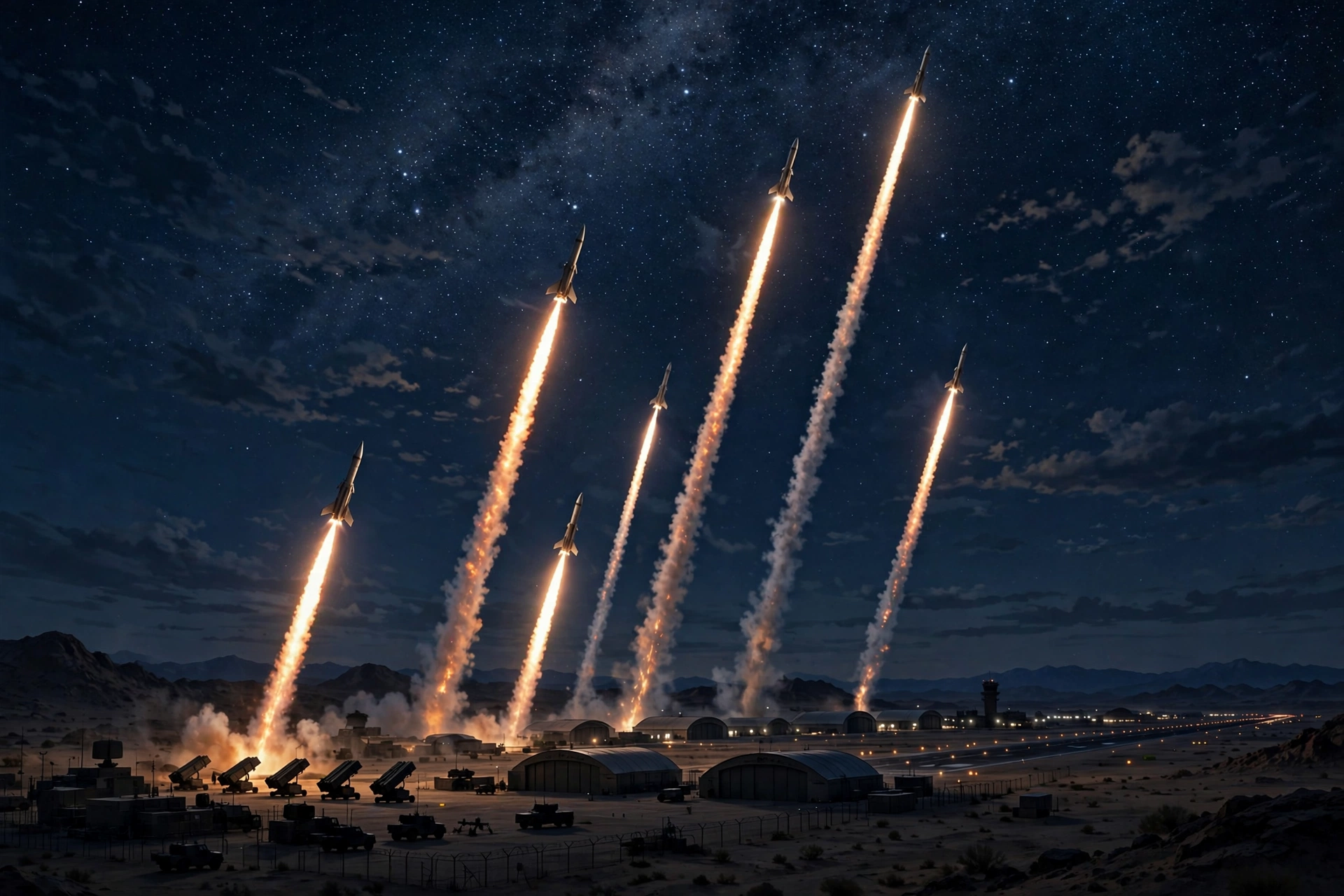
The picture of the damage remains contested. CBS News reported that multiple US aircraft were damaged at the base, including an A-10 Thunderbolt II left with a wing torn off and around eight F-15s sustaining minor damage before being returned to service. American officials, meanwhile, characterised the Iranian response as largely ineffective and credited integrated air and missile defences, with more than 30 Patriot interceptors expended. Jordan is a staunch US ally that hosts American forces, making its bases a repeated target of Iranian strikes.
The Wider Gulf: Hormuz, Qeshm, Kuwait and Bahrain
The exchange did not stop at the tankers and Jordan. Iran said it had attacked ten ships near the Strait of Hormuz — two American vessels and eight oil tankers, by its account — as they tried to cross waters Tehran had just declared a restricted maritime area stretching from Chabahar into the Gulf of Oman and the Arabian Sea. There is no independent confirmation of what, if anything, those attacks hit.
American forces also struck a missile launch site on Iran’s Qeshm Island, while Kuwait’s air defences intercepted hostile drones on Tuesday night and Bahrain said it had intercepted an Iranian drone attack on a US radar system at the Sheikh Isa air base — a claim of a direct hit that US Central Command denied. The IRGC Navy separately warned crews of oil tankers near ports in Kuwait and Bahrain to leave their vessels immediately, saying the ships could be targeted in retaliation.
Oil Prices Climb Toward $100 a Barrel
Energy markets reacted fast. Brent crude, which closed Tuesday up 0.76 percent at $93.14 a barrel, pushed higher on Wednesday as the fighting continued, with oil prices pushed toward $100 a barrel for a fourth straight session of gains. Some reports put Brent past the $100 mark during Wednesday trading, its highest level since July.
The Strait of Hormuz is one of the world’s most important routes for oil shipments, and Tehran has closed it as part of the conflict while Washington enforces a naval blockade on Iranian ports. Any prolonged disruption to shipping through the strait would ripple through global fuel prices, shipping insurance and supply chains — which is why traders are watching every new strike.
A War in Its Seventh Month
The conflict began in late February 2026, when US and Israeli strikes killed Iran’s supreme leader and other senior officials amid collapsed nuclear talks, touching off months of aerial exchanges before a ceasefire took hold in the spring. That ceasefire has now broken down, and the tanker war — attacks on the oil trade that funds both sides’ war efforts — has become its sharpest edge.
The timing adds a diplomatic dimension. The escalation comes just two days before Thursday’s first-ever trilateral summit in Shenzhen, where US President Donald Trump is expected to meet China’s Xi Jinping and Russia’s Vladimir Putin and to raise both the war in Iran and reducing nuclear arsenals. US Secretary of State Marco Rubio has warned that Washington will keep striking Iranian oil tankers if Tehran attempts further attacks on US warships.
What Happens Next
Neither side is signalling a climbdown. Washington has framed the tanker strikes as defensive — a response to missile attacks on its warships — while Tehran has framed its retaliation as legitimate defence of its shipping and sovereignty. With eight tankers struck in days, a US base in Jordan hit by ballistic missiles, and shipping through the Strait of Hormuz under threat, the risk is that the next exchange is bigger than the last.
For now, the world is watching three things: whether Iran attempts another strike on US forces or shipping, whether the United States expands its campaign against Iranian oil exports, and whether Thursday’s summit in Shenzhen produces any opening for talks. Until one of those moves, the Gulf tanker war looks set to grind on — and oil markets, airlines and shippers will keep paying the price.
Frequently Asked Questions
Why did the US destroy five Iranian oil tankers?
US Central Command said the strikes were a response to two attempts by Iran’s Revolutionary Guard to target a US Navy warship with ballistic missiles over two days. The tankers were described as part of an IRGC oil-smuggling network that funds the Guard.
Did Iran hit the US base in Jordan?
Iran fired ballistic missiles at the Al Azraq air base in Jordan, which hosts US forces. Jordan’s military said it intercepted 18 of 20 missiles and reported no casualties, though some reports say US aircraft at the base were damaged.
How have oil prices reacted?
Brent crude rose toward and past $100 a barrel as the fighting escalated, its highest level since July, as traders priced in the risk to shipping through the Strait of Hormuz.
How long has the US-Iran war been going on?
The conflict began in late February 2026 and is now in its seventh month, after a spring ceasefire broke down and fighting resumed around Gulf shipping and oil exports.