
SpaceX is going all in on artificial intelligence. The rocket company said on November 12 that it plans to invest more than $74 billion in two supercomputing campuses in the United States — one at its Starbase site in Texas and another in Cochise County, Arizona. The announcement turns SpaceX, long known for rockets and satellites, into one of the biggest would-be builders of AI infrastructure in the country.
The scale is hard to overstate. The Arizona campus alone could draw up to 6 gigawatts of power at full build-out, which would make it by far the largest data center complex in the world. But the plans are still proposals, not finished buildings: both projects need local approvals, and the first major decisions land on the same day — December 9.
Here is what SpaceX has actually announced, what is still uncertain, and why the power grid — not the chips — may be the hardest part of the plan.
The Texas Campus: A $24 Billion Supercomputer at Starbase
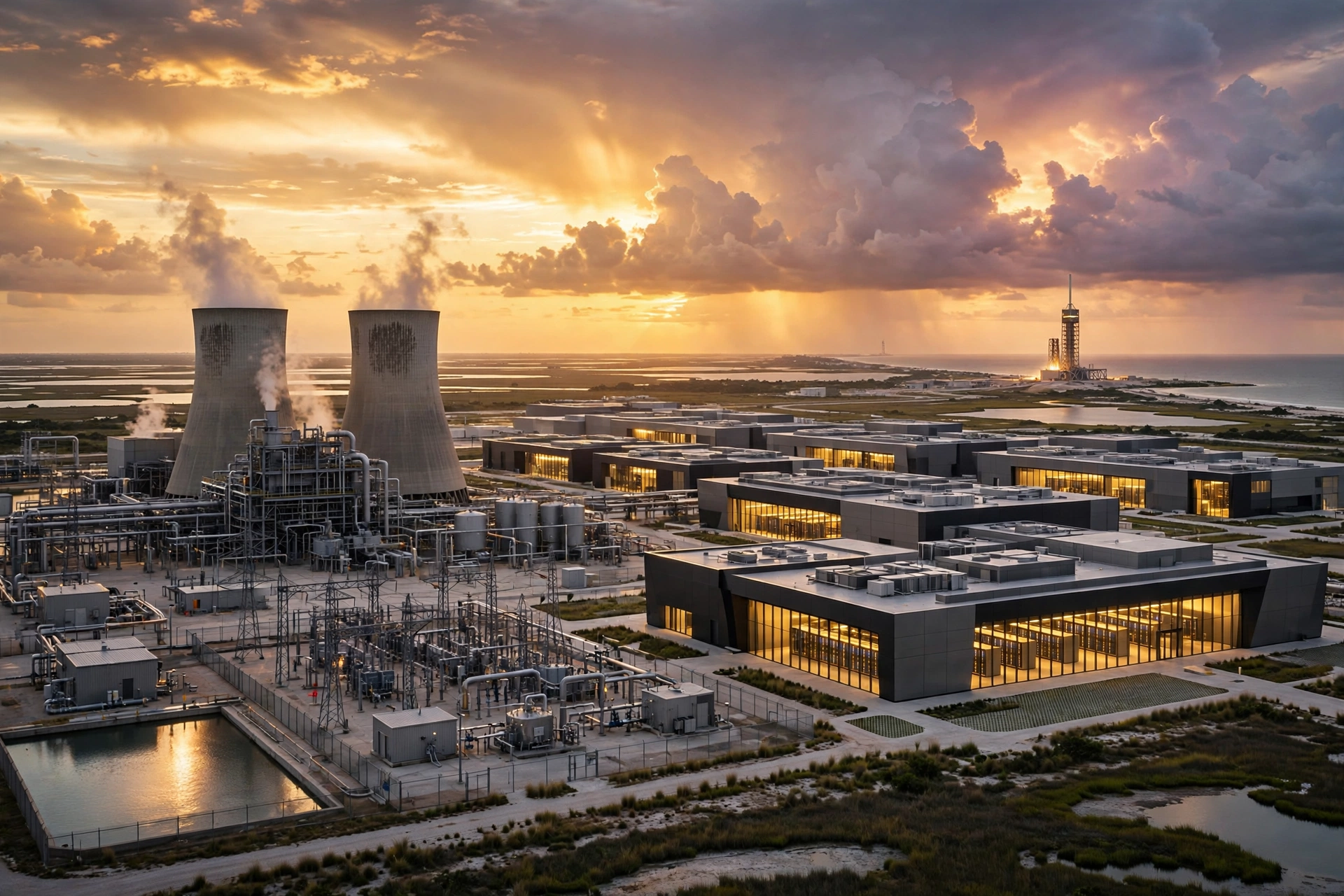
SpaceX expects to spend more than $24 billion on the Starbase site in South Texas, according to the company’s statement. The project sits on 444 acres east of Brownsville, between Boca Chica Boulevard and the Port of Brownsville in Cameron County, and would be built in phases.
What makes the Texas plan unusual is how it handles power. Earlier in the week, SpaceX said it was planning a gas-fired power plant alongside the supercomputing facility, and Reuters reported that the Starbase facility would generate its own electricity rather than draw from the public grid. Pairing generation and compute on the same tract lets the site supply its own power instead of waiting years for utility upgrades — a strategy SpaceX is repeating, in different forms, at both campuses.
The Starbase City Commission will consider a property tax abatement agreement for the project at its meeting on December 9, according to a public notice reported by Bloomberg.
The Arizona Campus: A 6 GW Giant in Cochise County
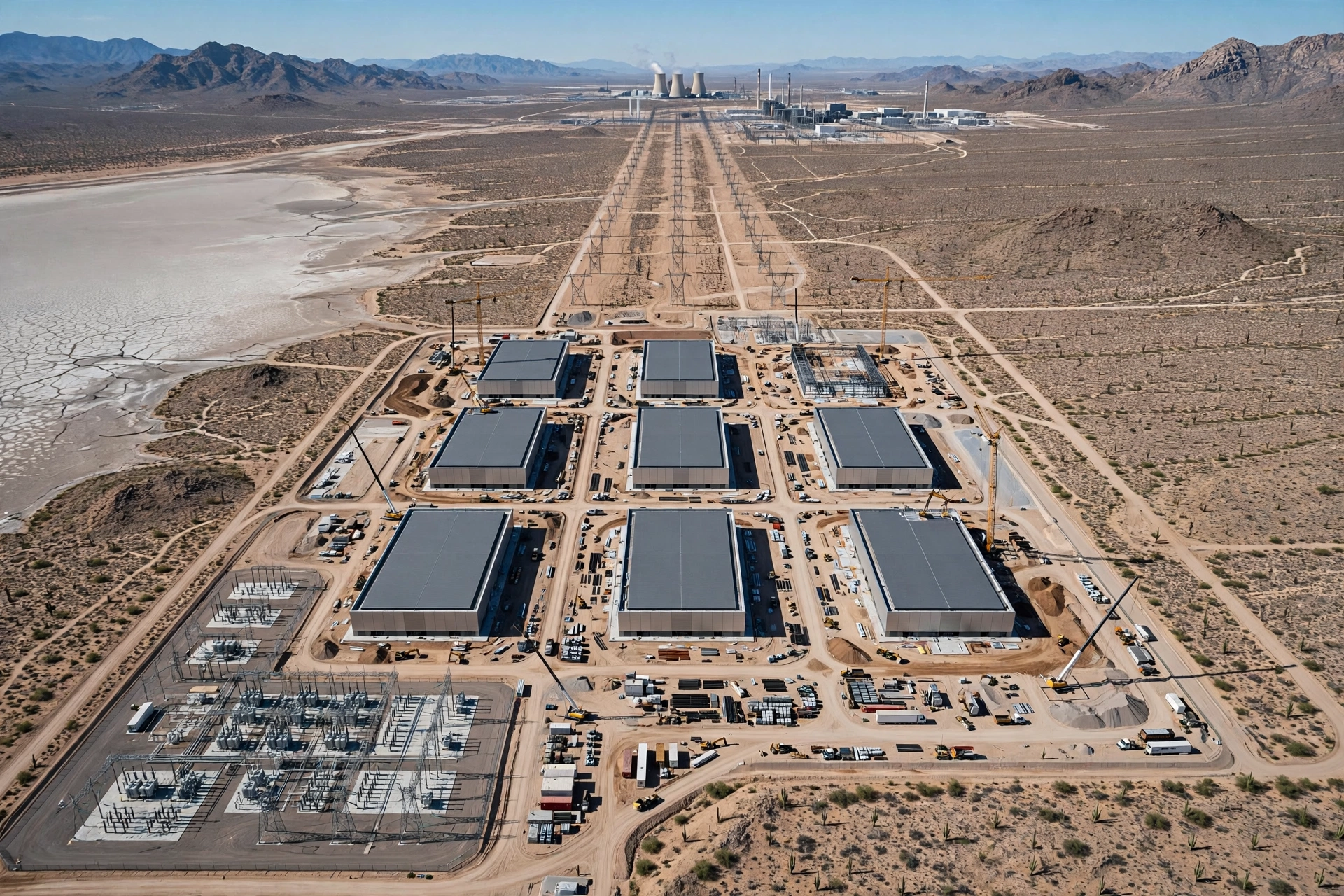
The bigger of the two projects is in Arizona. SpaceX expects to spend roughly $50 billion on a campus in Cochise County, near the Willcox Playa, a dry lake about 80 miles east of Tucson. The site covers 747 acres along U.S. Highway 191, on land currently owned by power firms Arizona Electric Power Cooperative (AEPCO) and Southline Transmission LLC.
According to the application filed by SpaceX affiliate Tombstone Resources LLC, the campus would eventually feature up to nine data center buildings, each measuring 493,000 square feet, brought online in four stages of about 1.5 gigawatts each. At full build-out, the site could require 6 GW of power — more than many entire US states use at peak. Construction could begin in March 2027 if zoning approval is received.
Power is the central engineering challenge. SpaceXAI says it will foot the bill for grid upgrades, spending some $3.6 billion on power infrastructure, including $500 million of work to enable the first phase. The company also plans a 24 GWh battery energy storage system to keep supply steady as demand fluctuates, so the facility’s power use does not destabilize Arizona’s grid. The site sits next to AEPCO’s Apache Generating Station, which produces 626 MW from coal, natural gas and solar.
The local impact is significant either way. SpaceX said the Arizona campus would create about 5,500 construction jobs and 1,000 permanent jobs. But the project still needs approval from Cochise County, and it faces community concerns — including its proximity to the Willcox Playa, a wintering ground for federally protected sandhill cranes, and questions about water use. The applicant says the site would be dry-cooled, using 3 million to 5 million gallons of water once to fill the system and 2 million to 3 million gallons a year for staff sanitation.
The Cochise County Planning and Zoning Commission holds a public hearing on the proposal on December 9 at 2 p.m. in Bisbee. Written comments must arrive by noon on November 27 to reach the commission’s packet.
What Is SpaceXAI?
The campuses belong to SpaceXAI, the company’s data center and AI division, formed by folding xAI into SpaceX. The division already operates a cluster of data centers around Memphis — one in Tennessee and the rest across the state line in Mississippi — used to run the company’s Grok chatbot and to sell AI cloud services to clients including Anthropic and Google.
Elon Musk has claimed more than 1 GW of capacity in the Memphis facilities, a figure that has been disputed, and this week he announced two new Mississippi data centers named Gun Range and Spam. The Texas and Arizona campuses would be the division’s first projects outside Memphis and Texas, and by far its largest.
The strategy connects directly to SpaceX’s broader empire. The same company that launches rockets and runs the world’s largest satellite constellation is now building the computing backbone for its AI ambitions. SpaceX’s Starlink business keeps expanding on the connectivity side, with the battery-powered Starlink Mini 2 dish aimed at off-grid internet users — a reminder that SpaceX now spans space, connectivity and computing.
Why Power, Not Chips, Is the Real Bottleneck
The AI industry’s defining constraint in 2026 is no longer just who can buy the most accelerators — it is who can power them. A 6 GW data center would be by far the largest in the world, and sourcing that much electricity is a monumental task. Arizona’s entire grid had net capacity of about 32 GW in 2024, according to US Energy Information Administration statistics cited by Data Center Dynamics — meaning one campus could consume nearly a fifth of the state’s grid capacity at full build-out.
Getting hold of enough AI accelerators to fill such a facility, plus all the power and cooling equipment required to run them, will likely be an even bigger challenge. The chip supply chain is itself in flux: NVIDIA’s leadership transition — founder Jensen Huang resigned as CEO on November 12, with CFO Colette Kress named interim chief — adds uncertainty at the top of the world’s dominant AI chipmaker just as demand for accelerators reaches new highs.
The hardware race is moving fast on every front. Google’s new TPU systems for confidential AI and long-context agents and AMD’s 256-core EPYC 6 Venice server CPUs show how quickly data center silicon is evolving, while sovereign AI data centers are spreading worldwide. But every one of those chips needs electricity, cooling and land — and SpaceX’s bet is that securing all three at gigawatt scale is the moat that matters most.
What Happens Next
December 9 is the date to watch. On that single day, the Cochise County Planning and Zoning Commission decides on the Arizona zoning request, and the Starbase City Commission considers the Texas tax abatement. Both decisions are gates, not guarantees: even with approvals, the Arizona campus would still depend on grid upgrades being completed, and the phased construction schedules stretch years into the future.
There are also political crosscurrents. Musk has said he hopes to build a $20 billion chip factory in Texas, dubbed TeraFab, to make silicon for his companies. But after Democratic gubernatorial nominee Gina Hinojosa swept to victory in Tuesday’s midterm elections in Texas, the environment in the Lone Star State may be less accommodating. Speaking to CNN on Thursday, Hinojosa said: “We can have a strong working relationship with Elon Musk and his companies, but it has to be on our terms.”
The key distinction to keep in mind: planned investment is not spent money, and announced campuses are not built data centers. SpaceX has described more than $74 billion of proposed AI infrastructure investment. Whether that becomes working supercomputers depends on permitting, financing, power delivery and chip supply — four separate bets that all have to pay off.
Frequently Asked Questions
How much is SpaceX investing in AI supercomputing campuses?
SpaceX said it plans to invest more than $74 billion in two campuses: over $24 billion at its Starbase site in Texas and roughly $50 billion in Cochise County, Arizona.
How big is the Arizona campus?
The Cochise County campus would cover 747 acres with up to nine data center buildings of 493,000 square feet each, built in four 1.5 GW phases to reach up to 6 GW of power demand at full build-out — which would make it the largest data center in the world.
When will the campuses be built?
Construction in Arizona could begin in March 2027 if zoning approval is received, with the first phase potentially online 3 to 6 months later. The Texas project would proceed in phases. Both timelines depend on approvals and grid upgrades.
What is SpaceXAI?
SpaceXAI is SpaceX’s data center and AI division, formed by folding xAI into SpaceX. It runs the Grok chatbot and sells AI cloud capacity to clients including Anthropic and Google from its Memphis-area data centers.
What are the main obstacles?
Local approvals (both key decisions fall on December 9), community concerns over water and wildlife near the Willcox Playa, massive grid upgrades costing $3.6 billion in Arizona, and securing enough AI accelerators and cooling equipment to fill gigawatt-scale facilities.
The Bottom Line
SpaceX’s $74 billion plan is the boldest AI infrastructure bet yet from a company that did not exist in the data center business a few years ago. If even part of it gets built, it would reshape the map of American AI computing — and prove that in the age of gigawatt-scale AI, the companies that win may be the ones that can generate their own power, not just buy the most chips. But for now, it is a proposal with a price tag, not a finished product. December 9 will tell us whether the first gate opens.

