SpaceX has removed the last cable from portable satellite internet. The Starlink Mini 2, announced on November 10, 2026, packs the dish, the Wi-Fi router and now a battery into a single unit about the size of a laptop — and it can keep you online for up to 4.5 hours on a single charge with no outlet, vehicle or power bank in sight. For travellers, remote workers and anyone who works beyond the reach of cell towers, that changes what a portable connection can do.
The original Starlink Mini, launched in 2024, proved there was demand for a truly portable dish. Its biggest limitation was also its most obvious: it always needed an external power source. The Mini 2 answers that complaint directly, while adding faster Wi-Fi, a thinner body and a few thoughtful hardware touches. Here is what SpaceX announced, what it costs, and who should actually buy one.
The headline upgrade: a quick-swap battery with up to 4.5 hours of runtime
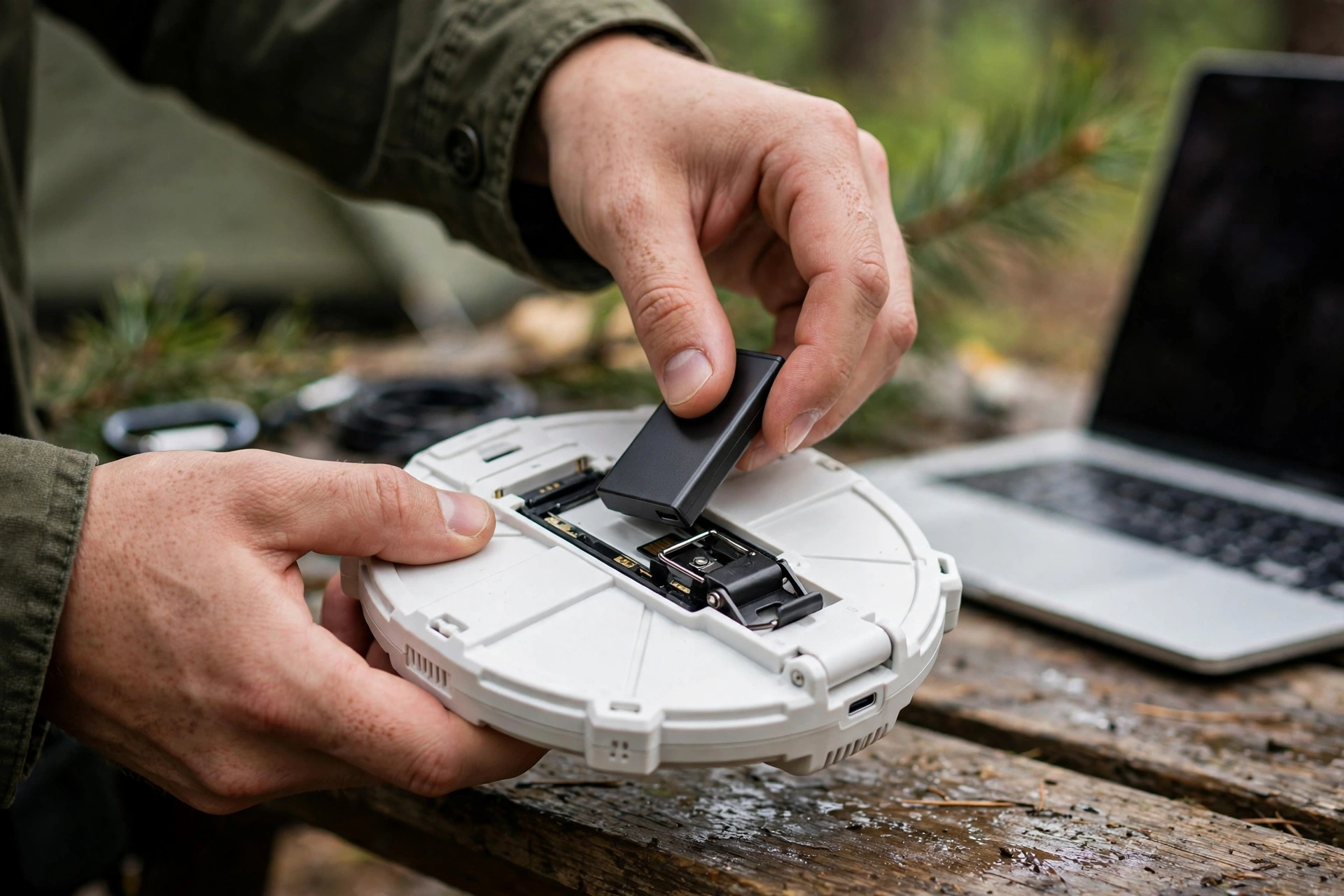
The Mini 2’s defining feature is its removable 71 Wh battery, which weighs 490 grams and clips onto the back of the dish with a quick-release, no-tool mechanism. SpaceX says the pack delivers approximately 4.5 hours of continuous connectivity on a full charge, and owners can hot-swap in a spare pack while the terminal stays online. Spare batteries will be sold separately.
The dish can also be charged over USB-C at up to 60 watts, and the box includes a matching 60W USB-C power supply and a 3-metre cable. If the battery runs flat, users can bypass it entirely and run the terminal directly from any suitable USB-C source. LED indicators show how much charge is left, and a real power button replaces the original Mini’s plug-and-go behaviour — a small change that matters when you want the dish off without unplugging it. The WFB News report on the swappable battery confirms the same invite-only pricing and mid-December shipping window.
Starlink Mini 2 specs: thinner, tougher and faster Wi-Fi
Despite adding a battery, the Mini 2 is thinner than the original Mini, at 23.1 mm thick, measuring 12.36 x 10.35 x 0.91 inches. It weighs 1.6 kg (about 3.53 pounds) with the battery and kickstand attached — roughly a pound heavier than the first Mini, which is the price of going cord-free. The IP67 dust- and water-resistance rating carries over, so the dish is still safe to use outdoors in rain and dust.
Connectivity gets a meaningful upgrade: built-in Wi-Fi 6 replaces the Wi-Fi 5 radio from the original Mini, covering up to about 1,800 square feet (167 square metres). With a clear view of the sky, SpaceX says you can get online in about 60 seconds, helped by a 55-degree field of view that makes it easier for the dish to lock onto satellites. An integrated kickstand folds away, and a standard quarter-inch camera thread lets you mount the dish on a tripod.
Starlink Mini 2 price, preorder and release date
Preorders are now open by invitation for select customers in the United States, with wider availability in more countries to follow. The invite preorder costs $999 and includes the first year of Roam Unlimited service, which SpaceX values at $2,100. Shipments to those first US customers are expected to begin in mid-December, after a $100 refundable deposit.
The Roam Unlimited plan included with the preorder provides unlimited high-speed data, travel at speeds of up to 100 mph, and use abroad for up to 30 days. A Canadian price and arrival date have not been announced yet, and the current Mini remains the portable option there for now. As TechEBlog’s breakdown of the Mini 2 notes, the bundle pricing is the story as much as the hardware: the first year of service is doing much of the heavy lifting in that $999 figure.
Who the Starlink Mini 2 is actually for
The Mini 2 is built for people whose work or travel takes them beyond reliable cellular coverage: van-lifers and overlanders, field researchers, disaster-response teams, rural homeowners, boaters and anyone who has ever balanced a dish on a car roof next to a power bank. For those users, the battery is not a convenience feature — it removes the single accessory that made the original Mini awkward to carry.
It is less compelling as a primary home connection. Fixed Starlink dishes are larger, faster and cheaper per month for a household, and 4.5 hours of battery life still means planning around charging on long off-grid days. But as a second connection, an emergency backup or a travel companion, the Mini 2 is the first Starlink terminal that genuinely works the way a portable gadget should: pick it up, put it down, and get online.

How the Mini 2 fits into SpaceX’s satellite strategy
The Mini 2 arrives as satellite connectivity moves from a niche product to another layer of everyday networks. SpaceX’s direct-to-cell work aims to extend connectivity to ordinary phones through satellites, and the company’s relationship with carriers is becoming more complicated even as the technology improves — as our earlier report on T-Mobile’s decision not to pursue a SpaceX MVNO deal shows, partnerships in this space are still being negotiated deal by deal.
That context matters because the Mini 2 is not just a gadget: it is SpaceX selling satellite internet the way consumer electronics companies sell laptops and phones, with bundles, preorders and invite-only launches. The hardware is converging with the smartphone world — USB-C power, Wi-Fi 6, an IP67 rating — and the Mini 2 is the clearest sign yet of that direction. The Motorola Signature 27 and the Xiaomi 18 Pro series show the same pattern in phones: flagship hardware increasingly defined by what it can do away from a charger and a cell tower.
The catch: battery life, weight and invite-only access
No launch is without trade-offs, and the Mini 2 has three worth knowing before you preorder. First, 4.5 hours is a real-world estimate under SpaceX’s own testing; heavy use, cold weather and poor sky visibility can all shorten it, so long sessions still need a spare battery or a USB-C source. Second, the dish is heavier than its predecessor, and 1.6 kg plus a laptop, tripod and spare battery adds up in a backpack. Third, the invite-only preorder means most buyers will wait — SpaceX has not said when general sales open or what the standalone hardware price will be outside the bundle.
Reports of a slower uplink have also circulated since the Mini 2 first surfaced in firmware leaks earlier in 2026, with the transmit duty cycle reportedly reduced from the original Mini. SpaceX has not confirmed those figures for the shipping product, so treat them as unconfirmed until independent tests of retail units appear. For now, the honest summary is this: the Mini 2 is the most portable Starlink yet, but it is still a first-batch product with first-batch availability.
Should you buy the Starlink Mini 2?
If you already own an original Mini and a power bank setup that works, the upgrade is a convenience, not a necessity — unless the battery is the thing that has been holding you back from taking the dish everywhere. If you travel off-grid regularly and have been waiting for a self-contained satellite terminal, the Mini 2 is the first one that truly qualifies, and the bundled year of Roam Unlimited softens the $999 price considerably.
The broader lesson is about where portable connectivity is heading. AI hardware built for the real world, like the Hedra Model Factory, and satellite hardware built for the field, like the Mini 2, are converging on the same idea: intelligence and connectivity that work where people actually are, not just where the infrastructure already reaches. The Mini 2 does not need a tower, a cable or an outlet — just a clear view of the sky. For a growing number of people, that is enough.
Frequently asked questions
How long does the Starlink Mini 2 battery last?
SpaceX says up to 4.5 hours of connectivity on a single charge from the removable 71 Wh battery. Spare batteries can be hot-swapped while the terminal stays online.
How much does the Starlink Mini 2 cost?
The invite-only preorder is $999 in the US, including the first year of Roam Unlimited service, which SpaceX values at $2,100. A $100 refundable deposit is required, with shipments expected from mid-December.
Is the Starlink Mini 2 waterproof?
Yes, it carries an IP67 rating for dust and water resistance, the same as the original Mini.
Does the Starlink Mini 2 have Wi-Fi 6?
Yes. Built-in Wi-Fi 6 replaces Wi-Fi 5 from the original Mini, covering up to about 1,800 square feet (167 square metres).
When will the Starlink Mini 2 be available outside the US?
SpaceX has not announced dates or pricing for other countries yet. Preorders are currently by invitation for select US customers, with more customers and countries to follow.
The Starlink Mini 2 is a small hardware change with an outsized effect: a battery turns a portable dish into a genuinely portable one. The price, the invite-only rollout and the 4.5-hour limit mean it will not suit everyone on day one, but for off-grid travellers and remote workers, it removes the last reason to leave satellite internet at home. As iPhone in Canada’s report on the launch notes, even the rollout itself tells the story — the Mini 2 is here, it works without a cord, and the rest of the world is still waiting for its invitation.