Most AI models are trained once and then frozen in time. Hedra, an a16z-backed research company building models and infrastructure for multimodal and physical AI, wants to change that. On November 10, 2026, the company launched Hedra Model Factory, an autonomous post-training and inference platform designed to build models for the real world — models that keep improving after they ship. The pitch is aimed squarely at robotics, manufacturing, biology and defense teams whose problems a general-purpose model alone cannot solve.
What Hedra Model Factory Is
Model Factory is not a single model or a single tool. It is a connected workflow that combines flexible GPU sandboxes, post-training run by Hedra researchers working alongside autonomous AI agents, co-optimized low-latency deployment, and a data flywheel that feeds production experience back into the next version of each model. Teams can work with Hedra researchers to build a custom model, start with flexible GPU sandbox capacity without long-term commitments, or bring an existing model to serve on Hedra’s inference engine.
“Recursive self-improvement is already changing how frontier models get built,” said Michael Lingelbach, founder and CEO of Hedra. “The next step is the real world, where the data is video, sensors and simulation. Hedra Model Factory gives robotics, manufacturing, biology and defense teams the infrastructure to post-train, deploy and keep improving their own models.”
The idea of recursive self-improvement — systems that get better at improving themselves — is central to the pitch. Hedra applies it to how models are made: researchers work alongside autonomous AI scientists that run experiments and iterate on training runs, and every deployed model feeds data back into the next version. The company says its revenue grew 15 times over the past 12 months, though it did not disclose the revenue base behind that figure.
How the Factory Works: Four Stages in a Loop
The platform is organized as a loop with four stages. First, compute: Hedra GPU sandboxes give teams flexible capacity running on the company’s inference engine, so they can scale training up without locking into long-term GPU commitments. Second, post-training: teams bring their simulation engines and data, and Hedra helps build the reinforcement learning environments and datasets they need, using tools such as vision-language models that caption and score data or give feedback during online reinforcement learning. For companies without their own research lab, Hedra researchers also set up data capture, evaluations and the training-to-serving loop.
Third, deployment: models run on low-latency compute, on premises or at Hedra’s nearest partner data center. That ranges from distilling world action models to run faster than real time without losing physical coherence, to fitting a vision-language-action model onto an edge device. Teams can also bring an existing model to serve on Hedra’s inference engine. Fourth, self-improvement: once a model is deployed, Hedra researchers analyze its production performance, retrain the model and release only versions that pass the customer’s evaluations.
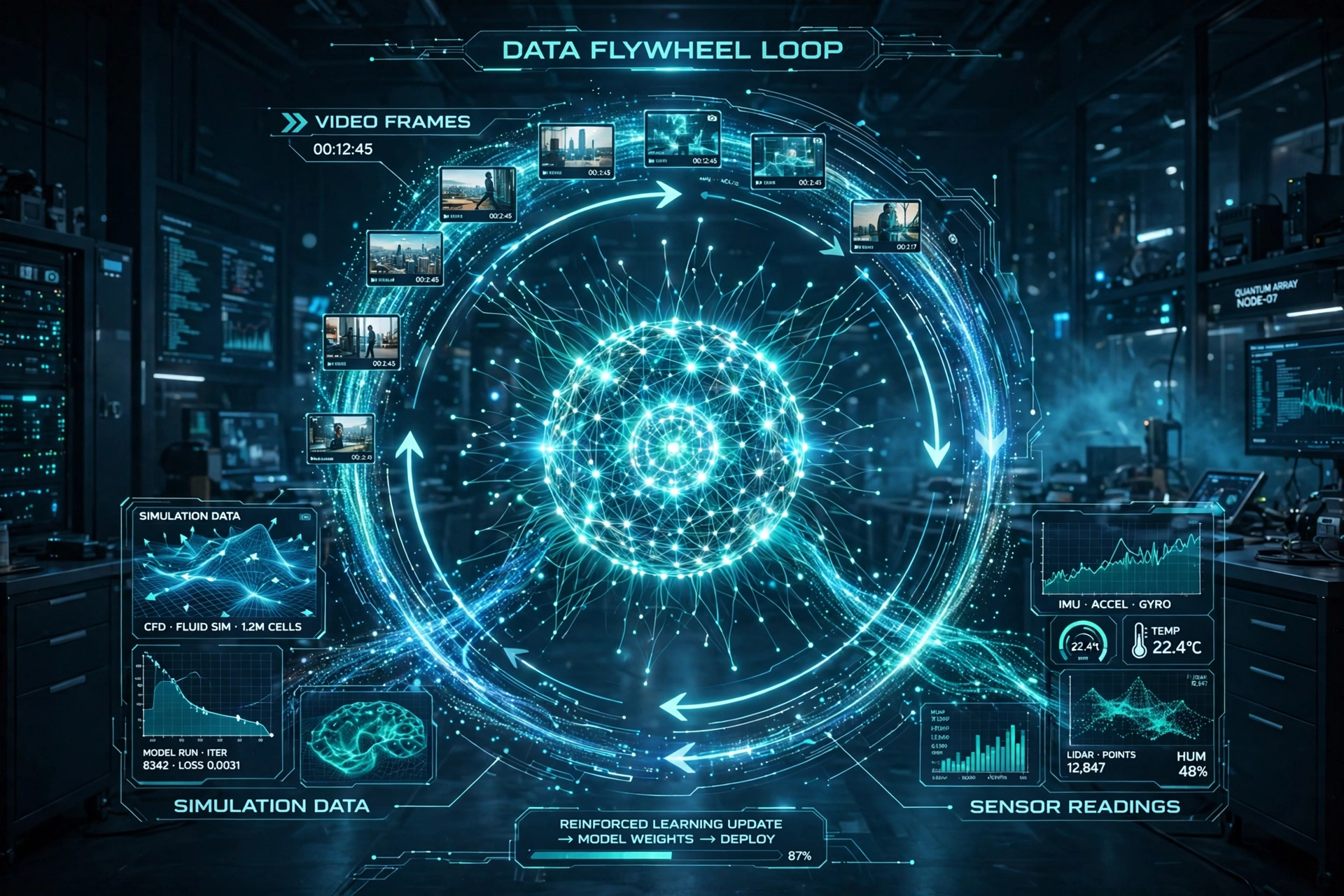
That last point matters. The announced process keeps researchers and customer evaluation gates in charge, rather than letting models change themselves in production without oversight. A faster model still has to satisfy the requirements of the application using it — a discipline that matters even more when the model controls physical equipment.
The Proof Points: Physics, Image Editing and Robot Hardware
Hedra backed the launch with three research results from its own work. The first is physically consistent video: Hedra retrained its H3 video model for physical consistency, and the retrained model scored 34.9 on Google DeepMind’s Physics-IQ benchmark, compared with 30.3 for H3 Max, with what the company describes as comparable visual quality. An autonomously distilled version rendered a five-second clip in under three seconds on AMD MI355X GPUs.
The second is image editing speed. Through distillation and inference optimization, Hedra says it cut 2K image edits from about 22 seconds to 3.6 seconds on the same four AMD Instinct MI355X GPUs, roughly six times faster, in under a week. The comparison deserves a careful read: the baseline ran the original bf16 model at 30 sampling steps, while the faster result uses a distilled 14-step model, so the gain combines changes to the model’s computation with changes to the software executing it. It is a reported result for a particular workload and configuration, not a general sixfold acceleration for every model.
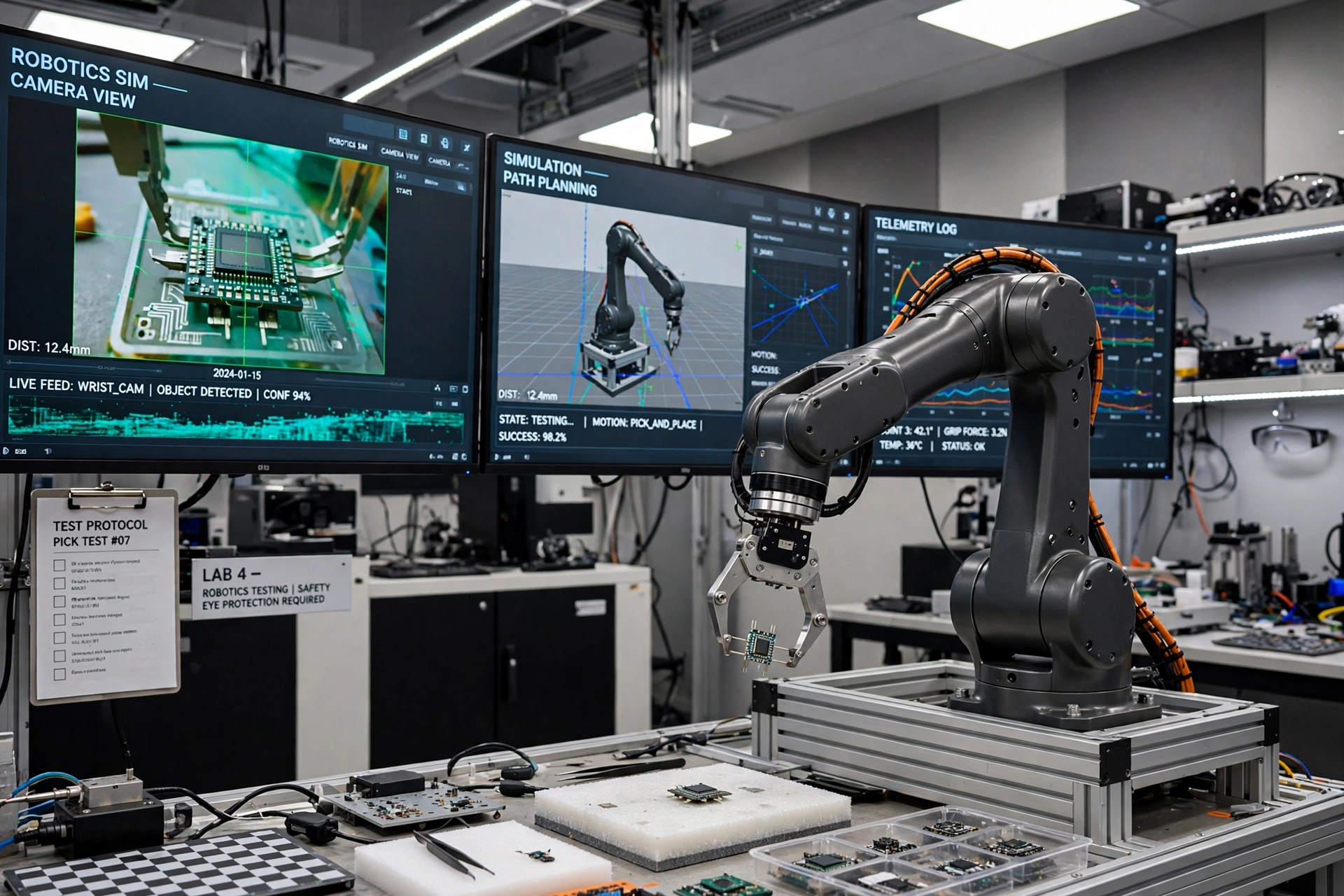
The third result is the most striking for robotics teams. In a simulation study, Hedra fitted a robot running a trained policy with a new gripper and restored task success from near zero to near 100 percent with no retraining, by matching the new gripper’s reach and grasp point in the wrist camera view. The finding concerns the reported simulation setup; it does not establish that arbitrary hardware changes can be handled without further training in deployed robots.
Why Physical AI Needs a Different Stack
The launch also highlights why physical AI is a different engineering problem from serving a text model. Hedra’s World Model Runtime, or WMR, provides additional context: the company describes it as an open-core inference engine for image, video, world and text models, with support for NVIDIA and AMD GPUs. Its optimizations target diffusion steps, attention across frames, and the encoding and decoding operations that can consume substantial GPU time in visual workloads.
For a vision-language-action model, inference produces actions as well as interpreting inputs. In a simulated environment, the model and the environment generating its training experience can both require accelerators. Improving the workflow therefore involves more than selecting a model: it can mean reducing data movement, matching numerical precision to quality requirements, and coordinating training with serving. That is the gap Model Factory is built to close — and it is the same gap other physical AI efforts are attacking from the hardware side, as NXP’s unified robotics platform shows.
The broader infrastructure race reinforces the point. Google’s new TPU systems for confidential inference and the wave of dedicated AI infrastructure deals show how much of the industry’s attention has shifted from training bigger models to running specialized models well. Hedra is betting that the next bottleneck is not raw compute but the loop between a model, its data and its deployment.
What to Watch Next
Three questions will decide whether Model Factory delivers on its pitch. First, whether the recursive self-improvement loop produces measurable gains for paying customers, not just for Hedra’s own research models. Second, whether the evaluation gates hold up in practice — customers need to trust that a retrained model will not regress on the edge cases that matter to them. And third, whether teams in robotics, manufacturing, biology and defense adopt a research-service model rather than building this capability in-house.
For teams evaluating their options, the practical questions are the same ones that apply to any AI platform: who runs the infrastructure, how is the model evaluated before each release, where does the data live, and what happens when a workload needs to scale. Our practical guide to AI agents covers the broader questions enterprises should ask before committing to an AI platform, and enterprise AI platforms like Snowflake’s agentic stack show how the same governance concerns are shaping the software layer too.
Model Factory is available starting today at Hedra’s website, and the company says its research team — drawn from Stanford, Berkeley and UIUC, with experience at NVIDIA, Meta Superintelligence Labs, Fireworks AI and Salesforce — will work directly with customer teams. If the factory model works, the companies that build robots, run factories and study living systems may soon treat their AI models the way manufacturers treat a production line: something that is measured, improved and rebuilt, version after version.