NXP Semiconductors unveiled a unified robotics platform on November 9, 2026, aimed at developers building physical AI systems — robots that sense, decide and act in the real world. The pitch is speed: a developer should be able to get initial drone functionality running within 30 minutes out of the box, and cut the months usually spent integrating and validating robotic subsystems down to days or weeks. NXP’s official announcement sets out the platform in full.
The platform combines NXP processors, an open-source modular software development kit and pre-validated hardware reference designs, all built on a distributed foundation NXP calls its Neural Axis Architecture. The first reference designs target drones, with service robots, autonomous mobile robots and humanoids to follow.
That roadmap arrives as physical AI gathers pace across the industry, from humanoid robots moving into warehouses to new software stacks for autonomous machines. NXP’s answer is to offer the whole chain — silicon, software and validated hardware — as one starting point rather than a set of parts developers must assemble themselves.
What Is the Neural Axis Architecture?
The Neural Axis Architecture is a distributed foundation that securely connects sensing, real-time control, AI processing and communications across a robotic system. It splits robotic autonomy into three functional layers inspired by nature — reasoning, coordination and reflex — so perception, decision-making and split-second motor responses each run where they belong instead of being crammed onto one processor.

This matters because a robot operating around people needs predictable, low-latency behaviour. Separating the layers keeps real-time control deterministic even while AI workloads run alongside it, so a machine can keep responding safely in the moment while heavier perception and planning work happens elsewhere in the system.
A Modular, Open-Source Robotics SDK
At the centre of the platform is an open-source, modular software development kit. It brings together supported drivers, middleware integration, reference applications, configuration tools and reusable software components, giving developers a common base to build on rather than starting each subsystem from scratch. Unite.AI coverage highlights the same modular approach.
The SDK works with established open-source robotics software including ROS 2 Jazzy, the PX4 autopilot, CogniPilot Cerebri, Zephyr RTOS, NuttX and AM32 electronic-speed-controller firmware, plus NXP’s eIQ Toolkit and Ara SDK for edge-AI work. Middleware and connectivity support includes Zenoh, MAVLink, uORB, DShot, 100BASE-T1 automotive Ethernet and RPMsg inter-core communication. It also sits alongside new AI models for robots that developers can use to train and test behaviour before deployment.
Developers can start with one function, such as motor control tested with the SDK, then add AI-based perception, flight control and navigation to build a complete autonomous drone in one validated development environment. The idea is to let a team grow a project step by step without rebuilding its foundations at each stage.
Drone Reference Designs: From Motor Control to Autonomous Flight
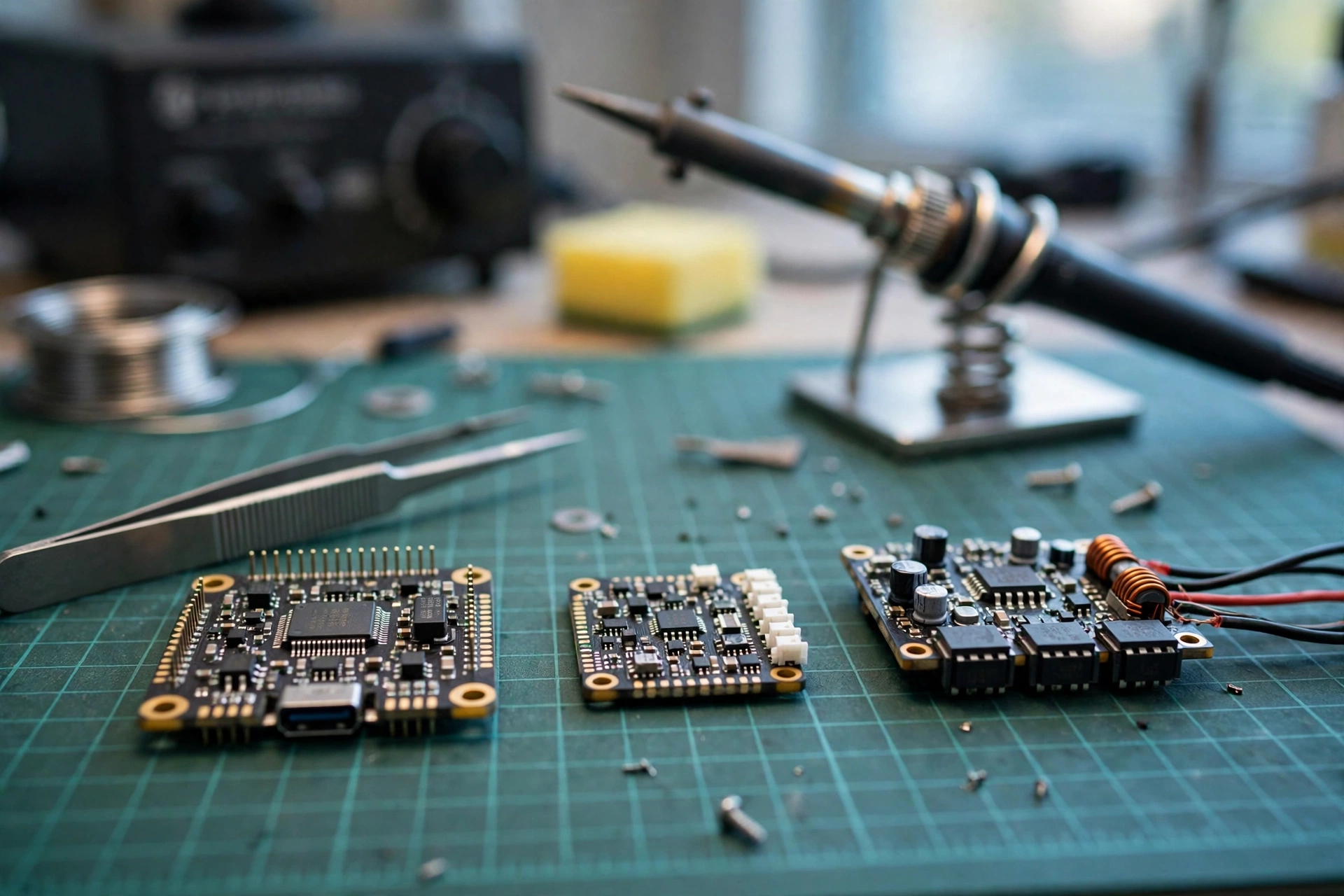
The first hardware offering is a set of four initial reference designs for drones, each covering a different part of the system. Together they take a developer from basic motor control through to autonomous flight, as described in All About Circuits coverage.
| Reference design | Role | Primary processor |
|---|---|---|
| NavQ95 | Autonomy compute and flight control | i.MX 95 applications processor |
| Tropic VMU/FMU | Flight management | i.MX RT1064 crossover microcontroller |
| 100Base-T1 Sensor Node | Intelligent sensor networking | MCX N947 microcontroller |
| AM32-compliant electronic speed controller | Motor control | MCX A13 microcontroller |
NXP describes the designs as interoperable and validated across the complete drone system, and each includes the safety and security enablement of its primary processor. That validation is the point: the boards are meant to work together as a system, not merely as standalone parts.
Security and Safety Are the Foundation
Security and functional safety are central because these robots will operate around people. NXP robotics vice president and general manager Jerome Legros identified those properties, along with real-time control and full-lifecycle reliability, as the foundation for trusted physical AI systems.
Orqa CEO and co-founder Srdjan Kovacevic stressed the system-level demands: efficient communication between computing elements, predictable behaviour and extremely low latency. Note the honest caveat: the platform, drone reference designs and SDK are listed as available now, but the Modular Drone Platform and its four associated boards carry preproduction labels, so specifications may still change.
Beyond Drones: Service Robots and Humanoids in 2027
Drones are only the starting point. Future reference designs will address service robots, autonomous mobile robots and other autonomous systems, with additional enablement expected in the second half of 2027. Those machines share the same requirements — perception, navigation, motor control, connectivity and safe real-time operation — so the same unified approach should carry over. The announcement came just ahead of the Electronica trade fair.
The move toward humanoid robots and other service machines will test whether the architecture scales beyond flight, where the demands on balance, manipulation and human interaction are different again.
What It Means for Robotics Developers
The robotics industry has spent years stitching together processors, middleware and safety features from different vendors, and integration — not raw AI capability — is often what slows a project down. NXP’s bet is that a single validated stack, from motor control up to autonomous flight, removes that bottleneck. It also lands amid broader AI infrastructure momentum, as companies invest in the computing foundations behind advanced AI systems.
Whether the approach extends beyond drones will be judged by the 2027 expansion and by how quickly developers adopt the SDK. For now, the immediate proposition is a common NXP-based route from a single motor-control subsystem to a complete autonomous drone.