Humanoid robots have spent years as the stars of demo videos. On November 5, 2026, one of them became a stock. Agility Robotics began trading on the Nasdaq under the ticker AGLT, becoming what the company describes as the first U.S. publicly listed pure-play humanoid robotics company with proven, active commercial deployments. The debut followed the completion of its business combination with Churchill Capital Corp XI, a special-purpose acquisition company, which closed on November 4 after shareholders approved the deal on November 2.
The listing matters for more than Agility’s balance sheet. It is the first time public investors can buy shares in a company whose entire business is humanoid robots — and the first real market test of whether robots that do paid work in warehouses are a business yet, or still a promise. The deal brought roughly $465 million in gross capital, and the company says it holds more than $300 million in committed multi-year orders for its next-generation robot, Digit 5. The honest version of the story is more complicated than either number suggests, and both numbers deserve a closer look.
What happened on November 5
Agility’s shares and warrants began trading on the Nasdaq on November 5, 2026, under the symbols AGLT and AGLTW, following the closing of its merger with Churchill Capital Corp XI. The company, headquartered in Salem, Oregon, with offices in Pittsburgh and Fremont, California, calls itself a humanoid robotics and physical AI company. Its mission, in its own words, is to build robot partners that augment the human workforce.
This was a SPAC merger, not a conventional IPO. The transaction valued Agility’s existing equity at approximately $2.5 billion before the deal, according to Bloomberg’s reporting — a pre-money valuation, not the market capitalisation, which moves with the share price. Existing shareholders rolled all of their equity into the new company and face a 180-day lock-up. Strategic investors and partners in the company include Nvidia, Amazon, SoftBank and Foxconn.
Chief executive Peggy Johnson, who took over in 2024 after running Magic Leap, connected the listing directly to the work already underway. As she put it in Agility’s official listing announcement: “Digit is doing real work in customer operations today, taking on repetitive, physically demanding tasks.” That claim — robots doing real work, not demos — is the whole investment case, and it is also the thing investors will now be able to test quarter by quarter.
Digit: the robot already doing paid work
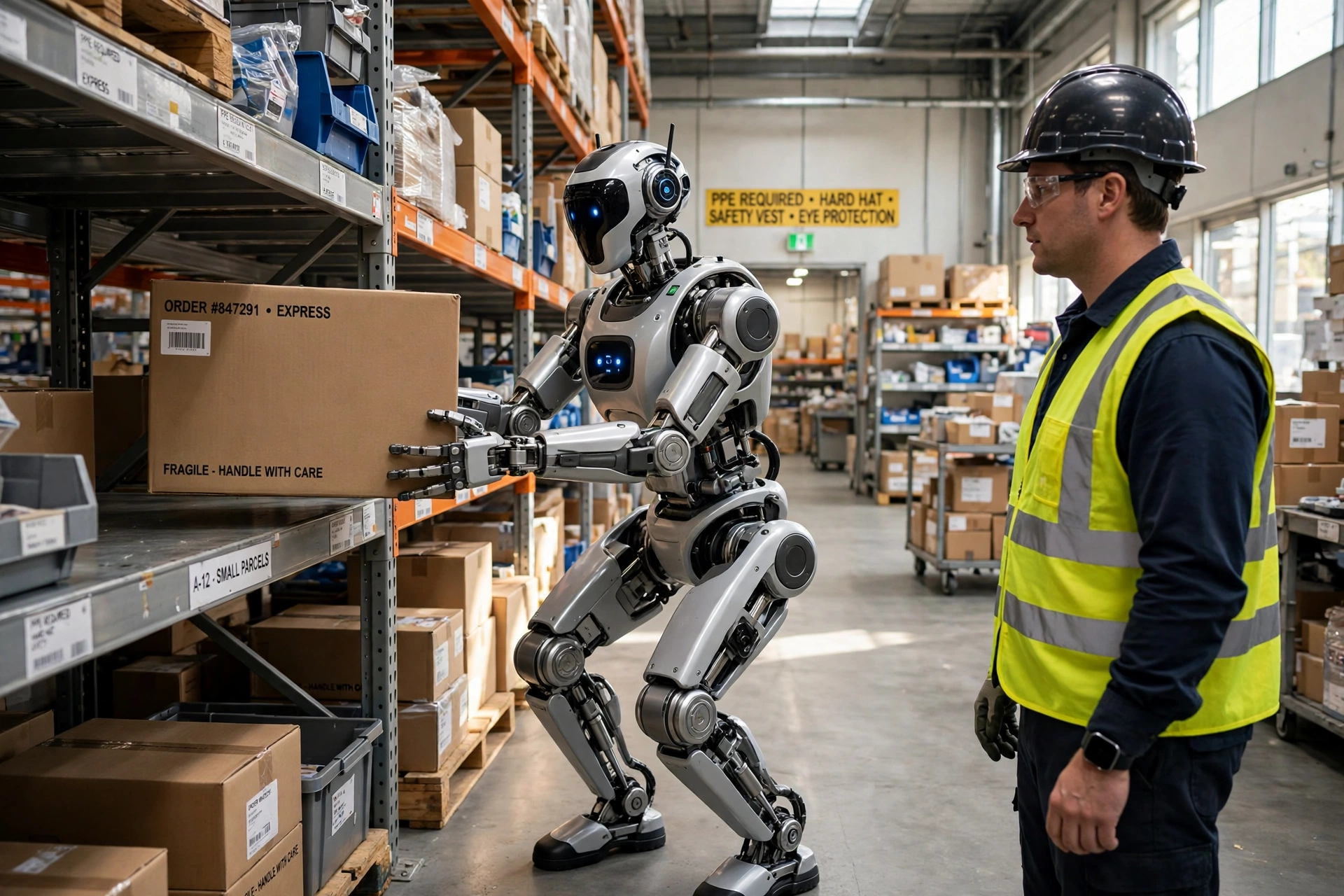
Digit is Agility’s flagship humanoid: a two-legged, two-armed robot built at human scale for facilities designed around people. It is designed to perform useful work in environments built for humans, helping businesses address persistent labour shortages and automate repetitive, physically demanding tasks. The company traces its roots to Oregon State University, where it spun out of research on bipedal locomotion in 2015.
What sets Digit apart from most humanoids is that it has a job. Agility says Digit has accumulated more than 65,000 hours of real-world operation, including paid work moving totes at a GXO Logistics site in Flowery Branch, Georgia — a deployment the companies describe as the first formal commercial deployment of a humanoid robot in live operations, and the first robots-as-a-service deal in the category. Digit has moved more than 100,000 totes under that paid GXO contract, and GXO plans to add Digit at two more U.S. warehouses, in Statesville, North Carolina, and Lebanon, Tennessee, starting in early 2027.
Digit also has deployments or active work involving Schaeffler and Toyota Motor Manufacturing Canada, and farm equipment maker AGCO has signed a commercial agreement for a Digit pilot expected to begin in 2027. That is a real, if narrow, customer base — and it is the foundation for everything else in the listing story.
The wider industry is moving the same way. Serve Robotics’ Physical AI Services turn fleet operations into a product for other robot builders, Embodied AI’s AIR humanoid learns factory jobs by watching workers, and Cainiao’s embodied AI warehouse robots are training inside live logistics networks. The difference for Agility is that it is now asking the public market to price the trend.
Digit 5: the robot behind the $300 million order book
Digit 5 is the next-generation humanoid at the centre of the listing. Unveiled in September 2026, it is designed to work safely alongside people and to handle a wider range of industrial tasks than the current Digit. The company says Digit 5 is designed for a payload of up to 50 pounds and a reach of 7.2 feet, though it also notes those figures are preliminary estimates from pre-production testing, with some safety features still in development.
Agility says it has secured more than $300 million in committed multi-year orders for Digit 5, from around 30 customers, subject to contractual milestones, product features and specifications. That qualification matters: the orders are potential value realised over time, contingent on the robot meeting throughput, uptime and placement-accuracy targets — not revenue already booked. Early customer access is expected to begin in the first half of 2027, with general availability targeted for the end of that year. Both dates are plans, not completed deliveries, and prototypes of Digit 5 have not been publicly demonstrated.
Still, the order book is the strongest signal in the announcement. A $300 million pipeline for a robot that is not yet shipping suggests customers are willing to commit before the hardware is proven at scale — or, read more sceptically, that the commitments are cheap to make while they are conditional. Which reading is right will be decided by whether Digit 5 ships on schedule and hits its performance targets.
Where the $465 million goes
The business combination and related financings represent approximately $465 million in gross capital raised before transaction expenses. The figure breaks down into about $164 million from the Churchill Capital XI trust, $201 million from a private investment in public equity (PIPE) led by Foxconn at $10 a share, and $100 million of equity funding received before closing, in July. Because that $100 million arrived earlier, the full $465 million should not be read as new cash landing on the first day of trading, and it is a gross figure — before transaction costs, not after.
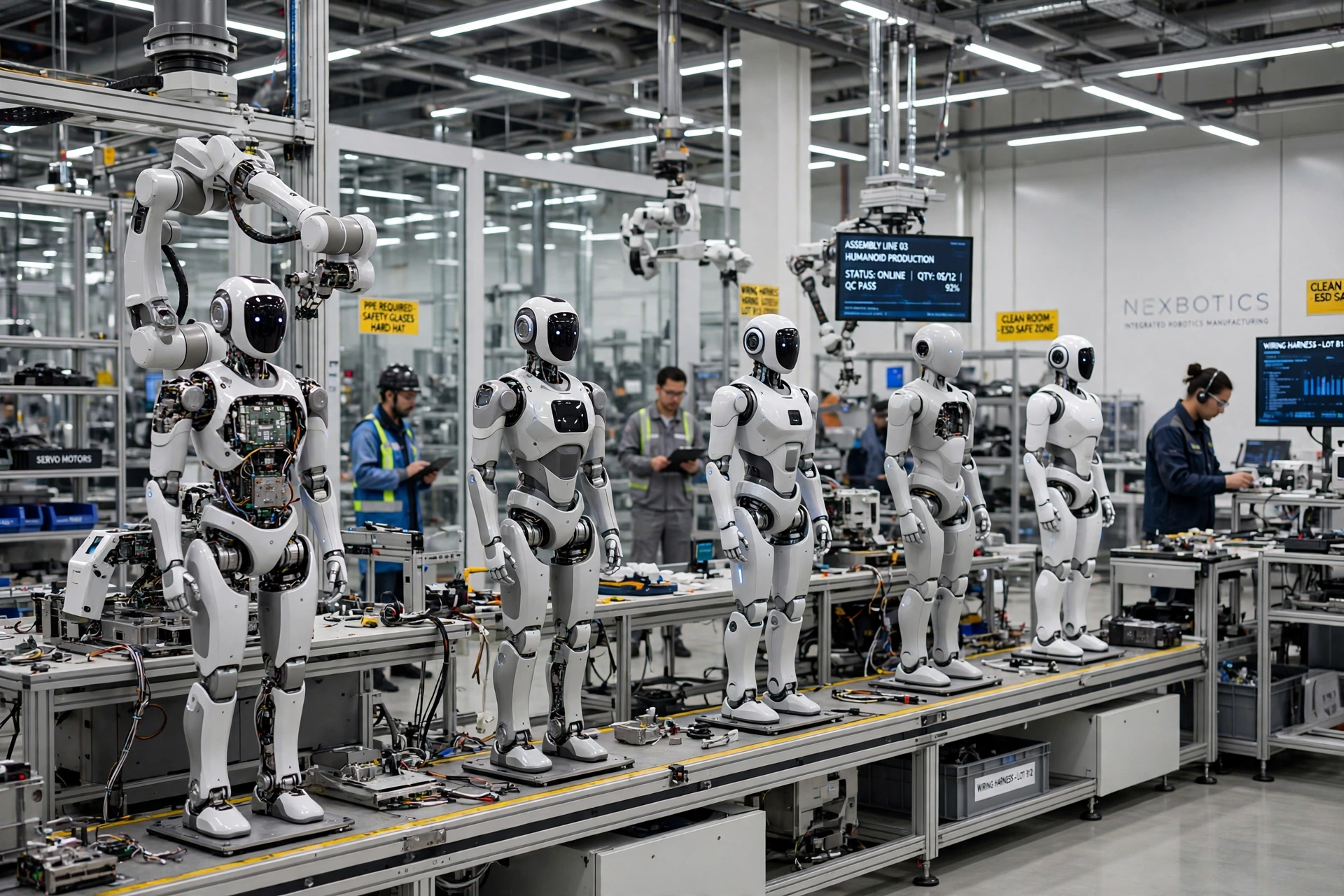
Agility says it plans to use the proceeds to fulfil customer orders, expand commercial deployments, scale Digit production and continue developing its integrated robotics and physical AI platform. The manufacturing piece is RoboFab, its 70,000-square-foot facility in Salem, Oregon, designed for annual production capacity of up to 10,000 robots. Turning that capacity into delivered robots is the execution challenge the money is meant to fund.
The numbers investors should not ignore
For all the momentum in the announcement, Agility’s financials are sobering. The company reported total net sales of $1.8 million for 2025, and just $174,362 in the first six months of 2026, compared with $624,866 in the same period a year earlier. Over that same first half it posted a net loss of approximately $361.9 million and used $86.2 million in operating cash. Its accumulated deficit stood at $675 million by mid-2026, with cash on hand of $14.7 million at June 30, before the July financing landed. The company states in its own filings that it expects to keep losing money for the foreseeable future.
That gap — a roughly $2.5 billion valuation against $1.8 million in annual sales — is the risk in the deal, and it is not hidden. It is in the company’s own documents, which is exactly why the listing is interesting: for the first time, the humanoid robot story has a public price, a public balance sheet and a public quarterly clock. The same pattern is playing out across AI, where always-on AI agents are becoming the product and the companies selling them are being judged on delivery, not demos.
None of this makes Agility a bad bet or a good one. It makes it a measurable one. A company with 65,000 hours of real operation, a paid customer, a factory built for 10,000 robots a year and $300 million in conditional orders has more substance than a demo reel — and far less revenue than its valuation implies. Both facts are true at once.
What to watch next
Three things will decide whether the listing looks smart in a year. First, Digit 5 delivery: early access in the first half of 2027 and general availability by the end of the year are the dates everything else depends on, and any slip turns the $300 million order book from a pipeline into a question mark. Second, the GXO expansion: adding Digit at two more warehouses in early 2027 would show the first deployment can repeat, which is the difference between a pilot and a product. Third, the cash burn: with losses running far ahead of revenue, investors will watch how quickly the $465 million is spent and whether sales start to climb toward the order book.
If Digit 5 ships on time, the GXO sites go live and the order book starts converting into revenue, Agility will have shown that humanoid robots can be a public company, not just a research project. If any of those three slips, the first pure-play humanoid stock will also be the first public lesson in how hard it is to turn a robot that works into a business that pays. Either way, the listing changes the conversation: from now on, the humanoid race has a ticker symbol, and the numbers are public. For the full details, read Agility’s official listing announcement and TechRepublic’s report on the debut, and check the company’s SEC filing for the financing breakdown.