
Most humanoid robots today are still demonstrations — impressive on stage, caged off from real work. Swiss robotics startup Embodied AI wants to change that. On November 6, 2026, the company unveiled AIR — as detailed in The AI Insider’s report — a wheeled humanoid robot built to share the factory floor with people and learn manual jobs by watching them do it first.
AIR — sold as the AIR01 — is aimed at the repetitive, high-dexterity tasks that change too often for conventional automation: kitting, packaging, SMT support, cable handling and complex assembly. Instead of replacing the people on the line, it is designed to take on the work that needs hands but not necessarily a human’s full attention, so experienced workers can focus on the jobs that need their skill. The company says AIR went from research to an industrial humanoid in just nine months, and it is already being tested with global manufacturers under signed contracts with major OEMs.
The timing is no accident. As many as 1.9 million US manufacturing jobs could go unfilled by 2033, according to Deloitte and The Manufacturing Institute, while the Manufacturing Leadership Council reports that 22% of manufacturers plan to use physical AI such as humanoid robots within two years — more than double today’s 9%. Yet Deloitte also found that more than 80% of factory task hours are expected to stay human-driven. The opportunity, in Embodied AI’s framing, is in helping those people, not replacing them.
What AIR is and how it works
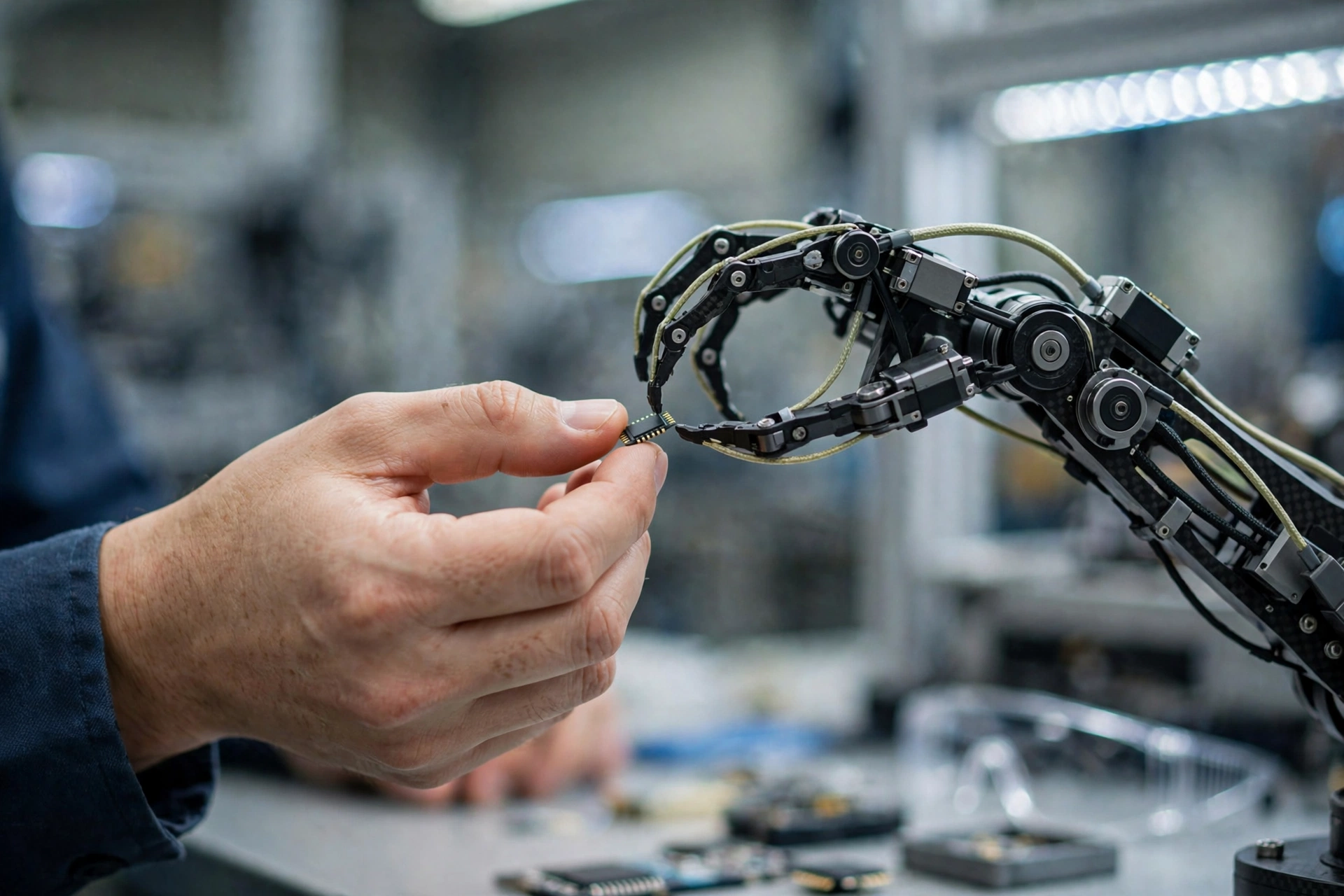
AIR is a humanoid in shape but deliberately not a copy of a human body. It moves on wheels rather than legs, because factory floors are flat and wheels are more stable. Its motors, gearboxes and electronics sit in its torso, while its arms are light and moved by tendons, so they carry almost no mass and give way on contact. The design — a tendon-driven architecture with a soft, compliant exterior — is the core of the robot: safety comes from how it is built, not from software holding it back. Advances in robotics hardware, such as STMicroelectronics’ STM32G5 microcontroller, are helping make on-device AI practical for robots like these.
The same physical AI stack powers the company’s other products. Its Flex02 bi-manual cells run the same AI for dexterous manipulation where a full humanoid is not needed, and its HELIX soft manipulator is a lightweight tendon-driven arm with more than nine degrees of freedom for high-precision work. The stack combines safe hardware, teleoperation and imitation learning, with compact multimodal policies orchestrated by a vision-language model running on the robot itself. Related embodied-AI deployments include Cainiao’s embodied AI warehouse robots.
Embodied AI’s official site describes the company as a spin-out of EPFL, the Swiss Federal Institute of Technology in Lausanne, headquartered in Lausanne with an office in Rome. Co-founder and CEO Francesco Stella, 28, developed the tendon-driven arm design during his PhD at EPFL after researching at MIT’s Computer Science and Artificial Intelligence Laboratory. He co-founded the company with chief technology officer Kai Junge and chief operating officer Max Polzin, both robotics PhDs with backgrounds at Cambridge, ETH Zurich and EPFL. The company is backed by Faber, which led its first funding round, along with TechShop, Look AI Ventures, Plug and Play and Vento.
Learning by watching: from human demo to autonomous in about a month
AIR’s party trick is how it learns. Every job starts under the control of a human operator, so the robot is productive from its first shift. Every run is recorded, and Embodied AI’s AI stack learns from those demonstrations until AIR can do the task itself — typically within about a month, depending on the task. The operator then stays on hand to cover anything the robot has not seen before, and what one robot learns, the next can use.
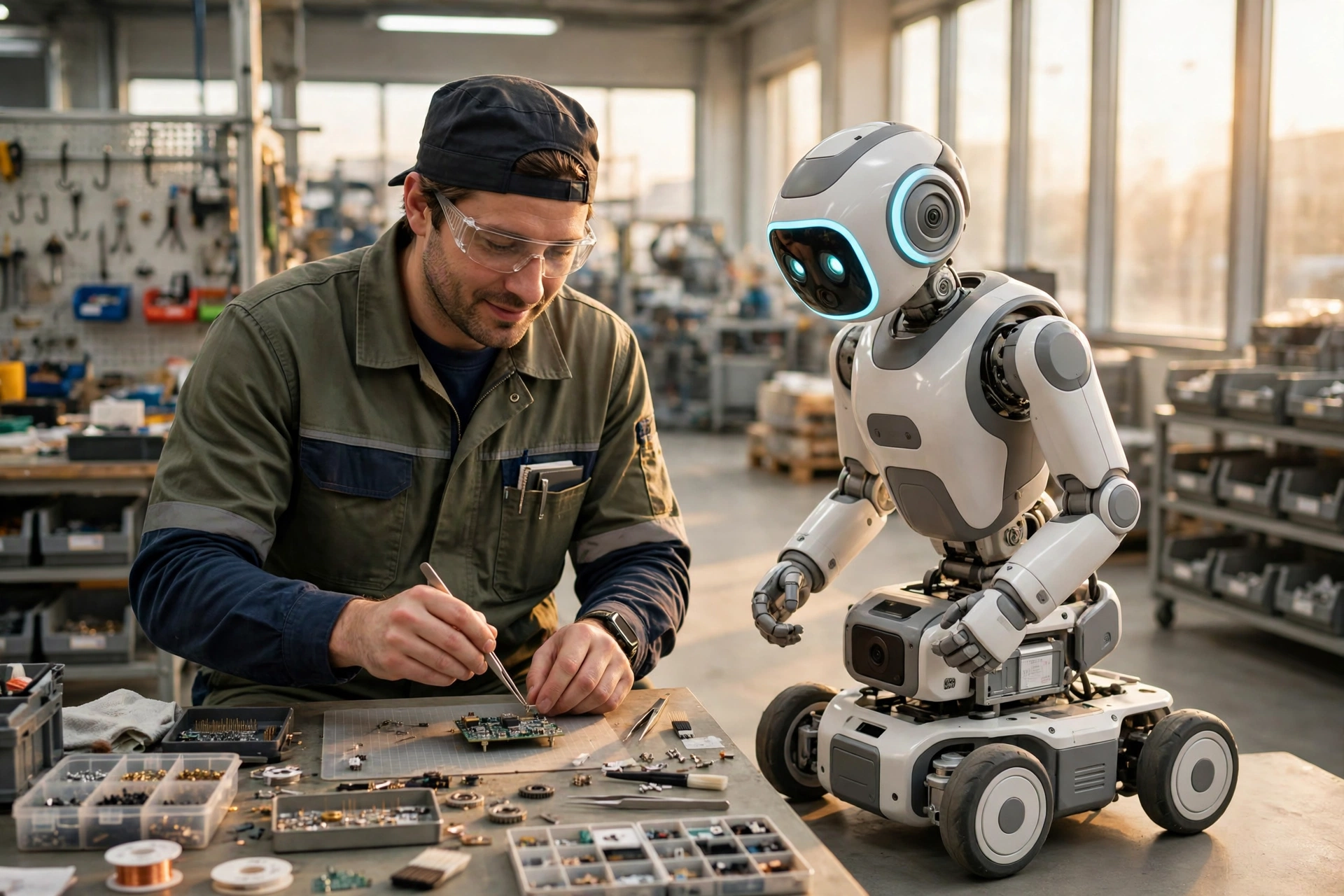
That matters because the tasks AIR targets are the ones conventional robots handle worst: manual work that requires precise hand movements and changes frequently. A traditional industrial arm is built for heavy, repeatable work and kept behind a cage. AIR is built for the opposite — light, variable, dexterous work done shoulder to shoulder with the people who know the job best. Because the models learn on site, in the actual workplace and under real conditions, they do not break the way simulation-trained models can when reality shifts.
The approach mirrors a wider shift across the industry. Serve Robotics’ Physical AI Services are moving from demos to deployments, with robot fleets taking on real operational work, and Moonshot AI’s Kimi Hosted Agents are becoming the product as AI moves from answering questions to doing ongoing jobs. AIR sits at the intersection of both trends: a robot that learns a job the way a new hire would, by watching someone who already knows how to do it.
Safety is built into the hardware
The reason most factory robots work behind cages is simple: a heavy arm that makes a mistake can hurt someone. Embodied AI’s answer is to remove the danger at the hardware level. The tendon-driven arms are light, compliant and designed to yield when they encounter an obstruction or make contact with a person, and the robot’s soft exterior, low inertia and high-frequency sensing are built to work safely around people rather than behind barriers.
AIR was designed under ISO/TS 15066:2016, the technical specification for collaborative industrial robot safety, with CE marking planned for 2027. That matters for buyers: a robot that shares space with workers needs to meet the safety standards those workers’ employers are judged against, not just pass a demo.
CEO Francesco Stella put the stakes bluntly in the launch announcement: “Hallucination of AI models is acceptable in the digital space because humans review, reject, or correct the output before acting on it. In robotics, however, incorrect actions have immediate and irreversible physical consequences. When AI is used to taking physical actions, errors can cause severe damage or endanger human lives. Safety and reliability are non-negotiable requirements of physical AI to enter the real world at scale.”
The proof so far: 98% reliability on cable handling
AIR itself is new, but the AI stack behind it is already earning its keep. Embodied AI says the stack is in paid factory deployments with its two-arm industrial cell, and it points to one evaluation as evidence: when a leading consumer electronics manufacturer tested five funded startups on a cable-handling task, Embodied AI says it was the only one to meet all the targets, reaching 98% reliability against a 90% goal. The four other startups failed to meet the manufacturer’s requirements.
That kind of result is the difference between a research demo and a deployable product. Cable handling is a classic hard problem for automation — flexible, tangled, variable — and hitting 98% reliability on it in a customer’s factory is a stronger signal than any staged keynote. It is also, it should be said, the company’s own account of a customer evaluation; independent verification will come as deployments scale.
Why factories want it now
The labour maths is driving the interest. With up to 1.9 million US manufacturing roles potentially unfilled by 2033, factories need a way to cover repetitive manual work without waiting for hiring markets to loosen. At the same time, the tasks themselves keep changing — new products, new variants, new packaging — which is exactly where fixed automation struggles and where a robot that can be shown a new job has an edge.
AIR’s pitch is that it goes onto the factory floor as it is, next to the team already there, with no infrastructure changes: a site assessment, a rapid pilot, then scale at the customer’s pace. For manufacturers that have watched humanoid demos for years without a deployable product, a wheeled robot that starts productive on day one under human control — and gets more capable the longer it stays on the job — is a more credible proposition than a bipedal showpiece.
What to watch next
Three things will decide whether AIR matters beyond launch day. First, scaled production: Embodied AI says it is preparing for larger-scale manufacturing after signing contracts with major OEMs, and turning a nine-month prototype into a production line is a different challenge from building the first unit. Second, CE marking in 2027, which will formalise the safety case for European factories. Third, reliability in real deployments over months, not single evaluations — the 98% cable-handling result needs to repeat across tasks, sites and robot fleets, with skills transferring between units as promised.
If those hold, AIR could mark a genuine step for physical AI: robots that learn jobs from the people doing them, work safely beside them, and get better the longer they stay. If they do not, it will join a long line of humanoids that looked ready on stage and never made it onto the floor. Either way, the direction is clear — the next factory robot is not a faster arm behind a cage, but a colleague that watches, learns and keeps working.

