Serve Robotics has spent years learning a hard lesson on public sidewalks: building a robot is the easy part. Keeping thousands of them connected, learning, and improving in the real world is the work that never ends. On November 5, 2026, the company announced it is turning that hard-won experience into a product. Its new Physical AI Services offering opens the technology behind its own delivery fleet to other companies building robots, drones, and autonomous machines.
The move matters because physical AI — AI that operates in the real world through machines — is hitting the same wall software AI hit a decade ago. Everyone can build a prototype. Almost nobody can run a fleet. Serve’s pitch is to sell the fleet-running layer: the connectivity, the data pipeline, and the real-world training data that turn a clever robot into a reliable service. If it works, the company stops being just a delivery-robot operator and becomes infrastructure for an entire industry.
What Serve Robotics’ Physical AI Services Actually Offers
Physical AI Services launched with three products, each aimed at a different bottleneck in running a robot fleet at scale. The first is Serve Link, a high-performance connection between machines in the field and the models, monitoring, and training systems that make them smarter in real time. The second is Serve Data Curator, a tool that sifts through the flood of data a fleet collects and surfaces the rare moments that actually teach a model something new. The third is a real-world foundation-model data catalog drawn from Serve’s own sidewalk deployments — terrain and infrastructure data that teaches models how to understand complex human environments such as city sidewalks.
The offering is aimed squarely at companies that already have a robot but not the systems around it. Among the launch customers is Bedrock Robotics, which builds autonomous systems for heavy construction equipment and uses Serve Link to connect its machines over Wi-Fi, LTE, 5G, and satellite networks. Serve says the services already power thousands of vehicles across a dozen industries, including construction, mining, and autonomous trucking, alongside its own sidewalk food delivery fleet.
Serve Link: Keeping Robot Fleets Connected to Cloud Intelligence
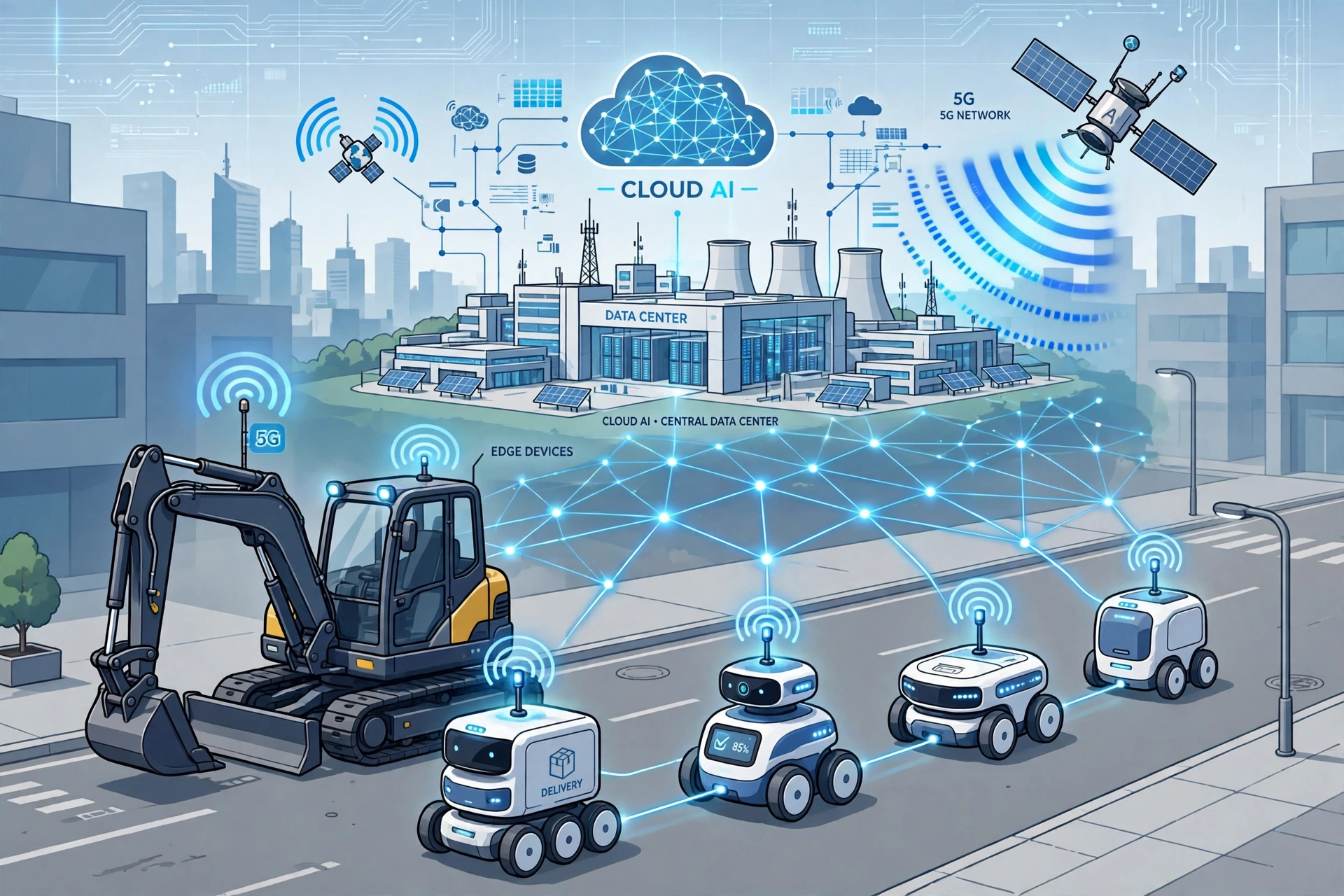
As more of the computation behind physical AI moves into data centers, the link between a machine and the cloud becomes the product. Serve Link is that link: a reliable, high-performance connection that keeps robots tied to off-board intelligence even as they roam through dead zones, dense streets, and changing networks. When a robot encounters something it cannot handle on its own, the connection lets a remote model, a monitoring system, or a human supervisor step in within seconds.
This is the same infrastructure problem that managed agent runtimes solve for software agents — the agent is only as useful as the platform that hosts, monitors, and coordinates it. The difference is that a robot’s connection can drop, its sensors can be blinded by rain, and its mistakes happen in physical space. Serve’s claim is that five years of operating a live fleet has already solved the failure modes other builders are about to discover.
Serve Data Curator: Turning Fleet Footage Into Better Models
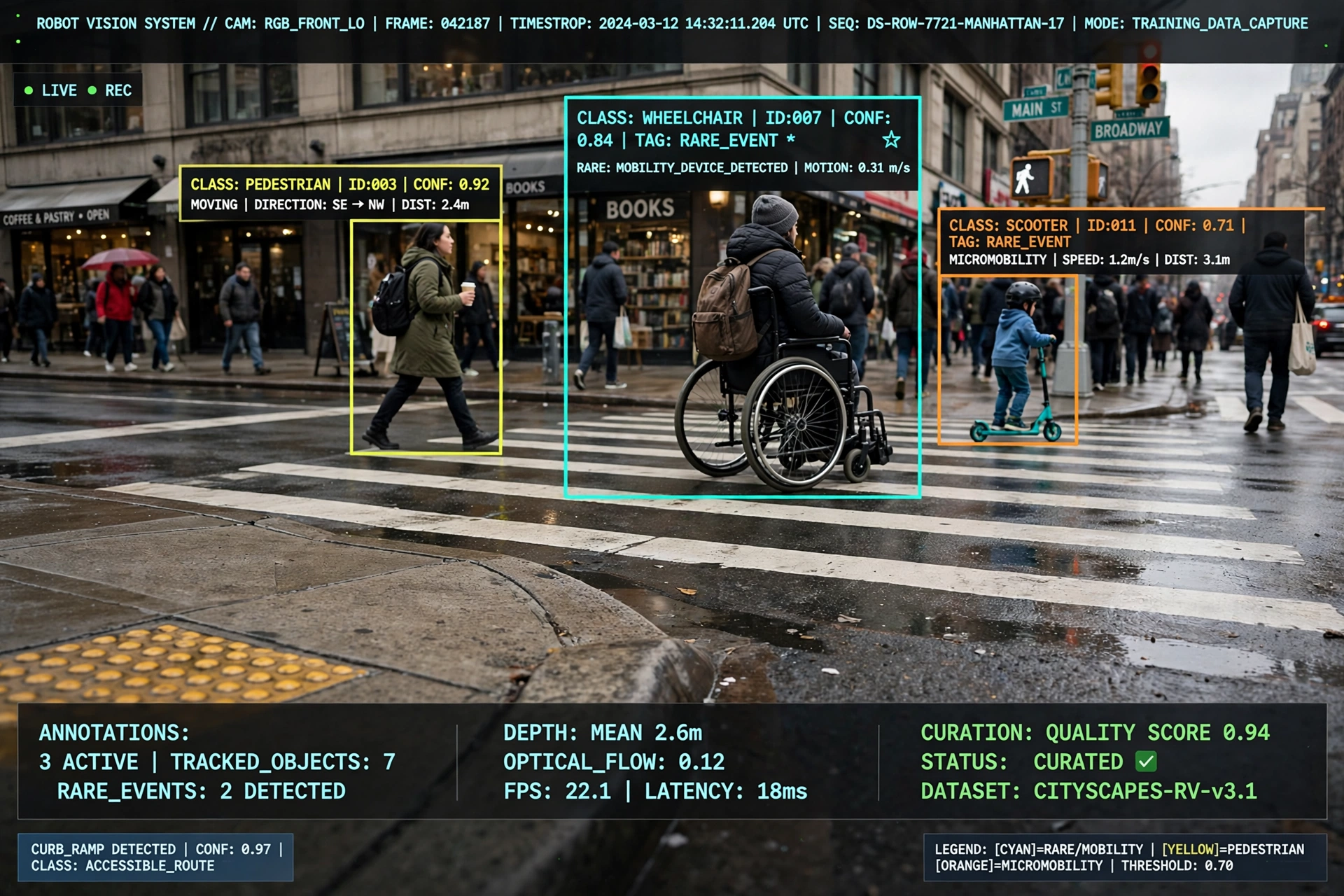
A fleet of robots produces far more real-world data than any engineering team can review. Most of it is routine: empty sidewalks, uneventful crossings, the same curb a thousand times. The valuable moments — a child darting into the path, a construction barrier that moved overnight, a wheelchair user needing extra space — are rare, and finding them in a mountain of footage is the bottleneck. Serve Data Curator shortens the loop between what robots see in the field and what their models learn by surfacing exactly those moments, so robots improve from the examples that count instead of drowning in the ones that do not.
The idea echoes what is happening across enterprise AI, where always-on AI coworkers and AI agents that pull context from enterprise content are only as good as the data pipelines feeding them. In robotics, the pipeline runs through the physical world, and the curation problem is harder because the data is messier, heavier, and often safety-critical. A tool that reliably finds the one-in-ten-thousand frame that matters is worth more than a bigger model trained on everything.
Real-World Training Data: Teaching AI to Understand Sidewalks
The third piece of the launch is the least flashy and possibly the most valuable: a catalog of real-world foundation-model data from Serve’s own deployments. Sidewalks are among the hardest environments for AI to understand. They are unstructured, crowded, and full of unwritten rules — where pedestrians walk, where a delivery robot should wait, how a curb cut works, what a temporary road closure looks like. Simulated data can approximate these things, but it cannot replace footage from thousands of robots navigating real streets every day.
Serve has deployed more than 2,000 robots in over 40 cities and 27 hospitals, reaching a population of about 3 million and supporting delivery for more than 4,000 restaurants. Since spinning off from Uber in 2021, and after acquiring Diligent Robotics in 2026 to expand into indoor hospital service robots, the company has accumulated a dataset that few competitors can match. Selling access to that data — terrain, infrastructure, and the edge cases of human environments — turns a cost center into a revenue line.
Why the AWS Comparison Makes Sense
Serve’s chief executive, Ali Kashani, framed the strategy plainly: “Building a robot is only the beginning. Keeping thousands of them connected, learning and improving requires another layer of technology. We’ve put that technology to work in our own fleet. Now we’re opening it to other companies so they can focus on what their robots do, rather than rebuilding the systems around them.” In an interview with TechCrunch, he compared the move to Amazon’s decision to turn the infrastructure it built for its own operations into AWS — a platform business built on solving your own hard problem first.
The comparison is flattering, but the logic is sound. The robotics industry is fragmenting into dozens of specialized builders — construction, agriculture, logistics, healthcare — and almost none of them wants to build fleet connectivity, data curation, and training-data pipelines from scratch. Serve is also working with T-Mobile to bring AI computing closer to machines operating in the physical world, a partnership that strengthens the connectivity story. Announced alongside third-quarter results in which Serve raised its full-year 2026 revenue guidance to $12 million, up from $9 million to $10 million, the launch signals that the company sees services, not just deliveries, as its growth engine.
What This Means for the Physical AI Race
Physical AI is becoming the next platform war, and the winners may not be the companies with the flashiest robots. They may be the ones that own the connective tissue: the networks that keep machines online, the pipelines that turn field data into smarter models, and the datasets that teach machines how the world actually works. That is the same lesson the cloud era taught, when the companies that sold picks and shovels — compute, storage, and fast inference, like the shared KV cache storage that speeds up AI inference now being built for large models — captured more durable value than many of the applications running on top.
Serve Robotics is betting that robot fleets follow the same pattern. If Bedrock Robotics and the other launch customers prove the model works beyond delivery, Physical AI Services could become the company’s most important product — not because Serve built the best robot, but because it learned, the expensive way, how to keep thousands of them working. The robots were the demonstration. The services are the business.
For robotics startups deciding where to spend their next engineering dollar, Serve’s launch is a useful signal: the fleet layer is now a product you can buy. Whether Serve becomes the AWS of physical AI depends on execution — uptime, data quality, and pricing that small builders can afford. But the direction is clear. The companies building the robots are no longer the only ones that matter. The companies keeping them connected, learning, and improving are now in the race too.