Perplexity has joined the race to give an AI agent a job instead of a chat window. On November 5, 2026, the company launched Teammates, a system of always-on AI agents designed to own ongoing work across an organization — and it is pitching the product as a direct challenge to OpenAI and Anthropic in the fast-growing market for workplace AI. Perplexity chief executive Aravind Srinivas announced the launch on X with a four-word pitch: “Teammates work for you.”
The idea is a shift in how people are expected to use AI at work. Instead of opening a chat, writing a prompt, and waiting for a single answer, a user gives a teammate a high-level goal — run a growth campaign, triage incoming bug reports, track a set of metrics, research a new market — and the agent keeps working on it in the background until the result is ready for review. That is the promise, at least. The launch also comes with a steep price tag and several open questions about who can actually use it and how much supervision the agents will need.
What Perplexity Teammates actually are
Teammates are persistent AI agents that live inside a shared workspace and own a responsibility around the clock. Each teammate gets a role, a standing brief, and rules for when to bring the human in. According to Perplexity, a teammate plans the tasks behind its job, brings in more agents when the work grows, and follows through until the result is ready for review. Every teammate also gets its own conversation thread, so a user can follow what each agent is doing and check its results without digging through one long chat history.
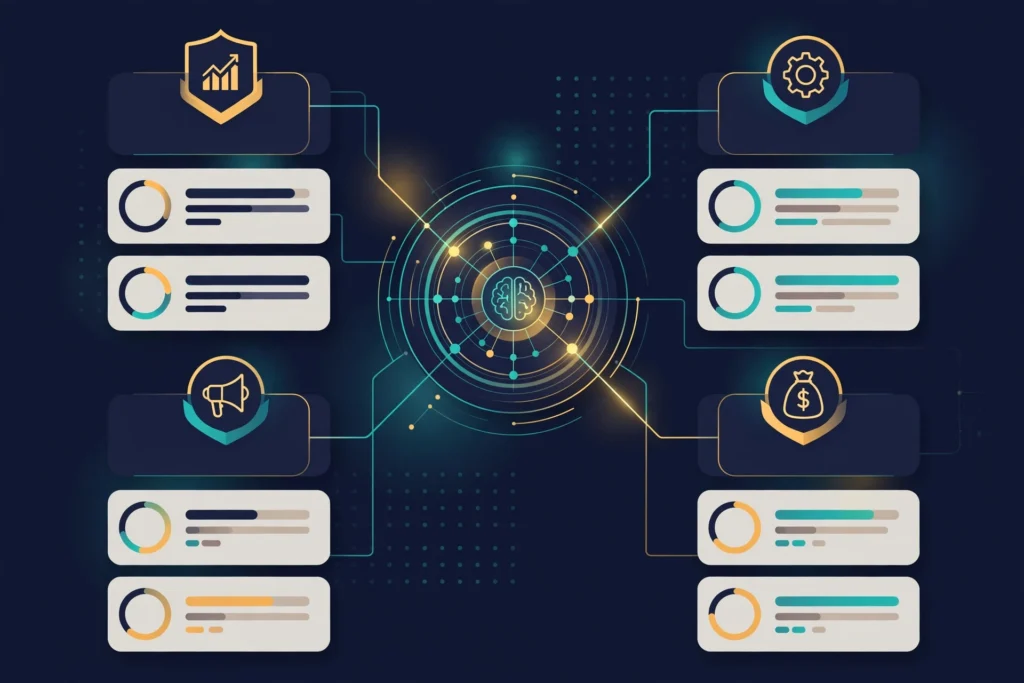
Perplexity’s product page illustrates the idea with a small business: a sales teammate that finds opportunities in customer inquiries, past purchases and unfinished conversations, then prepares outreach and quotes; an operations teammate that keeps deadlines, checklists, vendors and paperwork on track; a marketing manager that runs social posts, email, ads, SEO and review replies; and a finance teammate that keeps invoices, collections and job margins up to date. When an invoice passes 15, 30 or 45 days overdue, for example, the finance teammate drafts the reminder on its own. When a regular customer goes quiet, the sales teammate checks past orders, emails and support issues before preparing a relevant offer for approval.
The key design choice is persistence. Teammates inherit the user’s existing Perplexity Computer projects, skills, memory and tool permissions, so they start with context instead of from scratch. Each teammate runs in an isolated desktop and browser with independent sessions and cookies, keeping one agent’s work separate from another’s. That shared memory is what separates Teammates from a chatbot: the agent is supposed to remember the project, the decisions already made, and the files already gathered, and keep building on them between sessions.
Built on Perplexity Computer
Teammates are built directly on Perplexity Computer, the company’s existing AI agent platform that deploys agents onto a user’s own device to complete tasks. The integration matters because it determines what the agents can actually touch. Rather than working only through cloud APIs, Teammates can access local files, applications and system resources when the user allows it, and they can coordinate work across multiple tasks and respond to changes in connected tools. A marketing agent, for example, could monitor campaign performance and prepare follow-up work when the numbers move.
Users can also interact with their teammates through Slack, where coworkers can contribute instructions or review ongoing tasks. And when an agent goes off track, Perplexity says a user can monitor its progress, provide feedback, redirect the assignment, or take over the agent’s desktop session directly. Those controls are not a nice extra — they are the core of the product’s trust model, because an agent that keeps working without constant supervision needs a clear way for a person to step in.
Pricing and availability: $200 a month, Max subscribers only
Teammates launched as a research preview for individual Perplexity Max subscribers on the web, with native mobile and desktop apps coming later. Access requires the Max plan, which costs $200 per month or $2,000 per year — about $167 a month when billed annually. Max subscribers also get 10,000 Computer credits a month, and Perplexity says an additional Teammates usage grant applies before standard credits are charged, though it has not said how large that grant is or when it expires.
The initial release is not generally available to Enterprise Pro or Enterprise Max customers, and Perplexity has not confirmed a full enterprise rollout schedule. That makes the launch, for now, an individual product rather than a company-wide deployment: a single subscriber can run a small pilot, but an organization cannot yet buy Teammates for a whole team. Running complex tasks or several agents at once may also consume usage credits faster than simple work, so early users should watch their consumption in the first month.
Teammates vs OpenAI Dots and Anthropic Claude Duet
Perplexity is entering a market where its two biggest rivals already sell agents designed to keep working across tasks and applications. OpenAI’s Dots focuses on ongoing personal assistance, while Anthropic’s Claude Duet emphasizes workplace automation through connected services. Perplexity’s answer is to center the product on persistent roles that share project context and can work alongside colleagues, rather than on per-task invocation.
Srinivas has framed the ambition in much larger terms, saying he envisions a future in which every organization has hundreds of teammates working for each person. He also said Perplexity had about 10,000 teammates running in its own internal workspace over the last 30 days — a count he described as 20 times the company’s headcount. That is the company’s own figure, and it is best read as a statement of internal dogfooding rather than proof the product works for outside customers. Still, it signals how seriously Perplexity is betting on the model: the company is using Teammates to run parts of itself.
The same logic is driving managed agent runtimes across the industry. Moonshot AI’s Kimi Hosted Agents, launched the same day, package the agent harness as a hosted service for enterprises, and Agiloft’s new AI agents turn contract work from analysis into action. The pattern is consistent: the model is becoming the commodity, and the runtime that keeps agents running, recovering and auditable is becoming the product.
The catch: price, oversight and unanswered questions
The clearest practical limit is the price. At $200 a month, Teammates are a premium feature aimed at users willing to pay for ongoing AI assistance, and the launch announcement does not spell out whether that price is per user or for a team, nor does it give details about availability, security controls or the kinds of work agents can access. For businesses, the individual subscription requirement makes Teammates easier to evaluate as a small pilot than as a company-wide deployment.

Oversight is the second question. Perplexity has described its approach to agent permissions and supervision, but the launch announcement does not establish how reliably every safeguard performs in real-world deployments. An agent that can read project information and act through connected applications should have only the permissions needed for its assigned work, and teams should establish which actions require human approval — particularly when agents can send messages, modify shared files or change production systems. Those concerns are not unique to Perplexity: Anthropic’s Claude Duet targets the same kind of ongoing workplace work, making permissions, oversight and reliability important considerations for any buyer comparing the products.
The third question is the simplest one: does it work? Teammates’ usefulness will depend on how consistently agents complete real tasks, how much supervision they require, and whether the time saved justifies the subscription and usage costs. No independent test results exist yet, and the announcement offers no benchmarks or success rates. The product page examples — a teammate drafting a fix before the user notices a campaign slipping, or chasing a missing item 72 hours before a deadline — are scenarios, not measured results.
What to watch next
Three things will decide whether Teammates matter as much as Perplexity hopes. First, the mobile and desktop rollout: the web-only research preview limits who can use the product day to day, and native apps will determine whether teammates can follow users across devices. Second, enterprise access: until Enterprise Pro and Enterprise Max customers can use Teammates with administrative controls and clear data handling, the product will stay a power-user tool rather than an organizational one. Third, reliability in production: persistent agents are easy to demo and hard to run for weeks without mistakes, and only sustained use will show whether they finish real work or create a new kind of supervision burden.
If those three hold, Teammates could mark a genuine shift in how knowledge work gets done — from writing prompts in a session to giving high-level goals to agents that keep working until the job is done. If they do not, the launch will read as an expensive preview of a future that is still arriving. Either way, the direction is now clear: Perplexity, OpenAI and Anthropic are all betting that the next interface for work is not a chat window, but a team of agents that never logs off.
Further reading: Box’s NVIDIA-powered context layer · Serve Robotics’ Physical AI Services · TechRepublic’s report on Teammates pricing and features · Digital Trends’ look at the new AI coworkers