A robot brain trained on just 100 robots now claims to be the best in the world at its job. On November 3, 2026, Shanghai-based AgiBot unveiled GO-3 Preview, an embodied AI foundation model that it says took first place on three major robot benchmarks — RoboDojo, RoboTwin and RoboColiseum — and it plans to release the whole thing open source by the end of 2026.
The announcement matters for a simple reason: the hardest problem in robotics is no longer building the body. It is building the brain — software that can understand a messy real-world task, predict what will happen when it moves, and then move correctly. AgiBot’s answer is a new architecture, a new way of training, and a bet that giving the model away will make it the default.
What AgiBot actually announced
GO-3 Preview is AgiBot’s third-generation embodied foundation model, first shown on October 29 at the company’s Innovation Day in Shanghai and formally announced on November 3. Unlike a chatbot or an image generator, it is designed to run a physical machine: it takes in what the robot’s cameras see, works out what to do, and produces the movements to do it.
According to AgiBot’s announcement, GO-3 Preview supports learning across the full lifecycle of a robot — pre-training, post-training and post-deployment — so a robot can keep improving after it leaves the factory floor. The company also introduced Genie Master, an embodied agent framework that sits alongside the model.
The headline claim is the benchmark sweep. AgiBot says GO-3 Preview ranks first on RoboDojo, RoboTwin and RoboColiseum, three leaderboards that test how well robot AI handles manipulation, household-style tasks and long, multi-step jobs. The scores in the release graphic were 61.90 and 56.42 percent on RoboDojo, an 85.0 percent average on RoboTwin, and a 78.82 percent overall score on RoboColiseum.
One honest caveat belongs here: these are the company’s own numbers. AgiBot has not published a technical report for GO-3 Preview, and no independent benchmark results exist yet to check the claims against. The real test arrives when the open-source release lands and other labs can run the model themselves.
WRAM: a brain built for bodies, not text
Most robot AI today is assembled by taking a language or vision model — a system originally designed for text or images — and bolting robot training data onto it. AgiBot says GO-3 Preview takes the opposite approach. It runs on WRAM, short for World Reasoning Action Model, an architecture built from the ground up for physical tasks.
WRAM is designed to do three jobs at once: understand what a task requires, predict what the world will look like a moment after an action, and generate the next action itself. Inside it, three components split the work. CoAE converts camera footage into representations the robot’s control system can act on. SVP generates single-step predictions of what happens next. KASO filters those predictions down to the ones that are physically plausible and consistent with how the robot was trained to move.
The point of predicting before acting is generalization. A robot that can imagine the outcome of a movement can attempt tasks it has never explicitly practiced, instead of only replaying patterns from its training data. That is the difference between a machine that repeats a demo and one that can cope with a kitchen, a warehouse or a shop floor that never looks exactly the same twice.
Genie Evolver: training a robot brain on just 100 robots
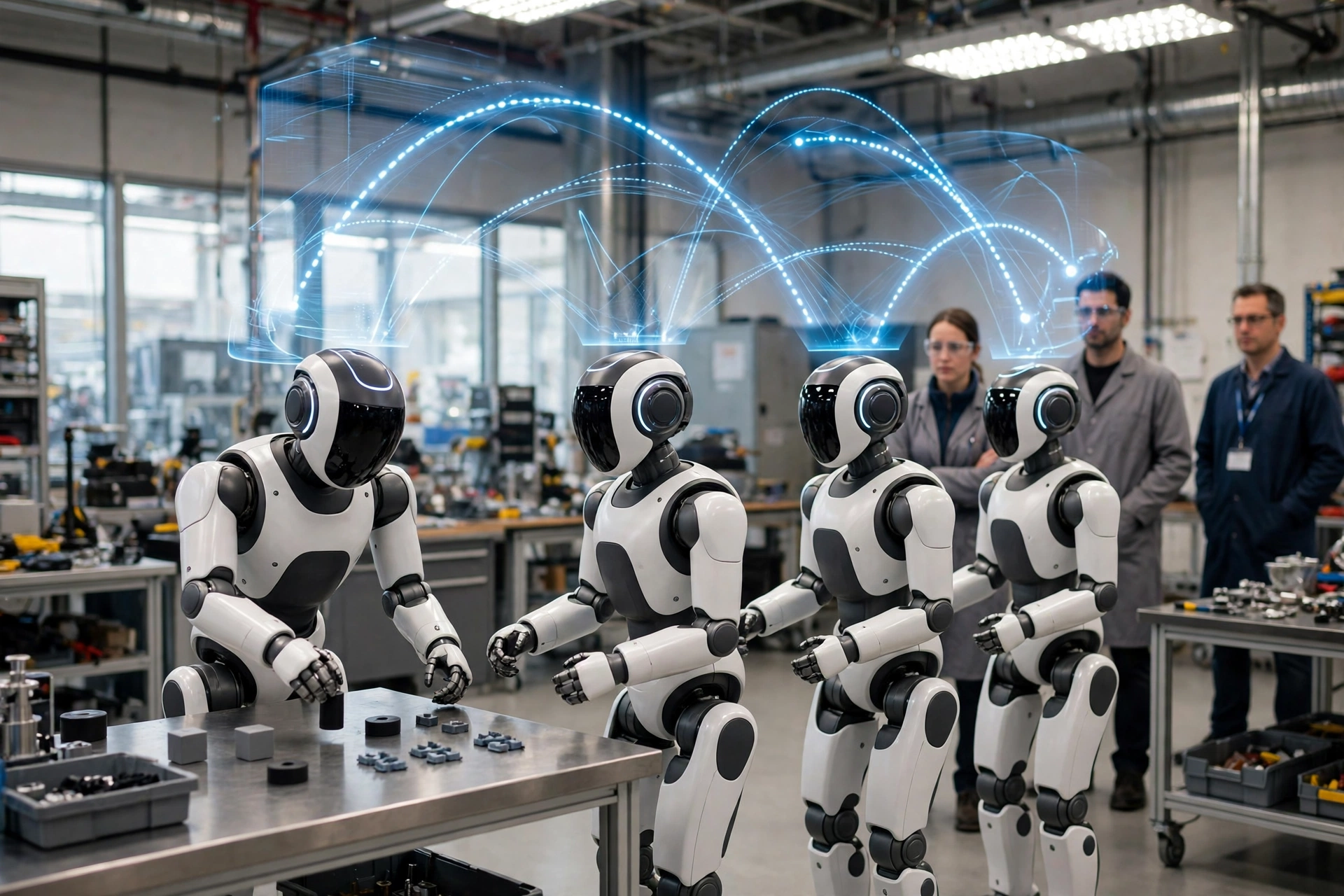
The most striking number in the announcement is not a benchmark score but a fleet size: 100. Large language models learn from a scrape of most of the public internet, but there is no equivalent library of real-world force, friction and contact data sitting online for robots to download. So AgiBot built a training system called Genie Evolver that combines a fleet of 100 physical robots with physics simulation and separate world models, then pools what every robot learns through a process it calls Collective Experience Learning — a skill picked up by one machine becomes available to the rest of the fleet.
In demonstrations, AgiBot showed a robot improving at tabletop curling to the point of beating a typical human player after only a few hours of practice, and a separate unit operating inside a convenience store with what the company describes as autonomous improvement and no human correcting it in real time.
That small-fleet approach is a deliberate contrast with the data-hungry methods of the big AI labs. If 100 robots plus simulation can produce a competitive foundation model, the economics of robot AI change: smaller companies and research labs can afford to play, and the advantage shifts from who owns the most hardware to who builds the best learning loop.
Why open source changes the race
AgiBot’s biggest strategic bet is not technical at all — it is the decision to fully open-source GO-3 Preview by the end of 2026, roughly eight weeks after the announcement. No model size, licence terms or download details have been given yet, but the intent is clear.
China’s robot makers have been pouring money into the software layer this year faster than into new hardware, with rivals such as RoboScience and GenRobot AI raising fresh funding specifically to build shared “brains” that can run across many robot bodies. By open-sourcing GO-3 Preview rather than keeping it proprietary, AgiBot is betting that wide adoption of its architecture, rather than licensing fees, is the faster route to becoming the default foundation model other hardware makers build on.
That puts it on a different track from closed-model developers such as Physical Intelligence and Figure, which have kept their foundation models in-house as a competitive moat. The open-source route has an obvious payoff if it works — a community that tests, fixes and extends the model for free — and an obvious risk: rivals can study and copy the approach. AgiBot is betting the community effect is worth more than the secrecy.
The timing fits a wider moment. Humanoid robots moved beyond stage performances into practical work at the 9th China International Import Expo in Shanghai this week, and Agility Robotics’ Nasdaq debut showed investors are now willing to value a humanoid maker as a public company. The hardware race is crowded; the software race is where the next winners will be decided.
AgiBot’s momentum behind the announcement
GO-3 Preview did not arrive from nowhere. AgiBot said it shipped its 20,000th robot in September 2026, and introduced a metric called Worken to measure how much productive work a robot actually completes — a sign the company is thinking about robots as workers with output to measure, not demos with applause to collect.
That scale matters for GO-3. A company shipping tens of thousands of robots has the deployment footprint to gather real-world data and the customer base to distribute a new model quickly. The question is whether the open-source release converts that footprint into an ecosystem, or whether the big closed labs keep the lead.
The AI investment climate is also moving fast. Anthropic’s IPO roadshow is set to begin next week, and DeepMind’s AI agents finding RSA weaknesses showed how quickly AI systems are moving from answering questions to doing expert work. Robots are the next frontier of that shift — and like Huawei’s first HarmonyOS desktop, GO-3 is a reminder that much of the next wave of AI infrastructure is being built in China, on Chinese terms.
What to watch next
Three things will decide whether GO-3 Preview lives up to its announcement. First, the open-source release itself: the date, the licence, the model size and what training resources come with it. Second, independent benchmark runs once researchers can test the model themselves — the moment the self-reported scores either hold up or fall apart. Third, real deployments: robots running GO-3 in warehouses, shops and homes, where the gap between a benchmark and a Tuesday afternoon is where robot AI lives or dies.
If the release lands as promised by the end of 2026, GO-3 Preview could become the shared brain for a generation of robots that no single company could afford to train alone. AgiBot trained it on just 100 robots. The interesting question is what the rest of the world does with it next.