Motorola has spent years building its reputation on value — good phones at prices that undercut the big names. The Signature 27 is the opposite bet. Announced on November 5, 2026, it is the most expensive phone Motorola has ever sold in the United States, at $1,599.99, and it arrives loaded with hardware designed to justify every dollar: a 200-megapixel periscope zoom camera, the brightest display Motorola claims any smartphone has ever shipped, a 7,000mAh battery, and the first GrapheneOS support on a Motorola device. Pre-orders open November 19, with the phone going on sale November 26.
The question is not whether the specification sheet is impressive. It is. The question is whether Motorola can sell a phone priced above Samsung’s Ultra and Apple’s Pro Max — and whether the buyers who pay that price get something those phones do not offer.
The price is the story
At $1,599.99, the Signature 27 costs more than the Galaxy S26 Ultra and the iPhone 18 Pro Max, according to launch coverage. That is a deliberate statement from a company that built its modern identity on phones costing a third as much. Motorola is selling the Signature 27 universally unlocked in a single US configuration — 12GB of RAM and 512GB of storage — through Motorola.com, Amazon, and Best Buy, with no US carrier deals listed at launch. Global pricing is set at $1,599, £1,300, and €1,899 depending on the market.
The phone was first shown at Qualcomm’s Snapdragon Summit in September, but Motorola held back the price and full specifications until November 5. That gap matters: the company let the hardware tease build for two months, then asked buyers to accept a flagship price on a brand that has never charged one. For that to work, the rest of the phone has to be genuinely exceptional — and on paper, Motorola has thrown everything at it.
A 200MP periscope camera leads the hardware push
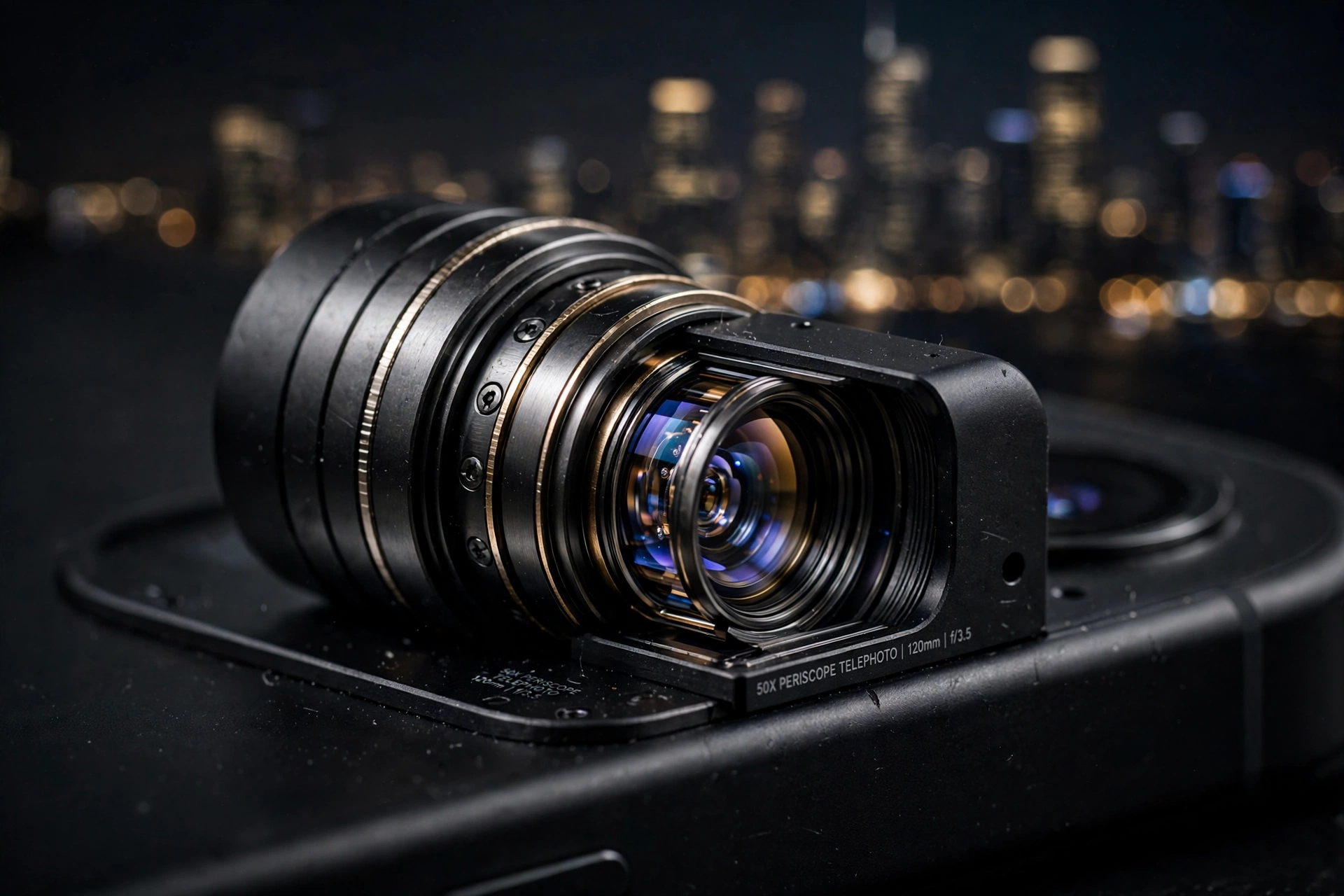
The camera is the Signature 27’s headline, and Motorola made an unusual choice with it. Where Samsung puts its 200-megapixel sensor on the main camera, Motorola puts the 200MP sensor behind the zoom: a 1/1.56-inch periscope telephoto with 3x optical zoom and an AI-assisted Super Zoom Pro mode that reaches 100x. The main camera is a 50-megapixel Sony LYTIA L910 with an f/1.6 aperture, optical image stabilization, and LOFIC technology designed to hold highlight detail in harsh light. A 50-megapixel ultrawide covers a 122-degree field of view and focuses down to 2.5cm for macro shots, and the front camera is a 50-megapixel sensor that records 4K video.
There is also a fourth sensor that no other phone has: a dedicated EVS action sensor, built to freeze fast-moving subjects with more light and detail than a conventional burst mode can capture. Video runs up to 4K at 120 frames per second with Dolby Vision, and up to 8K.
The camera system carries a DXOMARK Gold Label for image quality, with an overall DXOMARK camera score of 173 — the highest the lab has given any phone launched in 2026, Android or iOS, according to launch reports. That is a strong claim, but it comes with the usual caveat: a lab score is not a real-world verdict. The zoom system still has to prove itself against the Galaxy and Pixel phones it now matches on price, especially at the far end of that 100x range, where phone cameras usually fall apart and AI processing does the heavy lifting.
The brightest display on any phone
The 6.78-inch Extreme AMOLED Duo display is built on tandem OLED technology, which stacks two light-emitting layers into one panel to raise brightness and efficiency together. Motorola rates it at up to 12,000 nits of peak brightness — a figure it claims makes it the brightest display available in a smartphone — with up to 3,000 nits in high-brightness mode. The panel runs at 1.5K resolution with a 120Hz refresh rate, supports Dolby Vision and HDR10+, and is protected by Corning Gorilla Glass Ceramic 3.
Peak-brightness numbers deserve a note of caution. The 12,000-nit figure applies under specific conditions, and Motorola’s own comparison is limited to smartphones priced at or above $1,599 in the United States and Canada. Even so, a tandem OLED at this brightness is a genuine hardware story: the same panel technology that has improved tablets and laptops is now doing the same job in a phone, and outdoor visibility should be dramatically better than on last year’s flagships.
Snapdragon power and a 7,000mAh battery
Under the hood, the Signature 27 runs on Qualcomm’s Snapdragon 8 Elite Extreme Gen 6, built on a 2nm process, paired with 12GB of LPDDR5X RAM and 512GB of UFS 4.1 storage in the US configuration. It is among the first phones to ship with Qualcomm’s latest flagship platform, and Motorola pairs it with a cooling system that uses diamond-infused thermal gel and a vapor chamber.
The battery is a 7,000mAh silicon-carbon cell — 35 percent larger than the 5,200mAh battery in the previous generation. Motorola rates it for up to 77 hours of mixed use and 47 hours of video playback. Wired charging runs at 90W TurboPower, and Motorola says median users can get about 12 hours of battery life from roughly 12 minutes of charging. Wireless charging runs at 50W.
The phone is built to survive as well as it performs: IP68 and IP69 ratings, MIL-STD-810H testing across 16 categories and 14 procedures, and an aerospace-grade aluminum frame. It ships in two Pantone finishes, Coal Smoke with an automotive-inspired tactical weave texture and Capulet Olive with a textile-inspired one. Wi-Fi 8 arrives via a 6-antenna array with enhanced 5G connectivity.
GrapheneOS support is the real differentiator

The most unusual part of the announcement is not a specification at all. The Signature 27 is Motorola’s first phone built to support GrapheneOS, the privacy-focused, security-hardened Android-based operating system developed with the GrapheneOS Foundation. Until now, GrapheneOS has been found almost exclusively on Google’s Pixel phones, so a second hardware option — and a flagship one — is a meaningful change for privacy-conscious buyers and for businesses that want a hardened device without being locked to one vendor.
The hardware backing matters. The phone includes ARM Memory Tagging Extension (MTE), a hardware feature that helps prevent memory-corruption vulnerabilities and that GrapheneOS requires. It also ships with Motorola’s ThinkShield and Moto Secure frameworks.
Buyers should understand exactly what is — and is not — being promised. The phone does not ship with GrapheneOS installed. Motorola has made it compatible, and a version of GrapheneOS built for the device is expected in 2027, but no official build exists yet and the project has only prototypes for development so far. That distinction matters in a week when mobile security is front of mind: November’s exploited-vulnerability wave put a Zyxel zero-day, a WordPress Core flaw, and an Apple WebKit bug on CISA’s exploited list, and the lesson of that week was that patches only help when they are actually installed. GrapheneOS support is a real differentiator, but it is a promise to track, not a feature to buy the phone for today.
Android 17, seven years of updates, and Gemini Intelligence
The Signature 27 ships with Android 17 and a promise of seven operating system upgrades and up to seven years of security updates, measured from the phone’s global launch date. That matches what Google and Samsung now offer, and it closes a gap that once made Motorola flagships hard to recommend for long-term ownership.
On the software side, the phone is designed for Gemini Intelligence, the version of Google’s AI assistant coming to its most advanced Android devices, with features such as Rambler, Create My Widget, and Sign-to-Text expected to roll out in the coming months. Motorola adds its own Qira tool, which coordinates tasks and data sharing with compatible Lenovo PCs, including multi-app actions such as booking a ride or completing a grocery order from a list. Audio is tuned in collaboration with Bang & Olufsen.
The AI angle is worth keeping in proportion. Always-on AI agents are arriving across the industry — Perplexity Teammates and supervise AI agents from your iPhone — and the phone in your pocket is becoming the control surface for agents that keep working between prompts. The Signature 27’s job is to be a fast, long-lasting, secure device for that world, not to reinvent it.
Who should buy it — and who should wait
The Signature 27 makes the most sense for three groups: photographers who want the most ambitious zoom hardware on a phone and are willing to test the 100x claim themselves; privacy-minded buyers who have wanted GrapheneOS on something other than a Pixel and can wait for the 2027 build; and Motorola loyalists who have waited years for the company to build a true no-compromise flagship.
Everyone else should wait for independent reviews. The price puts it above established rivals with deeper camera software, wider carrier support, and proven resale value. The DXOMARK score is encouraging, but lab labels are not test results, and the phone’s real-world camera, battery, and display performance are all still unverified by independent testing. The GrapheneOS timeline is also unresolved: Motorola has not given a complete timeline or explained exactly how GrapheneOS support will work alongside its standard Android experience.
The bottom line
The Signature 27 is the most interesting phone Motorola has built in years, and the most expensive — those two facts are the same story. The hardware is genuinely ambitious: a 200MP zoom camera, a 12,000-nit tandem OLED display, a 7,000mAh battery, and the first GrapheneOS support on a Motorola phone. If the camera delivers in the real world and the GrapheneOS build arrives on schedule, Motorola will have earned its place in the ultra-premium tier. If either slips, the $1,599 price will be the detail everyone remembers. Pre-orders open November 19; the first independent reviews, due before the November 26 sale date, will settle the argument.
Related reading
- November’s exploited-vulnerability wave: why patching is now a continuous discipline — https://inspireviraltimes.com/november-2026-exploited-vulnerabilities-zyxel-wordpress-apple-patch/
- Tencent’s Hy4 model trains for defense, not attack — https://inspireviraltimes.com/tencent-hy4-open-source-ai-defensive-cybersecurity/
- DigitalOcean Cuttlefish lets you supervise AI agents from your iPhone — https://inspireviraltimes.com/digitalocean-cuttlefish-iphone-ai-agent-approval/
- Perplexity Teammates: always-on AI agents that take over your ongoing work — https://inspireviraltimes.com/perplexity-teammates-always-on-ai-agents-work/
Sources
- PhoneArena, “Motorola Signature 27 is here” (Nov 5, 2026): https://www.phonearena.com/news/motorola-signature-27-official_id184398
- The Gadgeteer, “Motorola Signature 27 has a 200MP zoom camera and a $1,599 price” (Nov 5, 2026): https://the-gadgeteer.com/2026/11/05/motorola-signature-27-price-specs-release-date/
- TechRepublic, “Motorola Signature 27 Cheat Sheet”: https://www.techrepublic.com/article/news-motorola-signature-27-cheat-sheet/