
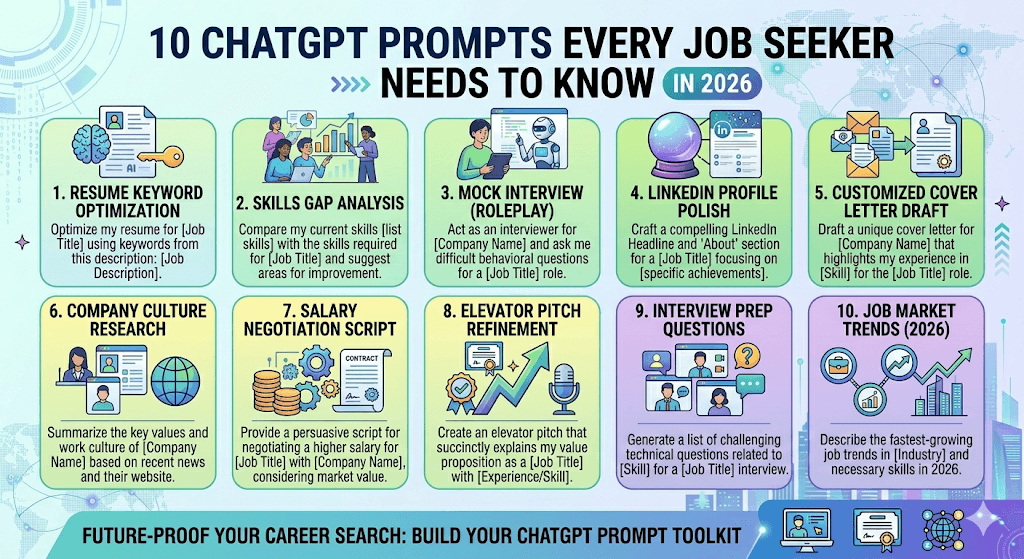
Blog post: 10 ChatGPT prompts every job seeker needs to know
10 ChatGPT Prompts Every
Job Seeker Needs to Know
Stop sending generic applications into the void. These battle-tested prompts turn AI into your personal career coach — from first draft to final offer.
The job market in 2026 is more competitive than ever — and the candidates landing interviews aren’t necessarily the most qualified. They’re the most prepared. Used strategically, ChatGPT can help you research roles, craft standout applications, and walk into interviews with confidence. Here are the 10 prompts that actually move the needle.
The prompts
A generic résumé gets lost. This prompt forces ChatGPT to align your experience directly with the job description’s language — so your résumé passes ATS filters and reads like it was written for that role.
Here is the job description: [paste JD]
Rewrite my résumé bullet points to mirror the language and priorities in the job description. Keep it honest — only use skills and achievements I’ve listed. Highlight the top 3 keywords from the JD I should make sure appear.
The biggest mistake people make with AI cover letters: they sound like AI cover letters. This prompt gives ChatGPT enough context to write something that sounds like you — specific, warm, and compelling.
About me: [2–3 sentences about your background and why you want this role]
Key experience: [your most relevant achievement with numbers if possible]
Tone: conversational and direct. No filler phrases like “I am excited to apply.” Start with a hook. Keep it under 250 words.
Job descriptions are often written by HR teams, not hiring managers. This prompt cuts through the corporate-speak and tells you what the role actually demands — so you can position yourself strategically.
1. What are the top 5 skills or traits they’re really hiring for?
2. What problem is this hire solving for the team?
3. What “hidden” requirements are implied but not stated?
4. What would make a candidate stand out versus just qualify?
Behavioral questions trip up smart candidates because they haven’t structured their stories. This prompt builds a personalized STAR-method answer bank from your own experience.
Here are 3 work experiences I can draw on: [brief summaries]
Generate the 8 most likely behavioral questions for this role and draft a STAR-format answer for each using my experiences. Keep each answer under 2 minutes when spoken aloud.
Walking in knowing a company’s strategy, recent news, and competitive position signals serious interest — and helps you ask smart questions. This prompt builds a cheat sheet in minutes.
Based on what you know (and note if your info may be outdated), give me:
1. Their core business model and how they make money
2. Recent strategic priorities or challenges
3. Key competitors and how they differentiate
4. 5 smart questions I can ask that show genuine business understanding
This question opens almost every interview and most people wing it. A crisp, memorable 90-second answer sets the tone for everything that follows.
My background: [paste a few bullet points from your résumé]
What I want them to remember: [your core value proposition]
Make it 90 seconds when spoken. Lead with a strong hook. End by bridging to why I want this specific role.
Most people leave money on the table because they don’t know how to respond to an offer. This prompt gives you a word-for-word negotiation script tailored to your situation.
My target range: [what you want]
My leverage: [competing offers, unique skills, current salary]
Write me a confident but collegial email negotiating a higher base. Don’t be aggressive. Acknowledge the offer positively, make a specific counter, and give a brief reason. Keep it under 150 words.
Finding out you’re under-qualified in an interview is demoralizing. Getting ahead of it — and addressing it — is a superpower. This prompt gives you an honest audit and a learning plan.
Here is a job description for a role I want: [paste JD]
Identify the gaps between what I have and what’s required. For each gap, suggest the fastest realistic way to close it — courses, certifications, projects, or portfolio pieces.
The best jobs are filled through warm introductions, not job boards. But most cold messages get ignored because they lead with “I’m looking for a job.” This prompt flips that.
My context: [who you are, why you’re reaching out]
What I want: [a 15-min chat, an introduction, their perspective]
Rules: Lead with something specific about them or their work. Make it about them first. Don’t ask for a job directly. Keep it under 75 words. Sound like a human.
The single best way to get comfortable with interviews is repetition. ChatGPT can simulate an interviewer and give honest feedback — without the embarrassment of practicing in front of a friend.
Conduct a 10-question mock interview. Ask one question at a time. After I answer each one, give me brief feedback — what landed, what was vague, and what I should improve. Be honest, not just encouraging. Start with the first question now.
These prompts aren’t magic — they work because they give the AI enough context to produce something genuinely useful. The more specific you are in the placeholders, the better your output. Generic input produces generic output.
A word of caution: never send AI-generated content without reading it carefully and adding your own voice. Hiring managers have seen thousands of applications — they recognize polish-without-personality. Use these prompts as a first draft engine, not a send button.
Your next move starts with one prompt
Pick the prompt that matches where you are in your job search right now, and try it today. The job market rewards the prepared — and preparation is no longer a luxury reserved for people with expensive career coaches.