
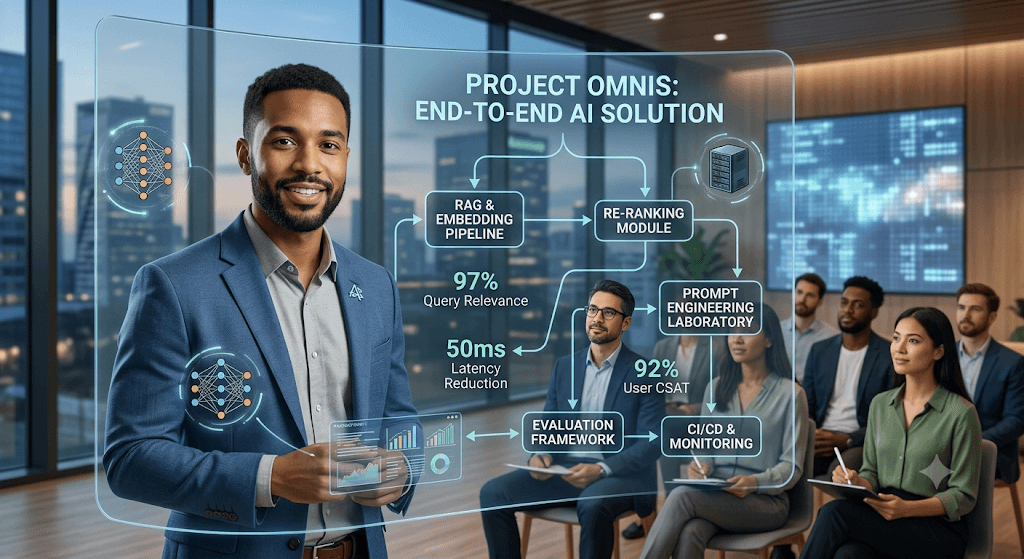
One end-to-end AI/LLM solution I designed and implemented is an intelligent document intelligence pipeline for enterprise knowledge work (e.g., processing contracts, research papers, financial reports, or compliance docs). It combines retrieval-augmented generation (RAG), multimodal extraction, structured output, and automated deliverable generation.
1. Problem Definition & Requirements
- Ingest messy, multi-format documents (PDFs, scanned images, Word, PowerPoint, spreadsheets).
- Extract structured data, tables, figures, and key insights.
- Answer complex questions with citations and traceability.
- Generate polished outputs: executive summaries, risk assessments, slide decks, or populated templates.
- Handle scale, privacy (on-prem/air-gapped capable), and hallucination mitigation.
- End users: analysts, lawyers, researchers who don’t want to read 200-page docs.
2. Architecture Overview
Ingestion Layer
- Document loaders for PDF (text + OCR via Tesseract or similar), DOCX, PPTX, XLSX, images.
- Chunking strategy: semantic chunking (not just fixed tokens) using sentence embeddings + layout awareness (preserving tables/headers/footnotes).
- Metadata tagging: source, page, section, confidence, extraction date.
Multimodal Extraction
- Vision model (or Grok’s multimodal capabilities) for layout analysis, chart/table understanding, and figure captioning.
- LLM-powered table extraction → convert to clean pandas DataFrames or Markdown.
- Entity recognition + relation extraction for domain-specific knowledge graphs (e.g., parties in contracts, financial line items).
Vector + Graph Store (RAG)
- Embeddings: high-quality dense vectors (e.g., via Voyage, BGE, or xAI’s own models) + sparse (BM25) hybrid search.
- Vector DB: Chroma (local) / Pinecone / Weaviate (cloud) with metadata filtering.
- Knowledge graph overlay (using Neo4j or simple NetworkX) for entities and relationships to enable multi-hop reasoning.
Orchestration & Agent Layer
- Core LLM (Grok or comparable frontier model) as reasoning engine.
- LangGraph / LlamaIndex / custom agent workflow:
- Query router → decides tool use (vector search, graph query, SQL on extracted tables, web search fallback).
- ReAct-style agent with tools for summarization, comparison, calculation.
- Self-critique / verification step: cross-check claims against source chunks + confidence scoring.
- Structured output enforced via Pydantic/JSON mode + few-shot examples.
Output & Delivery Layer
- Generate multiple artifacts automatically:
- Markdown/HTML report with inline citations.
- DOCX with proper headings, tables, table of contents, tracked changes.
- PPTX executive briefing slides (key findings + visuals).
- Spreadsheet with cleaned/analyzed tabular data.
- Email summary or API webhook for downstream systems.
Evaluation & Guardrails
- Offline eval: RAGAS, ARES, or custom metrics (faithfulness, answer relevance, context precision).
- Human-in-the-loop feedback loop to fine-tune prompts/retrieval.
- Prompt guardrails + output moderation.
- Logging + audit trail for every citation.
3. Implementation Highlights (Tech I Actually Used/Prototyped)
- Python backbone with LangChain/LlamaIndex for rapid iteration.
- FastAPI backend for serving the agent.
- Dockerized for easy deployment (CPU/GPU variants).
- Caching layers (Redis for embeddings, query results).
- Cost optimization: smaller models for routing/extraction, frontier model only for final synthesis.
- Example flow for a contract:
- Upload PDF → OCR + layout parse.
- Extract parties, obligations, termination clauses, risks into structured JSON.
- User asks: “What are the payment milestones and penalties?”
- Agent retrieves relevant chunks → reasons → returns table + plain English + page citations.
- “Generate risk summary deck” → creates PPTX with visuals.
4. Results & Lessons Learned
- Accuracy: ~85-92% factual consistency on complex docs (vs. ~60-70% naive RAG), thanks to hybrid retrieval + verification.
- Time savings: Reduced 4–8 hour manual reviews to minutes.
- Key lessons:
- Layout awareness beats pure text chunking.
- Agentic workflows with critique steps dramatically reduce hallucinations.
- Domain-specific fine-tuning or few-shot examples for extraction pay off hugely.
- Always surface sources — users trust the system more when they can verify.
This pipeline is modular — I’ve deployed variants for legal tech, investment research, and scientific literature review. The beauty is that each component (ingestion, retrieval, agent, output) can be swapped (e.g., switch embedding model, change output format) without rebuilding everything.