For decades, the Moon has been a place you visit with everything you need packed into a single spacecraft. Astrolab wants to change that model. Its new LUMIS concept treats lunar power and communications as infrastructure that can be shared, moved and expanded — closer to a utility grid than to a one-off mission payload.
What Astrolab announced at UP.SUMMIT
On November 4, 2026, at Kennedy Space Center, Astrolab introduced LUMIS, short for Lunar Utility Module for Industrial Services. The company describes it as a lunar power, communications and data node, designed to support other vehicles and instruments on the surface rather than to carry out a single experiment of its own. Alongside LUMIS, Astrolab introduced LUNAR OS, an integrated suite of mobility, power and communications products and services. Together, the two announcements signal a deliberate shift in identity: Astrolab is presenting itself as “The Lunar Operations Company,” a business that wants to run the services around exploration, not only build the rovers that do the exploring.
Full-scale models of the new hardware are scheduled to be shown on November 7 and 8 at the NASA hangar at the Kennedy Space Center Visitor Complex. That public display matters, because it gives the concept a physical scale that renderings cannot. A lunar utility node is not a small box on a lander deck; it is a piece of surface infrastructure, and its size, height and deployment method are central to whether it can work.
Why placement matters more than landing
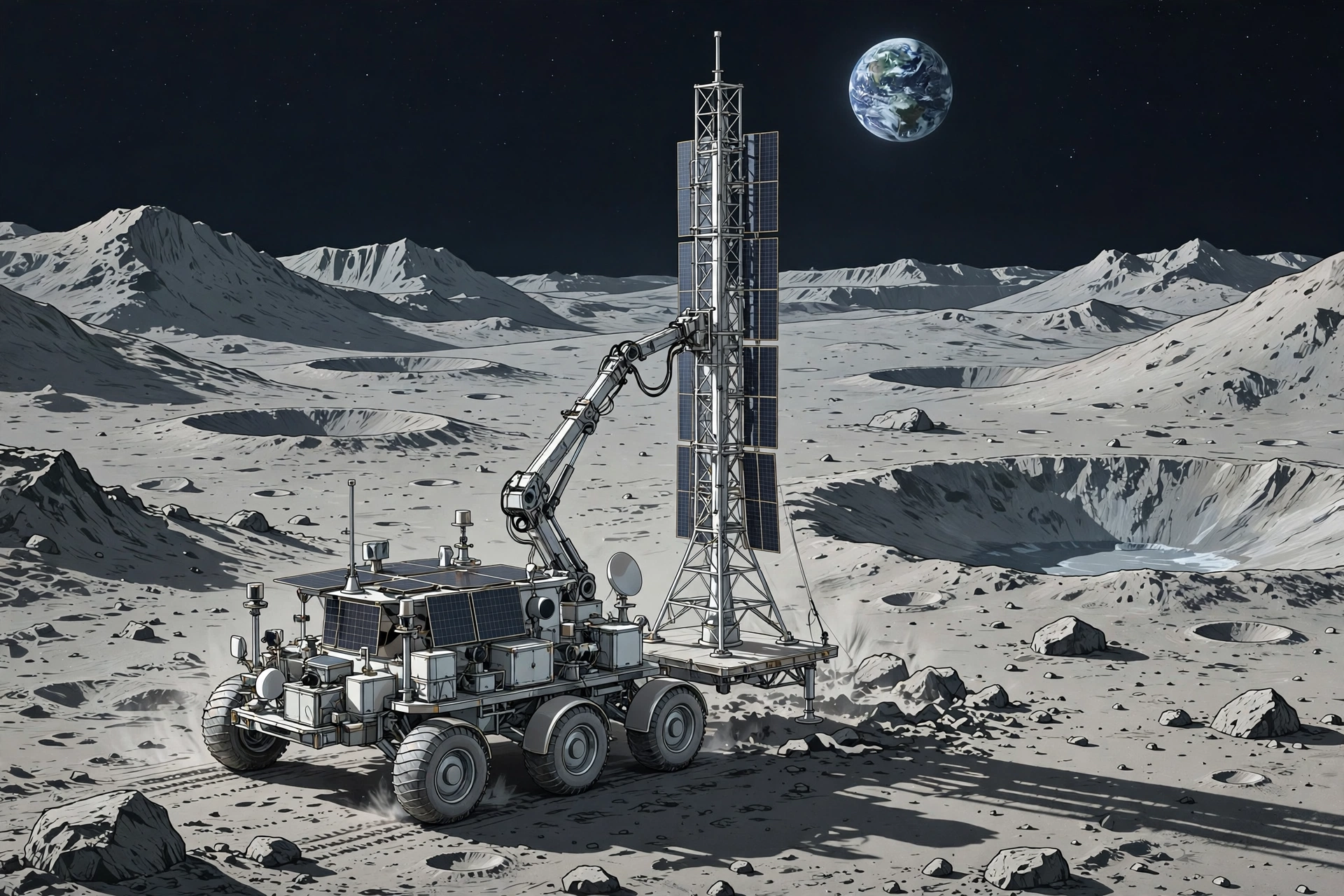
The most interesting part of the LUMIS idea may not be the node itself, but where it ends up. A lander can only touch down where the terrain, lighting and risk allow. A rover, by contrast, can travel. Astrolab says its FLEX rover can transport payloads for tens of kilometres, which means LUMIS nodes do not have to stay where they land. They can be driven to the places where sunlight lasts longest and where Earth stays in view.
Near the lunar south pole, that distinction is decisive. Small moves can have outsized effects: shifting infrastructure by just 50 metres can mean hundreds of hours more darkness, or can cut near-continuous Earth visibility to roughly half. In other words, a site that looks almost identical on a map can be dramatically better or worse for a mission that needs power and a reliable link home. The ridge between Shackleton and de Gerlache craters, the Malapert Massif and Mons Mouton — more than 100 kilometres away — illustrate how widely the best locations can be spread, and why a system that can reposition itself has an advantage over one fixed to a landing ellipse.
Inside LUMIS: power, connectivity and edge computing
LUMIS is built around a vertical solar array tower, paired with batteries, transceivers and surface wireless power transfer. The tower form factor is a response to the low Sun angles at the poles: going up, rather than spreading out, helps the array catch light over ridges and crater rims. The batteries carry the node through darkness, while the wireless power system is intended to recharge visiting equipment without a physical plug — a useful trick on a surface covered in abrasive dust.
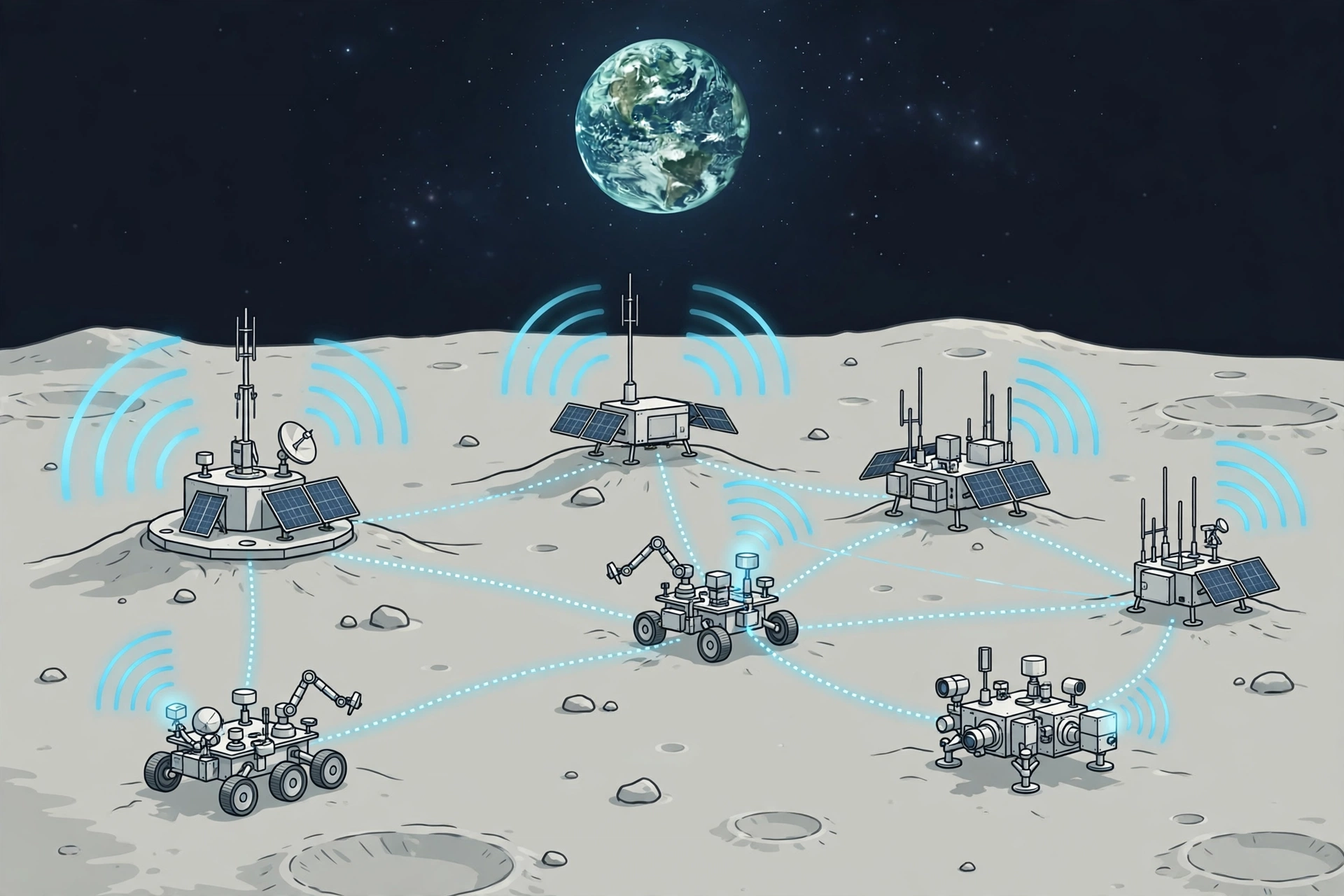
Connectivity is the other half of the package. Astrolab describes high-bandwidth direct-to-Earth communications, local Wi-Fi and 5G for surface equipment, and long-range backhaul links between nodes. That combination would let a rover, a drill or a science station talk locally, pass data across the surface and then send it home without each piece of equipment carrying its own deep-space radio. As with shared satellite ground networks on Earth, the value is in not duplicating the expensive link for every user. High-bandwidth data links matter just as much on the Moon, where science data can pile up faster than a narrow link can clear it.
The node also carries onboard edge computing, so some decisions and data processing can happen on the surface instead of waiting for a round trip to Earth. For onboard edge computing in space, efficiency is everything: every watt spent on processing is a watt not spent on driving, heating or transmitting. Astrolab puts the initial demonstration nodes at 2 kilowatts each, with future nodes reaching 20 kilowatts each, and says the system can hold internal reserves for more than 400 hours while still supporting external payloads. If those numbers hold, a node would be more than a battery pack — it would be a small power station with a brain.
A network, not a single box
LUMIS is designed to work as a network. Multiple nodes can arrive on a single cargo lander, then be positioned and linked by one FLEX rover. Linked together, Astrolab says, an interconnected grid could deliver more than 100 kilowatts before anticipated nuclear systems arrive — and without the regulatory and safety requirements that come with nuclear power. That framing is important: the pitch is not that solar replaces nuclear forever, but that a solar grid could fill the gap, and perhaps remain useful long after nuclear systems are added.
The practical uses are easy to picture. A visiting rover could pull up, recharge and upload its science data. In-situ resource utilization equipment — machines that would process lunar ice or regolith — could draw steady power instead of bringing their own oversized supplies. Coordinated operations could run over the local wireless network, with several vehicles and instruments sharing timing, position and data. Customers, in this vision, would pay for access and usage through LUNAR OS, rather than building their own power and communications infrastructure for every mission. It is the same logic that turned computing and connectivity into services on Earth, applied to a place with no grid at all.
What LUMIS is not yet
For all the ambition, LUMIS remains an announcement, not a flown system. The first deployment is targeted for 2028, on the previously announced commercial FLEX mission aboard a SpaceX Starship. That date, the landing, the deployment and the first winter night will all test claims that currently exist mainly on paper and in models. No pricing has been published in the announcement, so it is still unknown what a kilowatt-hour or a gigabyte on the Moon would actually cost — or which customers are willing to pay it.
The wider company context helps explain the timing. Astrolab plans to move in 2027 from Hawthorne to a Torrance facility about four times larger, and it has a Houston facility at the Texas Space Institute for lunar-analog testing of LUMIS. Its smaller FLIP rover is preparing for launch aboard Voyager Technologies’ Griffin-1 later this year, and Astrolab has also been selected to develop a crewed lunar rover for NASA’s Artemis program. LUMIS, in other words, is not a side project: it sits alongside a growing roster of vehicles that could themselves become its first customers, much like autonomous machines that must work far from help need reliable power and communications wherever they operate.
What to watch next
Three questions will decide whether LUMIS matters. First, does the 2028 demonstration hit its schedule? Lunar schedules slip often, and a missed window can push a program by years. Second, do the scaling claims survive real lunar testing — the jump from 2 kilowatts to 20 kilowatts per node, and the idea of a grid delivering more than 100 kilowatts? Power on paper and power in polar cold, dust and long darkness are different things. Third, and perhaps most importantly, will other operators actually buy power and connectivity as a service instead of building their own? The technology could work and the business model could still fail if mission planners prefer to own their infrastructure.
If the answers are yes, the Moon could start to look less like a series of isolated expeditions and more like a place with shared utilities — where arriving with a rover is enough, because the lights, the network and the power are already there. That is a big if, but it is also the clearest statement yet of what a lunar economy might actually need.