Most AI still lives in the cloud: you send data up, wait, and get an answer back. That works for a chatbot, but it breaks down for a robot that must dodge an obstacle, a drone that must spot a fire, or a camera that must flag an intruder — right now, not after a round trip. Mobilint’s REGULUS chip, announced November 2, 2026 with Ceva silicon IP inside, is built for exactly that problem: serious AI inference, done on the device itself, inside a tiny power budget.
What REGULUS actually is
REGULUS is a standalone edge AI system-on-chip (SoC) — a complete processor that runs on-device AI without needing a host computer. It combines Ceva’s SensPro AI DSP for sensing and signal processing with Ceva’s NeuPro-Nano NPN32 neural processing unit for efficient, always-on inference, inside Mobilint’s own processing architecture. The headline numbers are 10 TOPS (tera operations per second, INT8) of AI performance at under 3 watts, with support for up to 8GB of memory. For context, that is the kind of compute that used to need a much larger, hotter, hungrier board — now squeezed into a 17mm chip meant for cameras, drones and robots. This is also the first production deployment of Ceva’s NeuPro NPU family, which matters because it moves this technology from a licensing catalogue into shipping silicon. For more on the chip itself, see Mobilint’s REGULUS product page.
Why 10 TOPS at under 3 watts matters
Power is the real constraint at the edge. A robot, drone or battery camera cannot carry a data-centre GPU, and it cannot afford to stream raw video to the cloud all day — that costs bandwidth, battery, latency and privacy. At under 3W, REGULUS fits inside devices where size, weight, heat and battery are already fixed. The multi-engine design is the trick: instead of one big processor doing everything badly, different workloads run on the engine best suited to them — SensPro for sensing and signal work, NeuPro-Nano for always-on neural inference. That is why the chip can promise real-time responses: detection, tracking and analysis happen where the data is created, so only the event — not hours of raw footage — needs to go upstream. The same on-device logic is reshaping other fields too: read our coverage of Toyota and Waymo’s factory-built robotaxi.
Physical AI: sensing, inferring, acting on-device
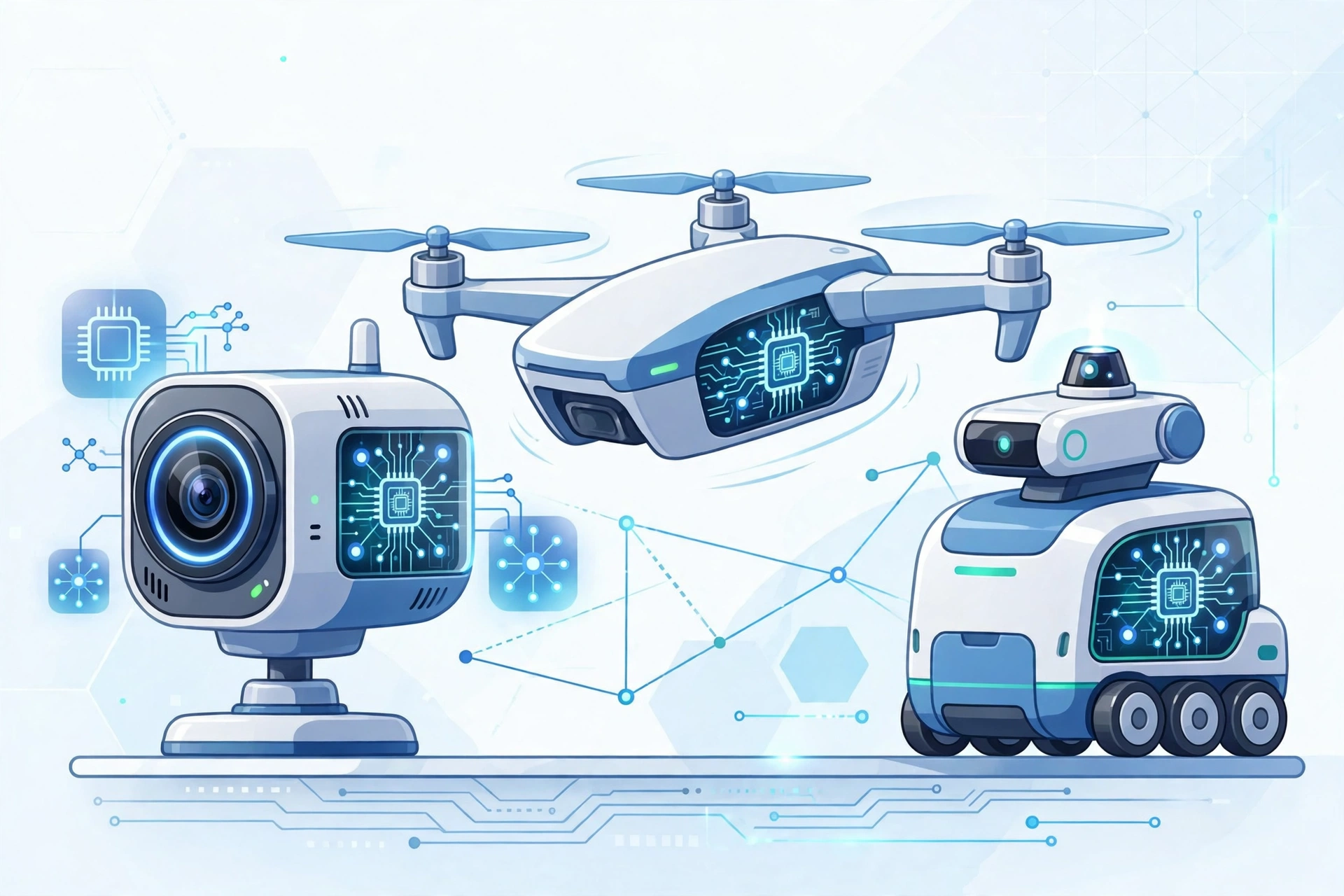
Ceva calls this shift ‘Physical AI’: systems that sense their surroundings, interpret them and respond in real time, rather than just answering questions on a screen. REGULUS targets robotics, drones, machine vision, smart cameras and IoT devices — the places where a wrong or late answer has physical consequences. Mobilint lists concrete uses: wildfire watch, search and rescue, crop spraying, factory inspection with OCR and pattern matching, and security and medical devices. In each case the video is analysed on board, not after landing or after upload. Ceva’s own explanation of edge AI makes the same point about latency and privacy: Ceva’s Edge AI portfolio. And the broader AI shift toward systems that act, not just chat, is visible in software too — see our report on how AI agents now start over 40% of GitHub pull requests.
The MLD-R1 USB accelerator: AI for existing systems

REGULUS is already shipping inside a real product: Mobilint’s MLD-R1 AI USB accelerator, first previewed at COMPUTEX 2026 and now shipping. Plug it in and an existing system gains on-device AI for computer vision, video analytics and generative AI workloads — for smart factories, robotics, machine vision, security, medical devices and digital signage. It supports widely used frameworks including PyTorch, ONNX, Hugging Face, TensorFlow, TFLite and Keras, and Mobilint says more than 490 model architectures across CNN, RNN and transformer designs have been validated. That compatibility matters more than raw TOPS: a chip nobody can easily program for is a paperweight. For the full announcement details, see the Ceva-Mobilint announcement.
What to watch next — and the honest limits
A chip announcement is not a product review. We have not seen independent benchmarks for REGULUS beyond the vendor’s 10 TOPS figure, and TOPS alone do not tell you real-world accuracy, latency on your model, or how easy the SDK is to use. Pricing, volume availability and which specific products beyond MLD-R1 will use REGULUS are also still to be confirmed. What is genuinely newsworthy is the direction: efficient, specialised silicon is letting AI leave the data centre and live inside the machines that need it most. That trend cuts both ways — powerful on-device models also raise questions about surveillance and safety, which is why gated, carefully deployed AI matters. See our coverage of Google’s Gemini 4 Carbon cybersecurity model. And for a reminder that powerful agent tools need careful handling, see our coverage of DeepSeek’s open-source coding agent.
Bottom line
REGULUS will not replace cloud AI, and it is not trying to. It is for the jobs the cloud cannot do fast enough, privately enough, or reliably enough: a drone over a field, a camera on a factory line, a robot in a warehouse. If Mobilint’s power and compatibility claims hold up in independent testing, 10 TOPS under 3W is a meaningful step toward AI that works where the action is — on the device, in real time, without asking the cloud first.