
DeepSeek’s Harness team quietly published something on October 31, 2026, that deserves more attention than a typical open-source release. Called dsh-superagent, it is a coding agent built not for one developer sitting at a keyboard, but for an entire software team. It watches a GitHub repository and, optionally, a team chat channel, picks up requests from approved teammates, and answers with real work — often in the form of a pull request. The code is free under the MIT license, and within a day of going public the repository had already collected thousands of stars on GitHub. See the dsh-superagent repository on GitHub for the code.
What is dsh-superagent?
dsh-superagent is a proactive coding agent scoped to a single GitHub repository, packaged as a bundle for DeepSeek Harness, the company’s open-source agent runtime. It listens to GitHub events and can also connect to Feishu, ByteDance’s workplace chat app, for requests from approved team members. When someone who is allowed to ask it for work does so, the agent opens a work item, handles it in its own session and working directory, and replies in the original conversation — for example, with a pull request the team can review and merge. A web panel shows only the items that actually need a human, so the team is not flooded with notifications. The design principle, stated in the project’s own documentation, is simple: take as little human attention as possible, and give as much value as possible. The agent acts only when asked, or when a rule the team wrote allows it, and it speaks only when someone must act or can use a result.
How the router-worker design works
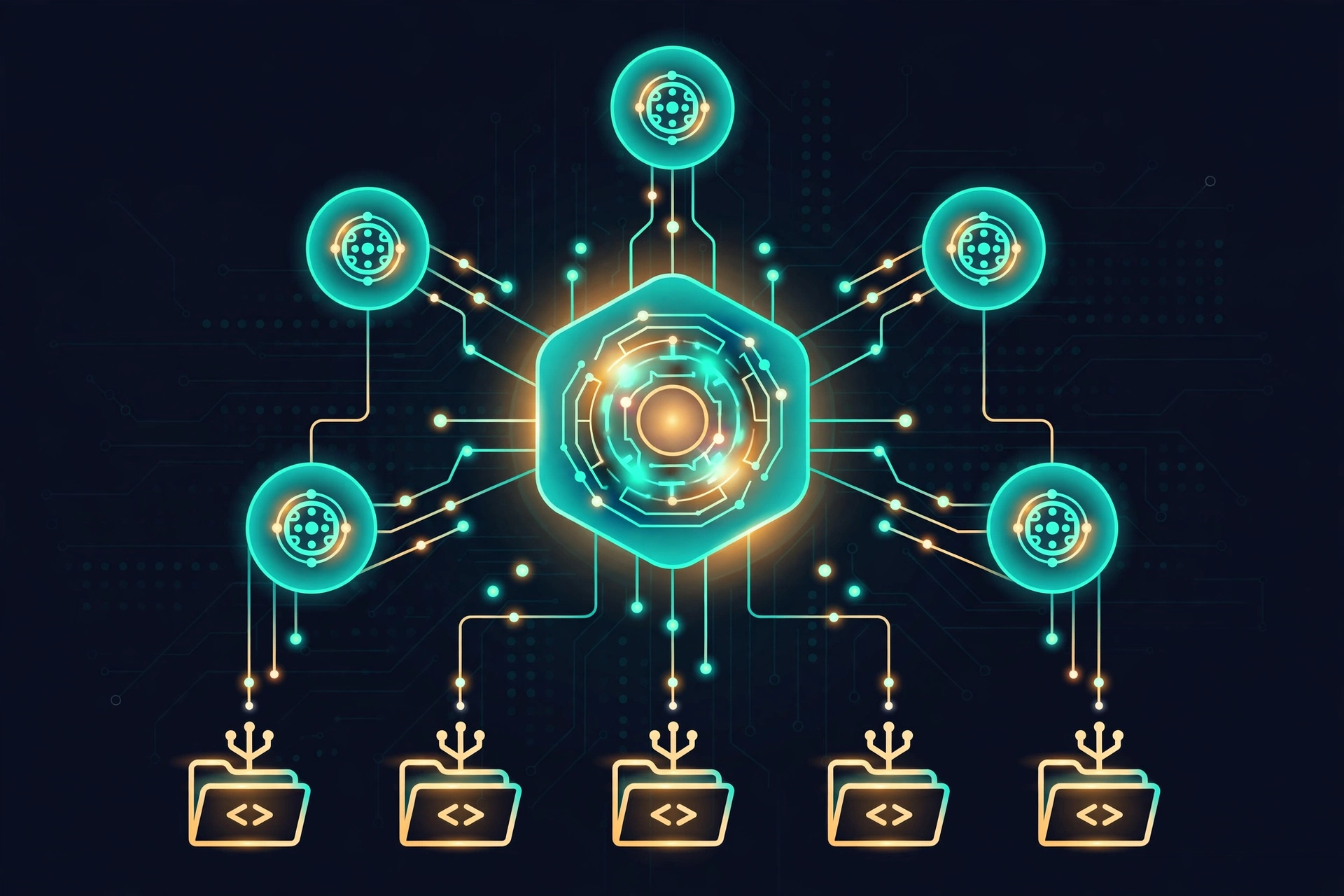
Under the hood, dsh-superagent uses a router-worker architecture. A long-running Router session handles interaction and dispatch, while isolated Worker sessions do the actual coding. Each work item, called a Ticket, runs in its own session with its own directory, so parallel jobs do not interfere with each other. The flow runs from a Source (GitHub or Feishu) through a Trigger, an evaluation step that decides whether a batch of messages asks for new work, and then the Ticket itself, which carries an immutable Mandate stating why the work is authorized. Later comments on a pull request are routed back to the right Worker through a Subscription, without needing a fresh mention. Proactive work is gated by three accept modes: off, observe (the default), and auto. In observe mode the agent only records what it would have accepted, so teams can see what it would do before handing it real authority. See MarkTechPost’s breakdown of the router-worker design for a closer look at the architecture.
What the early tests actually show
DeepSeek’s own numbers come with an important asterisk: they are from simulations, not real-world projects. In tests with simulated group chats and GitHub CI streams — roughly 300 messages per run, of which about 20 were real work requests — the super-agent finished tasks with a median time of 12.4 minutes and a 95th-percentile time of 15.7 minutes. A single-session agent with subagents, by comparison, took 29.5 minutes at the 95th percentile. The gap is real but should be read carefully: the baseline agent reportedly never called a subagent at all in five runs under a neutral prompt, and no real coding quality was measured. Token usage is also heavy — about 23.2 million cached tokens per run in one reported configuration — so this is not a cheap way to run an agent, even if the code itself is free. You pay for whatever model access you connect to it.
How it compares with other coding agents
The release arrives as GitHub’s own data shows AI agents starting more than 40 percent of pull requests opened on the platform in September 2026, up from 17 percent in March. Tools such as GitHub Copilot’s cloud agent, Claude Code, and OpenAI Codex already let teams delegate coding work, but dsh-superagent differs in a few ways: it runs on your own machine rather than in a vendor’s cloud, its code is fully open under the MIT license, and it is explicitly designed around team chat as an input channel. That combination makes it an interesting reference design for teams that want to study or adapt an agent architecture, even if they would not run this exact prototype in production. For more background on the wider shift toward agent-driven development, see our coverage of how AI agents now start over 40 percent of GitHub pull requests, and our guide to building agentic AI systems in Python.
The honest caveats
DeepSeek is unusually blunt about this release’s limits, and readers should take them seriously. The repository header states plainly that this is a research prototype for reference only, not an official DeepSeek product. It is not production-ready, it may still contain bugs, and it differs from the version DeepSeek’s own team uses internally. Some designs described in the accompanying article, Exploring Super-agent Design: Towards a More Autonomous Agent System, are directions for future development and are not implemented in the prototype. Setup is also non-trivial: it needs a dedicated GitHub account for the agent, Node.js 22.19 or later, Git 2.32 or later, Python 3.8 or later, tmux, and GitHub CLI 2.48 or later, and only github.com is supported — not GitHub Enterprise Server. Most importantly, the agent runs with full access as the operating-system user, so it should be isolated before use and never pointed at a repository you cannot afford to break.
Should you try it?
If you are a developer or team lead curious about where coding agents are heading, dsh-superagent is worth an afternoon of experimentation — in a sandbox, on a disposable repository, with the observe mode left on. It shows a plausible answer to a real problem: as agents multiply, human attention, not model capability, becomes the bottleneck, and a system that batches, routes, and quietly handles routine requests could genuinely save a team time. But treat it as what it is: a research sketch of the future of team coding, not a tool to hand the keys to your production codebase today. For teams already experimenting with retrieval and agent architectures, our explainers on real-world AI success stories and on implementing RAG architectures are useful companion reading.
The most interesting thing about dsh-superagent may not be the code itself but the direction it points. Agents are moving from personal assistants that wait for a prompt to team members that listen, prioritize, and act — and DeepSeek just gave everyone the blueprints to study how that works. See the November 1 AI news roundup for contemporaneous coverage.

