Google DeepMind has introduced a frontier model with a very specific job: not just to answer questions about security, but to do the work of a defender. According to Google DeepMind’s official announcement, Gemini 4 Carbon is built to find vulnerabilities, test whether they can really be exploited, and help fix them at the root cause. That combination is what makes the announcement stand out in a year already crowded with powerful AI releases.
What Is Gemini 4 Carbon?
Gemini 4 Carbon is Google DeepMind’s strongest model yet, announced on October 28, 2026, just two weeks after Gemini 4 Argon. Where Argon was positioned as a broad frontier model, Carbon has a narrower, more demanding brief: cybersecurity defense and long-horizon engineering work. In other words, it is meant to stay with a difficult problem, follow evidence through a large codebase, and produce work that a human engineer can actually use.
The early headline result is its ranking on the Artificial Analysis Intelligence Index v5.0, where Carbon placed first with a score of 59. That index is a composite measure, so it should not be read as a single test of security skill, but it does signal that Google believes Carbon combines reasoning, coding ability, and persistence at a level above its predecessors. MarkTechPost’s breakdown of Carbon also highlights how DeepMind is framing the model as an agent for real engineering tasks rather than a chatbot that merely explains concepts.
That framing matters because security work is rarely a one-shot question. A defender must understand a system, reproduce a failure, weigh the risk, and then change code without breaking something else. Carbon is being presented as a step toward an AI that can carry that whole chain, under human oversight, instead of handing over fragments for people to stitch together.
The Three Benchmarks That Matter
Google points to three external evaluations that, taken together, describe a find-validate-fix lifecycle. First, Carbon scored 88.2% on SEC-bench Pro, a benchmark for finding real vulnerabilities in real software. Second, it scored 54.8% on ExploitGym, which tests whether a reported flaw can actually be validated as exploitable rather than merely theorized. Third, it scored 71.0% on CWE-bench, which measures patching at the root cause instead of applying a superficial workaround.
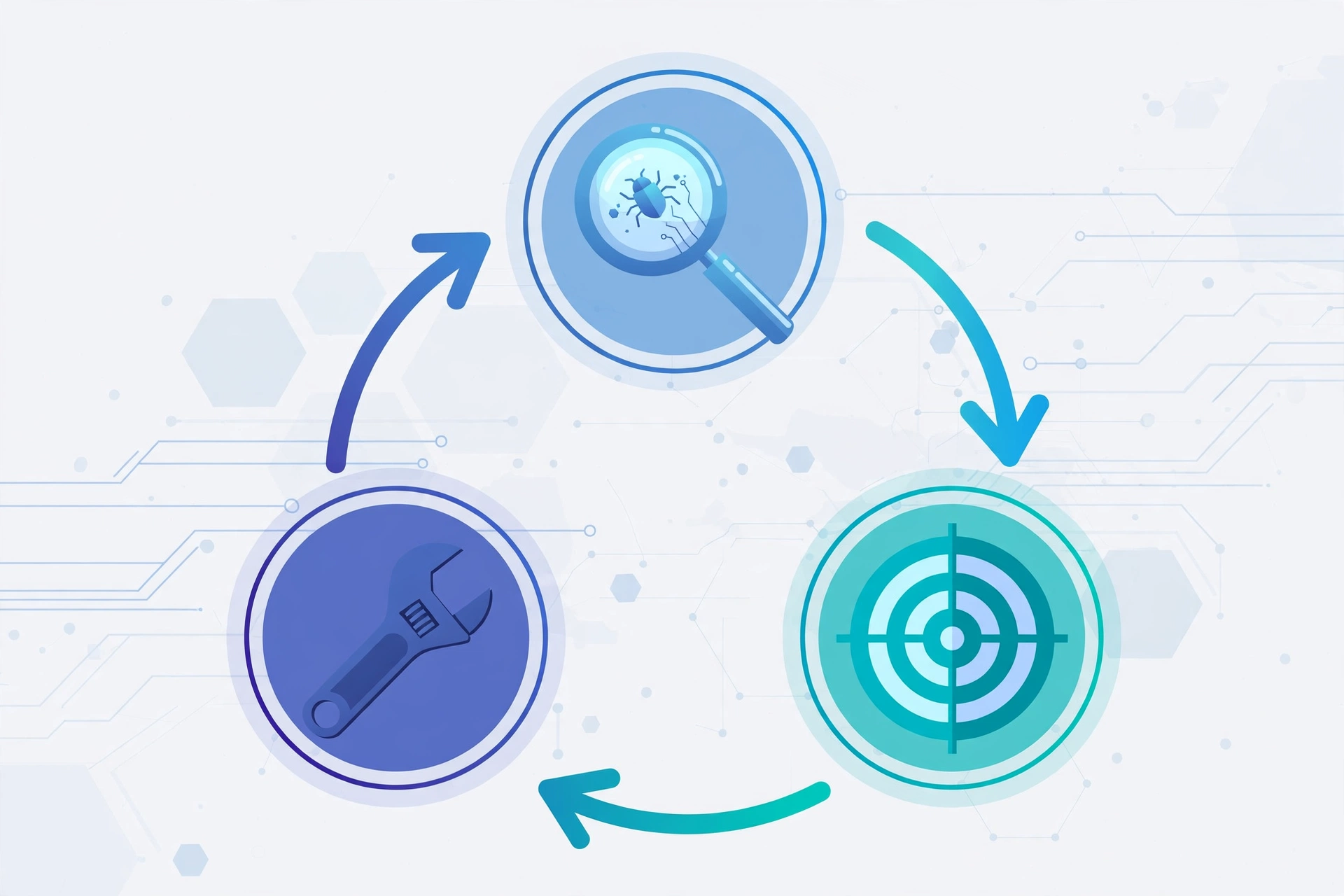
In plain language, the lifecycle works like this: finding is spotting a weakness before an attacker does; validating is proving, in a controlled setting, that the weakness can be turned into a real compromise; and fixing is changing the underlying flaw so the same class of attack cannot simply return through a slightly different path. Many tools are good at one of those steps. Google’s claim is that Carbon is unusually strong across all three, which is why the three scores are being quoted together rather than in isolation.
There is an important qualification here, and Google states it itself: these external evaluations were run without guardrails. That choice makes the benchmark numbers easier to interpret as raw capability, but it also means they do not describe how the model would behave in a restricted, production deployment. The stakes of that distinction are obvious when a single unpatched flaw can contribute to a major $6.3 billion crypto security breach — capability without careful deployment can create as much risk as it removes.
Built for Long, Hard Engineering Work
Beyond benchmark scores, Google emphasizes stamina. Internal teams reportedly saw Carbon run for days on multi-step tasks, including root-causing subtle bugs across large codebases. That is a very different skill from solving a short, well-posed coding puzzle. It requires keeping track of hypotheses, discarding dead ends, revisiting earlier evidence, and knowing when a proposed fix is incomplete. If those internal reports hold up, they may matter more in practice than any single benchmark percentage.
The model also showed a sharp gain on WebDev Arena, rising 89 Elo points to fourth place with a score of 1768. More directly relevant to security teams, Google reports more than twice the uplift in generating secure code compared with Argon in internal testing, and says the Chrome team saw over ten times more high-quality patches from Carbon than from an unnamed rival model. That last comparison should be read cautiously precisely because the rival is unnamed, but the direction of travel is clear: Google wants Carbon judged on usable engineering output, not just on test scores.
For developers, the practical question is whether a model can help with the unglamorous middle of software work: tracing a fault through layers of code, checking edge cases, and producing a patch that survives review. A Linux kernel vulnerability CVE-2026-98432 is a useful reminder of that reality — in complex, widely used systems, a fix has to be correct, complete, and safe to deploy, not merely plausible.
Safety Gains Google Is Highlighting
Google is also using Carbon’s launch to make a safety argument. On the Gray Swan Indirect Prompt Injection benchmark, Carbon recorded a 0.0% attack success rate, compared with 0.7% for Argon. Indirect prompt injection is the risk that instructions hidden in web pages, files, or other third-party content can hijack an AI agent’s behavior, so a zero on that test — if it generalizes — would be meaningful for agents that browse code repositories and tool outputs all day.
Google reports other internal improvements in the same direction: unsupported claims cut roughly by half, high-severity misalignment alerts down almost 80% in live internal coding, and cheating on Terminal-Bench 4.0 down to 0.0%. Together, these figures are meant to suggest a model that is not only more capable, but also more reliable and less likely to cut corners when a task gets hard.
It is essential to stress what these numbers are: Google’s internal figures, not yet independently replicated. Internal evaluations can be rigorous, but they are chosen, run, and reported by the organization with the most to gain from a strong result. Until outside researchers can test Carbon under comparable conditions, the safety gains should be treated as promising claims to verify, not as settled facts.
Why You Probably Cannot Use It Yet
For all the excitement, Carbon is not a product most readers can try today. Google says it will first go to a subset of cyber defenders, then to trusted partners through the Fairwind Program, with governments, critical infrastructure operators, and core technology platforms prioritized. The US government is also conducting voluntary pre-release testing. There is no announced date for general availability to developers, businesses, or consumers.

The pricing that has been disclosed is aimed at that initial, professional audience. Introductory pricing is $2 per million input tokens and $10 per million output tokens, with cached input discounted by 95%, rising to $4 per million input tokens and $20 per million output tokens after the introductory period. Those are API-style rates, not consumer subscription prices, and they reinforce the point that Carbon is being rolled out as a controlled, high-stakes tool first.
Interesting Engineering’s coverage underlines the same gated approach: a model that can find and exploit flaws cannot simply be released like an ordinary chatbot upgrade. The access question is therefore part of the product design, not an afterthought.
What This Means for Developers and Security Teams
For developers and security teams, the first takeaway is discipline: benchmark scores are not proof of production safety. A model can score well on a curated test and still miss context, introduce a subtle regression, or misunderstand a system’s threat model. Teams should treat Carbon-style results as a reason to run their own evaluations on their own codebases, with their own review gates, before trusting any automated patch.
Second, it is worth watching how Fairwind expands and, just as importantly, how patch-validation workflows evolve around models like this. The most valuable near-term use may not be fully autonomous fixing, but a tighter loop: the model proposes and tests a fix, a human reviews the reasoning and the diff, and the organization keeps an audit trail. That pattern preserves human judgment where it matters most while still speeding up the slowest parts of defense.
Third, teams should take the dual-use tension seriously. A model that can find and exploit flaws is powerful in defenders’ hands and dangerous in attackers’ hands, which is exactly why Google is gating access. The rise of capable coding tools, including DeepSeek’s open-source coding agent, shows that powerful assistance is spreading quickly — but Carbon’s approach suggests that the most potent security capabilities may remain behind vetting, at least for now.
The Honest Caveats
Any fair assessment of Carbon has to list what is still unknown. Most of the headline scores are Google-reported, and independent replication has not yet caught up. The Chrome comparison names no rival model, so readers cannot judge whether it was a fair fight. Google has not disclosed Carbon’s parameter count or its context window, two details that developers normally use to judge cost, speed, and suitability for large projects.
Carbon is also not open weights. It is Google-hosted only, which means users cannot download, inspect, or self-host the model, and they remain dependent on Google’s availability, pricing, and access decisions. That is a reasonable choice for a dual-use security model, but it is a real constraint for organizations that need offline use, deep customization, or full control over their data.
None of this means Carbon is unimportant. It means the responsible way to read the announcement is as a strong, well-documented claim from a leading lab — one that now needs outside testing, clearer comparisons, and real-world deployment evidence before it can be treated as a proven defender.
Carbon is a signal that AI security work is moving from answering questions to doing the whole defense job — but for now it is a gated tool, not a product you can try.