The most important part of an AI data center is not always the processor. It is the connection between processors. As AI models grow larger and training clusters grow to tens of thousands of accelerators, moving data quickly, and without wasting power, has become a bottleneck of its own. That is the bet behind one of the largest technology deals of 2026.
On November 2, 2026, Marvell Technology announced a definitive agreement to acquire Lumentum in an all-stock transaction with an implied enterprise value of $115 billion. The deal is not closed yet, and it is not expected to close until the first half of 2028, but its message is already clear: the companies that control how AI systems talk to each other want to control the whole signal chain, from electrical chips to light itself.
What Marvell and Lumentum actually agreed
Under the agreement, Lumentum stockholders will receive 4.500 shares of Marvell common stock for each Lumentum share they hold. Based on the unaffected closing prices on October 28, 2026, the last trading day before market speculation about a deal began, that exchange ratio implied about $1,132 per Lumentum share, a premium of about 23.9 percent. Reuters reported an equity value of about $102.54 billion, with the $115 billion figure representing enterprise value including debt.
After closing, current Marvell stockholders would own about 67 percent of the combined company on a fully diluted basis, and Lumentum stockholders about 33 percent. Both boards unanimously approved the transaction. Marvell chairman and CEO Matt Murphy will continue as chairman and CEO, and three Lumentum directors, including Lumentum CEO Michael Hurlston, will join Marvell’s board.
The $115 billion headline deserves one caution: because the deal is all stock with a fixed exchange ratio, its dollar value will move with Marvell’s share price until closing. The figures announced on November 2 are a snapshot, not a locked-in cash price. That is normal for a deal of this size, but it means shareholders on both sides are, in effect, betting on the combined company’s future value together.
Why copper is hitting its limit in AI clusters
Copper wiring has served computing well for decades, but it struggles as data rates climb and distances inside a data center grow. Electrical signals lose strength over distance, need more power to push further, and generate heat that then needs cooling. In a cluster where thousands of accelerators must exchange results constantly, those losses compound.
Optical connections avoid much of that problem by carrying data as light through fiber. They can move more data over longer distances with less signal degradation, which is why hyperscalers have steadily shifted more of their internal networking to optics. Marvell frames this as a fundamental architectural shift, not a one-off upgrade. Murphy called it an opportunity that comes along once in a generation, and the joint announcement argues that future AI systems, especially the tightly coupled scale-up and scale-in designs that link accelerators almost as if they were one machine, will need electrical and optical engineering designed together, not bought separately.
This is also why the deal matters beyond two companies. If AI infrastructure keeps scaling, the cost, power, and speed of interconnects will decide which systems are practical to build, not just which chips are fastest in isolation. For a contrast at the other end of the spectrum, see how efficient on-device AI is being pushed to the edge in our report on the REGULUS edge AI chip delivering 10 TOPS under 3 watts: https://inspireviraltimes.com/regulus-edge-ai-chip-10-tops-under-3-watts/
What each company brings to the combination
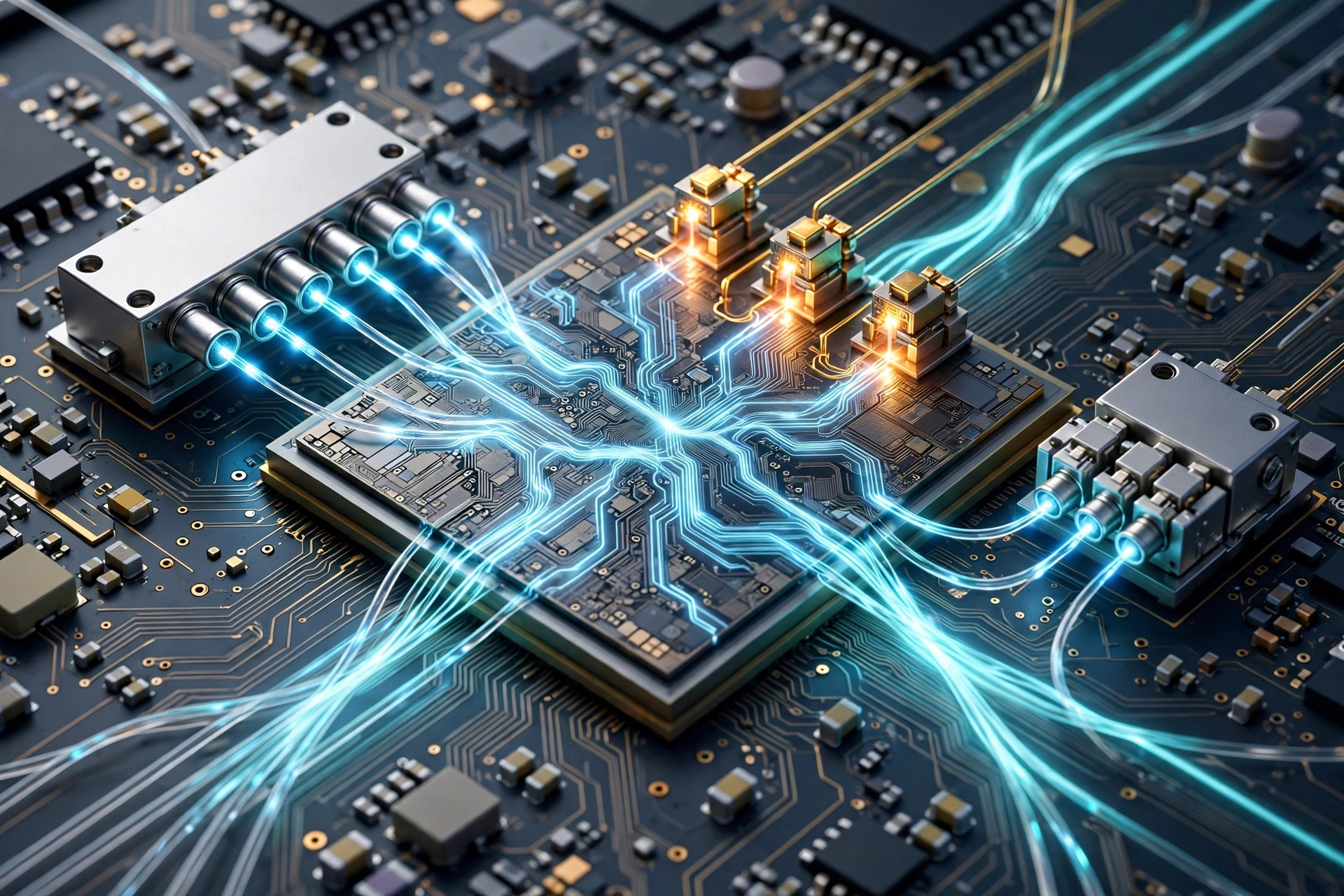
Marvell brings electrical and optical interconnect technology, network switching, custom accelerator silicon, and advanced packaging. It has spent recent years building a large custom-chip business for cloud customers, including a major August deal to supply chips alongside Google’s AI processors, and it closed a $3.5 billion purchase of Celestial AI in February 2026 to strengthen its photonics work.
Lumentum brings the light itself: high-performance lasers, optical transceivers, optical circuit switching, and specialized compound semiconductor manufacturing, including indium phosphide fabrication and high-speed, high-power laser technology. Those capabilities are harder to replicate than a standard chip design, because they depend on materials science and precision manufacturing as much as on circuit design.
Together, the companies say they will offer a portfolio spanning leading-edge CMOS, silicon photonics, compound semiconductors, advanced packaging, and manufacturing. They put the combined total addressable market at $550 billion, expect more than $1 billion in annual run-rate cost synergies, and expect the deal to be accretive to Marvell’s non-GAAP earnings per share in the first year after closing. Treat the $550 billion market figure as a company estimate, not an independent measurement: it is a statement of ambition, and it will be tested by how much AI spending actually materializes.
The Broadcom race and the Nvidia connection
Marvell is not buying Lumentum in a vacuum. Its larger rival Broadcom already offers cloud customers a broad menu of custom AI chips and networking hardware, and Reuters framed the Lumentum deal as Marvell stepping up that challenge during an AI spending boom. Owning Lumentum gives Marvell a deeper, more integrated optical story to tell customers who are planning their next generation of data centers.
Nvidia sits in the background of this deal too. Reuters reported that Nvidia invested $2 billion in each of Marvell and Lumentum earlier in 2026. That does not make Nvidia a party to the merger, and it does not guarantee that Nvidia will favor the combined company, but it underlines how central optical connectivity has become to the whole AI supply chain. Every major accelerator vendor benefits if data can move faster and cheaper between chips.
The scale of AI infrastructure demand is also visible in cloud capacity itself, as covered in our report on Google TPUs coming to Oracle Cloud for AI workloads: https://inspireviraltimes.com/google-tpus-oracle-cloud-2027-ai-workloads/
What could still stop or reshape the deal

A deal announced in 2026 and expected to close in the first half of 2028 has a long road ahead. It still needs approval from both companies’ stockholders and clearance from regulators, and Reuters noted that Marvell expects closing could extend to as late as August 2028 if regulatory approvals have not been obtained. Semiconductor deals of this size routinely attract close scrutiny, particularly where they touch supply chains spanning the United States, China, and other manufacturing hubs.
There is also a commercial risk that has little to do with regulators. Marvell has traditionally sold merchant silicon to optical transceiver manufacturers, some of which could now compete with its own Lumentum business. Managing that tension, keeping customers who are also competitors, will be one of the combined company’s first tests. Analysts quoted in coverage of the deal have flagged exactly that question: whether vertical integration helps Marvell win bigger system deals, or complicates relationships that currently generate revenue.
Finally, the AI spending boom itself is an assumption, not a guarantee. If hyperscaler capital spending slows, or if a different interconnect technology matures faster than expected, the strategic logic of paying a premium for optical capacity could look different in 2028 than it does today. Big AI acquisitions are a recurring pattern, as seen in Salesforce’s move for voice AI specialist Cresta: https://inspireviraltimes.com/salesforce-buys-cresta-voice-ai-agents-customer-service/ — but each one still has to survive integration, and most synergies are promised before they are proven.
Bottom line: a bet on optics, priced in shares
Marvell is betting that AI’s next bottleneck is not raw compute but connection, and that owning both sides of the electrical-to-optical boundary is worth $115 billion in stock. If that bet is right, the combined company could define how the largest AI clusters are wired for years. If it is wrong, or simply early, shareholders will share the cost, because the price is paid in Marvell shares, not cash.
For readers, the practical takeaway is simpler: watch the interconnect layer. Chip announcements grab headlines, and the rise of AI agents in software development, covered in our report on AI agents starting over 40 percent of GitHub pull requests: https://inspireviraltimes.com/ai-agents-40-percent-github-pull-requests-octoverse-2026/ , shows how fast AI work is changing. But underneath all of it, light is quietly replacing copper as the way AI systems think together. Marvell just placed the biggest bet yet on that shift.
Sources and further reading
- Marvell’s official announcement: https://investor.marvell.com/news-events/press-releases/detail/1040/marvell-and-lumentum-to-combine-creating-a-category-leader-in-ai-connectivity
- Reuters coverage of the deal: https://www.reuters.com/legal/transactional/marvell-buy-lumentum-115-billion-deal-ai-data-center-bet-2026-11-02/
- TechTarget analysis of the merchant-silicon question: https://www.techtarget.com/news/marvells-115-billion-lumentum-deal-tests-merchant-silicon-business/873486/