Oracle and Google have made a notable change to the AI infrastructure map. Announced on October 27, 2026, at Oracle AI World in Las Vegas, Google’s Tensor Processing Units (TPUs) will be available through Oracle Cloud Infrastructure (OCI), beginning in calendar year 2027. It is the first time Google TPUs will be offered on a hyperscale cloud platform outside Google, according to the companies. The deal does not make TPUs available on OCI today, and it does not settle pricing or regions. But it does signal where enterprise AI computing is heading: toward clouds that offer more than one kind of accelerator, so teams can match the chip to the job.
What Oracle and Google Announced
The core announcement is straightforward. OCI will provide the power, cooling, and datacenter networking needed to deploy Google TPUs at scale, while Google supplies its purpose-built accelerators. The rollout is planned for calendar year 2027 and will ramp over a multi-year period. Oracle president Mahesh Thiagarajan framed the point as choice: different AI workloads have different compute needs, and access to multiple leading architectures in one cloud lets customers choose infrastructure for performance, throughput, and economics. Google’s Amin Vahdat made a similar point, saying the next generation of AI will require a diverse range of compute. For background on how TPUs are already being tested beyond conventional data centers, see our coverage of Google’s orbital TPU test: Google’s orbital TPU test. The official announcement is here: Oracle brings Google TPUs to Oracle Cloud Infrastructure.
TPU 8t vs TPU 8i: Training vs Inference
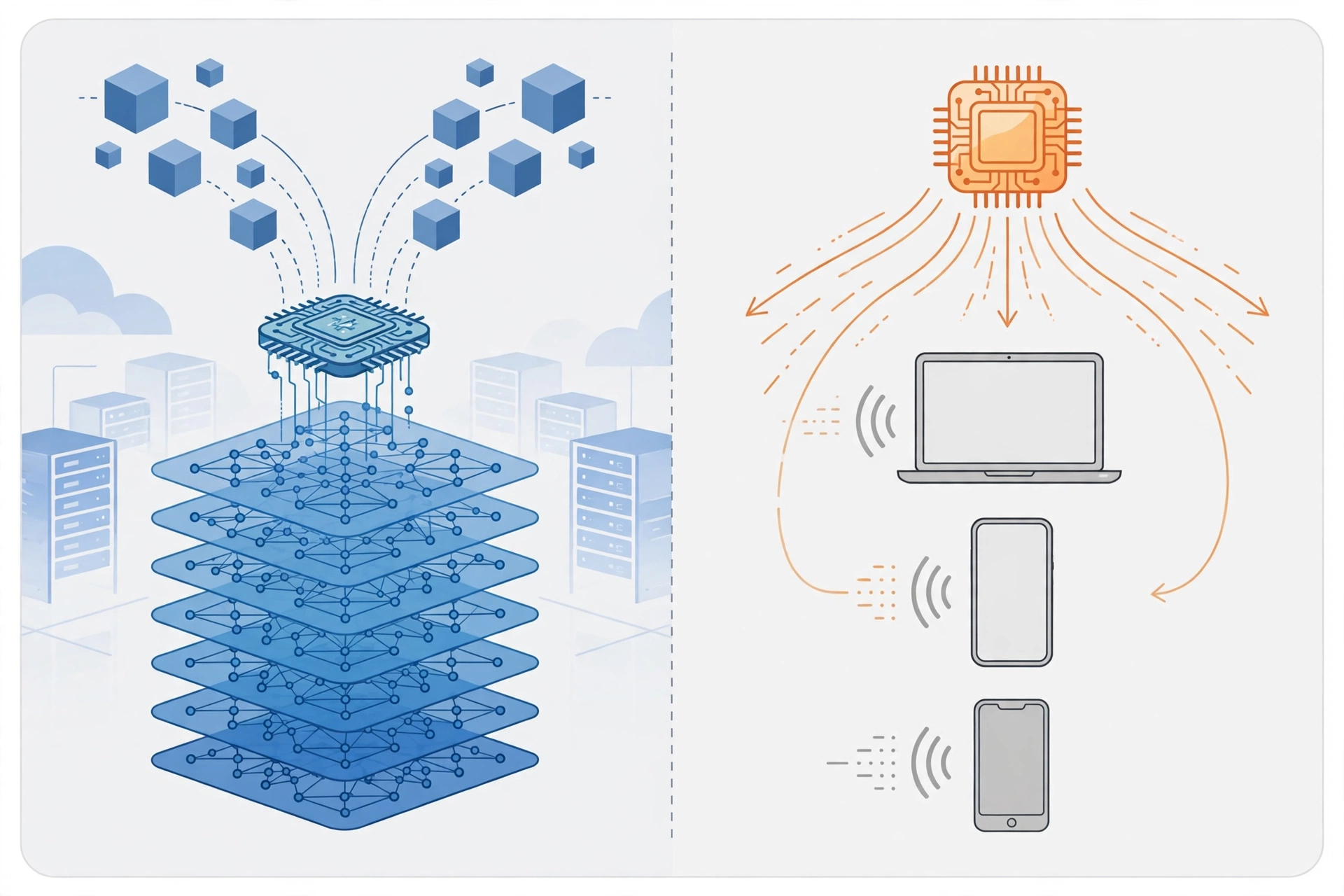
Google’s eighth-generation TPU lineup splits the work in two. TPU 8t is built for training: the large-scale process of teaching a model, including dense and mixture-of-experts models. Oracle says TPU 8t cuts frontier model development cycles from months to weeks and delivers nearly 3x the compute performance per pod over the previous generation. TPU 8i is built for inference: running a trained model to produce answers, including the iterative reasoning work of many specialized agents. That split matters because training and inference stress hardware differently. Training rewards massive, coordinated throughput across thousands of chips. Inference rewards low latency, high memory bandwidth, and efficient handling of many simultaneous requests. A cloud that offers both designs lets a team train on one architecture and serve on another without moving its whole stack to a different provider.
Why a Multi-Chip Cloud Matters
For years, the default AI accelerator conversation centered on GPUs, especially NVIDIA hardware. That is not disappearing: at the same Oracle AI World event, NVIDIA Vera Rubin NVL72 systems and Vera CPUs reached general availability on OCI. The TPU news adds a second, purpose-built path alongside GPUs. For enterprises, the practical benefit is workload matching. A company training a large internal model, running long-context agents, or serving millions of chatbot requests may not want the same chip for every task. Choice can also affect negotiations, supply resilience, and migration planning, because a team is less dependent on a single vendor’s roadmap, pricing, or availability. It also reflects how AI work itself is changing: models are no longer only trained once and forgotten. They are retrained, fine-tuned, and served continuously, so the cost of every inference request matters as much as the cost of the original training run. Related enterprise AI momentum is visible in partnerships such as the TCS and AMD collaboration on enterprise AI adoption: enterprise AI adoption.
What Is Not Ready Yet
This is where readers should stay cautious. The announcement names no OCI pricing, no initial regions, no instance shapes, and no customer names. It also does not confirm whether OCI will launch with TPU 8t, TPU 8i, or both. Other accelerator plans announced around the same event are on different timelines: Cerebras inference is planned for OCI in calendar 2027, Positron Atlas inference servers were described as generally available, while OpenAI’s Jalapeno and SambaNova’s SN50 had no announced date in the reporting. In other words, Oracle’s 2027 multi-silicon lineup is a roadmap, not a shopping list you can buy today. Treat vendor performance claims the same way: nearly 3x compute per pod is Google’s claim for TPU 8t, not an independent benchmark of an OCI service that does not yet exist. An independent summary of the multi-silicon announcements is here: Oracle builds a multi-silicon supercluster at AI World 2026.
What to Watch in 2027
The details to watch are practical, not just technical. First, which regions and instance types launch first, and whether quotas will be generous enough for production workloads or limited to pilots. Second, pricing: whether TPU capacity on OCI is priced per chip-hour, bundled with Oracle database and application services, or sold through existing Oracle Universal Credits. Third, software fit: how easily existing models, frameworks, and data pipelines move between GPU and TPU environments without a rewrite. Fourth, what Oracle’s own customers actually deploy, especially in regulated industries where Oracle databases already sit close to the data. Security teams will also be watching closely, as new AI infrastructure creates new attack surfaces alongside new defenses; see our report on Google’s cybersecurity-focused AI model for that angle: cybersecurity-focused AI model. HPCwire’s republication of the announcement is a useful cross-check: Oracle brings Google TPUs to Oracle Cloud Infrastructure.

Bottom Line
Google TPUs on Oracle Cloud will not change anyone’s AI stack overnight. The service is planned for 2027, key commercial details are still unannounced, and GPUs remain central to Oracle’s AI lineup. What the announcement does change is the shape of choice: for the first time, a hyperscale cloud outside Google will offer TPUs, giving enterprises a credible second accelerator family in the same cloud where many already run databases and business applications. If Oracle delivers competitive pricing, broad regions, and smooth software support, TPUs on OCI could become a serious option for training and inference alike. If it launches narrowly or expensively, it will remain an interesting announcement rather than a turning point. Either way, 2027 will be the year to judge it.