Artificial intelligence can forecast storms, spot vulnerable communities and squeeze waste out of power grids. It can also eat electricity at a scale that would have sounded absurd a few years ago. That contradiction was the centre of attention in Antalya, Türkiye, on November 16, 2026, when the COP31 Presidency and the International Telecommunication Union (ITU) launched the Antalya Artificial Intelligence Pledge — a voluntary commitment to make AI itself more sustainable, backed by 80 endorsements and 271 commitments on its first morning.
The pledge is not a treaty and not a law. It is a framework that governments, companies, researchers and civil society groups can sign up to, promising measurable action on the environmental cost of building and running AI. And it arrives at a moment when the industry’s energy appetite has become impossible to ignore. ITU Deputy Secretary-General Tomas Lamanauskas warned at the launch that energy consumption from the data centres powering AI is expected to double by 2030, and that some technology companies have already seen their emissions rise by 50 per cent in recent years.
Why AI’s footprint is suddenly on the climate agenda
The numbers behind the pledge are stark. Writing ahead of COP31, Lamanauskas pointed to a recent UN study: by 2030, the data centres powering AI growth could consume nearly 945 terawatt-hours of electricity a year — almost triple the combined electricity use of Nigeria, Pakistan and Bangladesh. The water needed to cool those centres could meet the domestic needs of 1.3 billion people a year. And the physical infrastructure supporting AI globally could sprawl across 14,500 square kilometres, more than 24 times the size of the San Francisco area.
That growth is visible in the building boom itself. Google’s $17 billion Wyoming data center and SpaceX’s $74 billion AI supercomputing campuses are only the largest examples of a global race to add computing capacity, and every one of those facilities needs power, water and land. The pledge’s supporters argue that AI’s climate story has two sides, and the ledger needs both: the same technology that guzzles power is also one of the best tools we have for cutting emissions elsewhere.
The four pillars of the Antalya AI Pledge
The pledge asks signatories to act in four areas, laid out in the ITU’s official press release. The first is the most direct: power and build AI infrastructure sustainably, using more low- and zero-emission electricity, improving energy and water efficiency, and plugging AI facilities into sustainable power grids. The second covers the full lifecycle of AI systems — designing, managing and buying them with their whole lifespan in mind, using internationally recognised sustainability standards and tackling electronic waste and hardware reuse.
The third pillar is about honesty in measurement. Signatories are asked to assess and report the environmental impact of their AI systems using standardised methods, so claims about “green AI” can be checked rather than taken on trust. The ITU says its standards will back this up, including what it describes as the world’s first international guidelines for measuring AI’s full environmental footprint, published as ITU-T L.1801 in 2026. The fourth pillar asks signatories to support AI for climate action in developing countries, least developed countries and small island developing states — the places with the least access to data, computing capacity and finance, and often the most to lose from a warming planet.
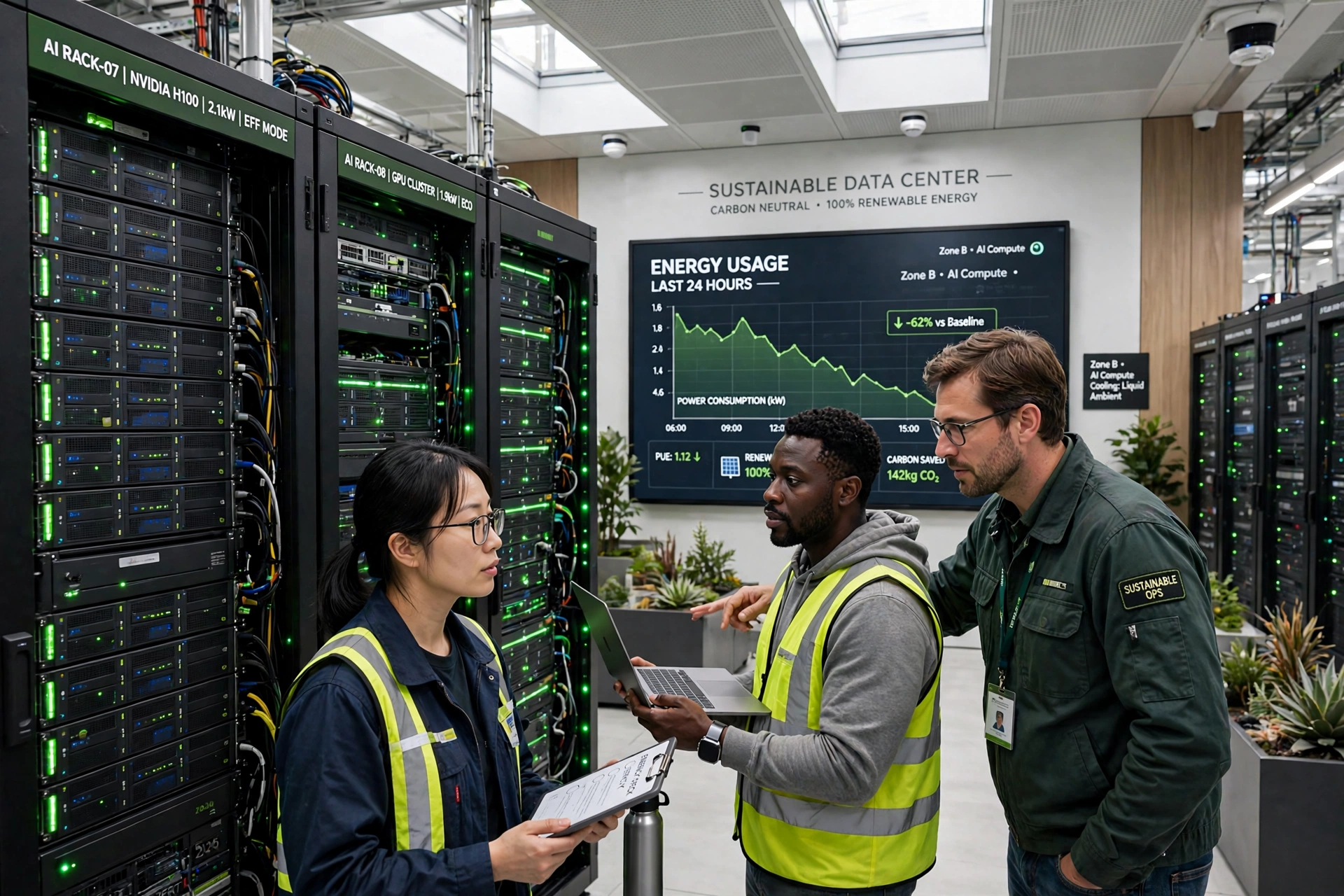
The numbers behind the pledge
The case for acting now rests on a simple imbalance. An analysis presented by the ITU and UN Climate Change found that 74 per cent of national climate plans mention digital solutions — but only four out of 140 address the environmental impact of the digital sector itself. In other words, almost every country plans to use digital tools against climate change, while almost none has a plan for the footprint of those tools.
The upside is real, and the pledge’s backers are keen to stress it. According to the London School of Economics, AI applied effectively could reduce global greenhouse gas emissions by 3.2 billion tonnes of carbon-dioxide equivalent a year by 2035 — roughly the European Union’s total annual emissions. That is the prize: models that design better batteries, optimise grids and predict disasters, like the research agents NVIDIA’s Nemotron for Science is built to support. But the prize only counts if the cost of running those models does not cancel it out.
Efficiency is part of the answer. Cheaper, leaner models such as Tencent’s cheaper Hy4 Flash model show that capable AI does not have to mean maximum-size AI, and the pledge’s lifecycle pillar pushes the industry in exactly that direction: smaller, better-measured models, run on cleaner power, with hardware that gets reused instead of scrapped.

What happens next — and why it might actually stick
Voluntary pledges have a poor reputation in climate politics, and the ITU is not pretending otherwise. Lamanauskas stressed at the launch that the real test of the Antalya Pledge is implementation, with the ITU committing to track progress and hold participants accountable. Progress will be tracked annually at the UN climate conferences through 2030, and endorsers will be invited after COP31 to work on implementation through Green Digital Action, an initiative that brings partners together around digital technology and climate action.
There are early signs of follow-through beyond the pledge itself. The ITU and UN-Habitat launched a Call to Action for resilient cities centred on digital innovation, the ITU signed a memorandum of understanding with UN Climate Change on Green Digital Action, and an AI Climate Institute was launched with support from the ITU, UNESCO and Brazil’s National Telecommunications Agency, Anatel, to help countries build the skills and institutions to apply AI to climate work. COP31 President Murat Kurum put it bluntly at the launch: “Industry and technology must be part of the climate solution.”
For the tech industry, the practical consequence is transparency. If standardised reporting of AI’s environmental footprint becomes the norm, companies will have to say — in comparable numbers — how much energy and water their models use. That is the kind of sunlight that changes procurement decisions, data centre siting and model design. The Antalya Pledge will not transform the tech sector overnight, as Lamanauskas himself acknowledged. But it is the first time the world’s governments and the UN’s digital agency have agreed, in one document, that AI’s own footprint is a climate problem worth measuring — and worth fixing. The hidden costs of AI are finally part of the official conversation.
Frequently asked questions
What is the Antalya AI Pledge?
A voluntary commitment launched on November 16, 2026, at COP31 in Antalya, Türkiye, by the COP31 Presidency and the ITU. Signatories promise measurable action to reduce AI’s environmental footprint across energy, hardware lifecycles, reporting and support for developing countries.
How many organisations have signed it?
By the morning of the launch, the pledge had attracted 80 endorsements and 271 commitments from governments, companies, research institutions and civil society organisations, according to UN News.
Is the pledge legally binding?
No. It is voluntary and non-prescriptive. Its accountability mechanism is annual progress tracking at the UN climate conferences through 2030, with implementation support through Green Digital Action and the ITU’s standards.
How much energy could AI data centres use by 2030?
Nearly 945 terawatt-hours a year, according to a UN study cited by the ITU — almost triple the combined electricity use of Nigeria, Pakistan and Bangladesh — with cooling water demand that could meet the domestic needs of 1.3 billion people.
How can AI help the climate?
The London School of Economics estimates AI could cut global greenhouse gas emissions by 3.2 billion tonnes of CO2 equivalent a year by 2035 if applied effectively — about the same as the EU’s total annual emissions. The ITU’s AI for Good page explains how the pledge links that potential to sustainability.