Anthropic told investors something this week that the chip industry will be arguing about for months: its own AI model moved Claude onto AMD hardware in about three days. The job — the fiddly, expert software work of making a frontier model run on a new kind of chip — used to take dozens of engineers six to twelve months. This time, according to Anthropic, the model did almost all of it itself, with “basically no human intervention.”
The claim landed in Anthropic’s IPO roadshow video, released on November 10, 2026, as the company heads toward a public listing. It is the kind of number that sounds too good to be true, and the honest version of the story is more interesting than the headline: the three days are real, but they cover a narrower slice of the work than the headline suggests. Here is what Anthropic actually said, what the fine print says, and why it still matters. The full materials are on Anthropic’s IPO roadshow site.
What Anthropic Actually Told Investors
The claim comes from Tom Brown, Anthropic’s co-founder and chief compute officer, in the compute chapter of the company’s 42-minute IPO roadshow video. Anthropic started using AMD GPUs for the first time this year, Brown said, and the old way of bringing up a new chip platform meant dozens of engineers working for months. This time, he told investors, the company “had Mythos try it out.”
His words, as quoted in the roadshow: Mythos “got Claude running on AMD in just three days with basically no human intervention. Claude ported or wrote almost 100% of the kernels.”
The context is Anthropic’s IPO roadshow, which went live on November 10 with 825 million Class A shares priced at an expected $70 to $78, listing on Nasdaq under the ticker ANT. The amended prospectus filed the same day makes the same point in writing: the company says it can now onboard new chip platforms “in a fraction of the time it once took.” That is the claim in its official form — made to investors, in a filing, days before a listing. It is not a chipmaker’s marketing slide, and that distinction is doing a lot of work here, because Anthropic buys chips rather than selling them.
The Three-Day Claim, in Plain English
To understand why three days is a big deal, you need to know what a kernel is. Kernels are the low-level programs that tie a model to a specific vendor’s silicon. Every time a model does a calculation — a matrix multiplication, an attention step — a kernel tells the chip exactly how to do it. Writing good kernels for a new chip used to be a specialist craft: months of work by engineers who understood both the model and the hardware at a deep level.
That craft is also the heart of NVIDIA’s moat. For nearly two decades, NVIDIA’s CUDA software stack has been the reason AI developers default to NVIDIA hardware: the kernels, libraries and tooling are mature, and moving to another vendor meant rewriting much of that software by hand. AMD’s equivalent stack is ROCm, with HIP as the programming layer and HIPify as the conversion tool — capable, but historically the reason teams stayed on CUDA.
What Mythos did, according to Anthropic, was port or write almost 100% of those kernels itself, in about three days. It is the same class of work that AMD has been arguing AI can do for over a year: AMD researchers published GEAK, a kernel-writing agent, in August 2025; its AI software chief said in April that Claude beats HIPify because it has web search built in; and in July, AMD’s AI chief reported that AI-generated kernels were sometimes better than the most carefully hand-tuned versions.
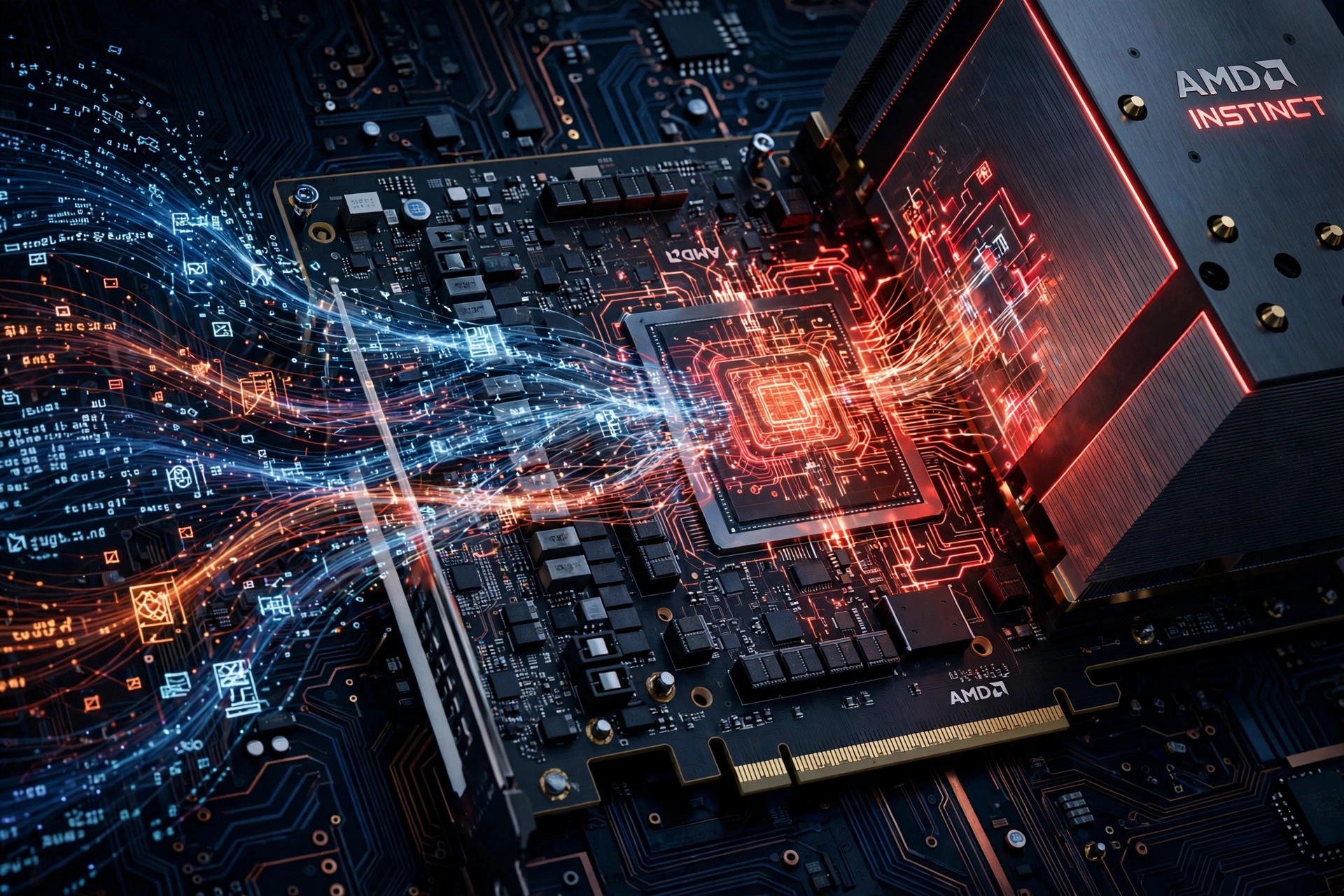
Why Kernels Are NVIDIA’s Moat — and Why This Chips at It
If an AI model can write the software that lets it run on a new chip in days instead of months, the switching cost between chip vendors collapses. That is the strategic point of Anthropic’s claim, and it is why the story travelled so fast.
SemiAnalysis made the argument in July that kernel software is no longer the moat it once was — with one catch. Every agent that writes kernels needs real GPUs to test against, and supply of test silicon may become the new bottleneck. In other words, the constraint moves from writing code to getting hardware to try it on.
NVIDIA’s chief executive, Jensen Huang, pushed back in April, saying his company already uses plenty of AI to create its own kernels and calling Anthropic a unique instance rather than a trend. He has a point worth taking seriously: one company doing this once is a demonstration, not yet a pattern. But it is also worth noting who is on the other side of the trade. NVIDIA is simultaneously among the seven companies buying $26 billion of Anthropic stock at the IPO price. The chipmaker whose moat is supposedly under threat is also one of the biggest buyers of the company making the claim. For another angle on NVIDIA’s open research, see NVIDIA’s Nemotron for Science.
The Footnote: What the Three Days Do Not Cover
Here is the part the headlines mostly skipped. The slide in Anthropic’s roadshow video carries a footnote, and it narrows the claim considerably. The roughly three days, the footnote says, reflect the approximate time for Claude Mythos Preview to bring up prompt processing — the prefill step, where a model reads and processes what it has been given before it starts replying — for one Anthropic model on AMD MI355X GPUs, “at a useful level of performance.”
What that leaves out matters:
- Decode is unaddressed. Anthropic has said nothing about the replying step, the part of inference that dominates cost in production serving.
- It is one model, one task. The claim covers prompt processing for a single model, not training, not full production serving, and not the whole Claude family.
- There is no speed comparison. Anthropic published no throughput or latency numbers, and no AMD-versus-NVIDIA benchmark. “Running at a useful level of performance” is not the same as running fast.
- The baseline is Anthropic’s own history. The six-to-twelve-month figure is the company’s estimate from its own past experience bringing up new accelerators, not an independent measurement.
None of that makes the claim false. It makes it specific. A three-day prefill bring-up with almost no human help is still a striking result — it just is not the same as “Claude now runs on AMD, end of story.”
Why Anthropic’s Word Carries Weight Here
There is a reason this claim landed harder than similar ones from chipmakers. Anthropic is a buyer, not a seller, of compute. It runs its models on NVIDIA GPUs, AMD GPUs, Google TPUs and AWS Trainium, managed as one fungible pool of compute, and it holds an agreement with AMD for up to 2 gigawatts of capacity. A company in that position has no reason to flatter AMD’s hardware — it needs the hardware to actually work, because its own models depend on it.
The model behind the claim is also now public. Anthropic’s announcement of Claude Fable 5.2 and Mythos 5.2 describes the pair as its most capable models for daunting technical work, with Fable carrying cybersecurity and biology safeguards for general use while Mythos is available to vetted organizations through verification programs. The new models generate outputs up to 30% faster than their 5.1 predecessors, cost $8 per million input tokens and $40 per million output tokens, and post strong results on agentic coding (49.1% on FrontierCode 2.0 at Xhigh effort) and cybersecurity (89.6% on CVE rediscovery for Mythos 5.2). A team of 1,000 Fable 5.2 agents formalized Fermat’s Last Theorem in 30 hours. The model that ported itself to AMD is, in other words, the same model Anthropic is selling as its flagship for hard technical work. For Anthropic’s fastest, cheapest option, see Claude Haiku 5.5.
What Happens Next: Helios Racks and the 2 GW AMD Deal
The real test of the three-day claim comes in the first half of 2027, when Anthropic’s first AMD MI450-based Helios racks are expected to arrive. That will show whether the three-day bring-up repeats on new silicon, at production scale, with real workloads — or whether MI355X was a one-off. That follows AMD’s Instinct MI450X launch, which set the stage for these MI450-based systems.
Anthropic’s agreement with AMD for up to 2 gigawatts of capacity is the commercial backdrop. Two gigawatts is an enormous amount of compute, and it only makes sense if Anthropic believes AMD hardware can carry a serious share of its training and serving load. The three-day onboarding story is, in that light, less a boast than a justification: here is why we are confident betting this much capacity on a second chip vendor.
Watch also for what AMD does next. If other frontier labs repeat the trick — and AMD’s own kernel-writing research suggests they can — the test-silicon bottleneck SemiAnalysis flagged becomes the thing to watch. The companies that can get early hardware into developers’ hands will set the pace.
What This Means for Developers and Buyers
For most developers, nothing changes tomorrow. Your Claude API calls will not suddenly run on AMD, and Anthropic has not announced any change to pricing or availability tied to this. But the direction of travel is clear, and it has three practical consequences.
First, multi-vendor AI infrastructure is becoming real rather than theoretical. Anthropic now trains and serves across four chip families, and if onboarding a new one takes days, the cost of adding a fifth falls too. Second, the CUDA lock-in argument is weakening at the margin — not gone, but no longer the whole story. Third, the skill that mattered most in GPU software — hand-writing kernels — is itself being automated, which is a strange and fitting turn: the models are now doing the work that used to keep them tied to one vendor.
The honest summary is this: Anthropic’s model did in three days what used to take a team of dozens the better part of a year, for one model, for one stage of the work, on one chip. That is a narrower claim than the headline — and still one of the most consequential AI infrastructure stories of the year. The wider race is also moving fast, as seen with OpenAI’s GPT-5.2.
Frequently Asked Questions
What is Claude Mythos?
Claude Mythos is Anthropic’s most capable model family for cybersecurity, science and hard technical work, paired with Claude Fable, which carries safeguards for general use. Mythos 5.2, announced on November 9, 2026, is available to organizations through Anthropic’s Cyber and Life Sciences Verification Programs.
What are GPU kernels, and why do they matter?
Kernels are low-level programs that tell a specific chip how to perform each calculation a model needs. Writing them has traditionally been expert, months-long work — and it is a major reason AI developers have stayed on NVIDIA’s CUDA platform.
Did Claude really port itself to AMD in three days?
According to Anthropic’s IPO roadshow, Claude Mythos Preview brought up prompt processing for one model on AMD MI355X GPUs in about three days, porting or writing almost 100% of the kernels, with basically no human intervention. The slide footnote limits the claim to prefill for one model; decode, training and production serving were not covered.
How long did this work used to take?
Anthropic says bringing up a new chip platform traditionally took dozens of engineers six to twelve months. That baseline comes from the company’s own historical experience, not an independent measurement.
What is AMD ROCm?
ROCm is AMD’s open software stack for GPU computing, the counterpart to NVIDIA’s CUDA. It includes HIP, the programming layer, and HIPify, a tool for converting CUDA code. You can read more on AMD’s ROCm software stack hub.
When will Anthropic’s AMD hardware go live?
Anthropic’s first AMD MI450-based Helios racks are expected in the first half of 2027, under an agreement with AMD for up to 2 gigawatts of capacity. That deployment will test whether the three-day bring-up repeats at production scale.