The Solomon Islands has signed a landmark security treaty with Australia, declaring it will never allow a foreign military base on its soil and naming Canberra as its primary security partner — a decisive shift in the contest for influence across the South Pacific.
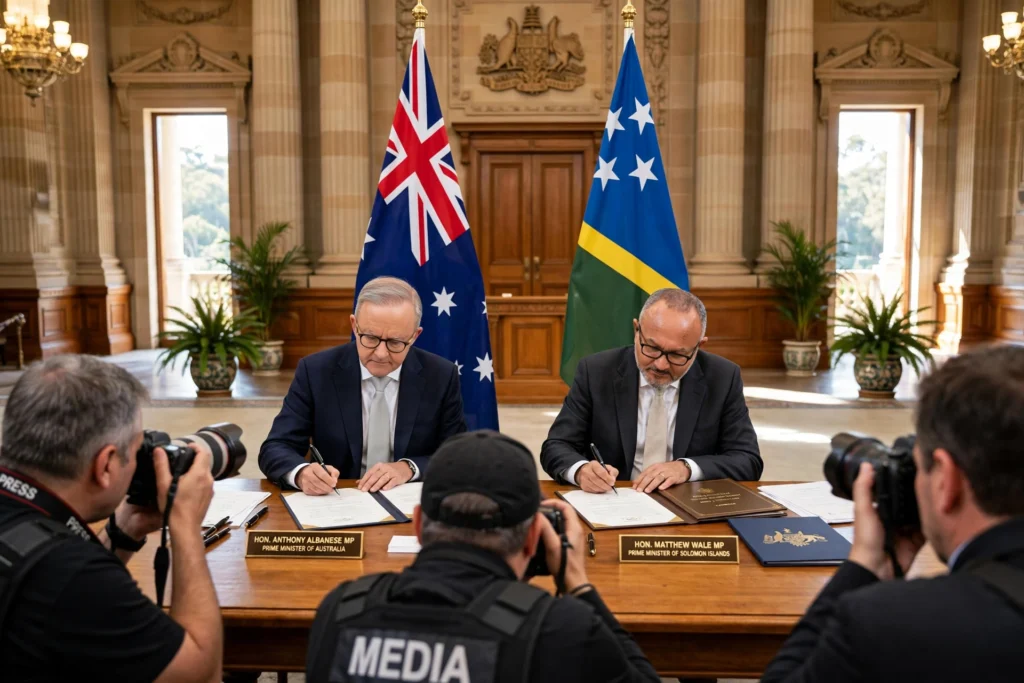
Prime Ministers Matthew Wale of Solomon Islands and Anthony Albanese of Australia signed the Australia-Solomon Islands Treaty in Canberra on Wednesday, November 25, 2026. The agreement, negotiated in a matter of months since Wale took office in May, replaces a secretive 2022 security deal with China that had raised fears of a Chinese naval foothold in the region.
“Solomon Islands has been for a number of years a source of uncertainty and doubt in the region. Those days are done,” Wale said at a joint press conference in Canberra.
A Treaty That Reshapes Pacific Security
Under the treaty, Australia will support the expansion and development of a stronger, modern and self-reliant Royal Solomon Islands Police Force, and help develop the country’s border management system. Honiara has agreed to consult Canberra on the development of critical infrastructure, and to look to fellow Pacific Islands Forum members for future security cooperation needs.
Crucially, the treaty states that there will be no foreign military or security base in Solomon Islands, and that the nation’s sensitive infrastructure will remain free from militarisation, foreign interference and unauthorised access. Australia and Solomon Islands said the agreement “affirms Solomon Islands’ sovereignty and capacity to determine its own security needs and partnerships” and “reflects Solomon Islands’ sovereign choice of Australia as its primary security partner.”
“Australia is proud to be the Solomon Islands’ main security partner, and that’s a responsibility that we take seriously,” Albanese said at the press conference.
What Australia Is Offering
The treaty reaches well beyond security. Australia will spend 740 million Australian dollars over the next decade on a package of initiatives for the Pacific neighbour — 670 million dollars in grants and 70 million dollars in loans — covering infrastructure, education, renewable energy and sport.
The funding includes substantial support for the Solomon Islands Government’s free education policy, so that every child can complete school from kindergarten through Year 12, along with budget support to help Honiara invest in its communities and increased investment in sustainable infrastructure, including roads and renewable energy.
Solomon Islanders will also benefit from improved visa arrangements with Australia, including longer stay periods, extended visa validity and in-country visa facilitation in Honiara. Under a “PALM Plus” approach, Australia will expand Solomon Islands’ participation in the Pacific Australia Labour Mobility scheme, opening new opportunities in early childhood and aged care work and increasing skills training.
The End of the China Security Pact
The treaty marks a sharp break from the 2022 security pact Solomon Islands signed with China under Wale’s predecessor — a deal whose secrecy alarmed Australia, the United States and other Pacific nations, who feared it could open the way to a Chinese naval base roughly 2,000 kilometres (1,200 miles) northeast of Australia, astride the sea route between the United States and Australia. For wider context on China’s growing reach, Pakistan’s first astronaut reached orbit aboard China’s Shenzhou-24 this week.
Wale, a long-time critic of the China deal, said in June that he would review the 2022 pact. Australian media reported on Wednesday that the China pact had been scrapped and would not be renewed when it expires after five years in early 2027, though Wale declined to confirm or deny the reports at the press conference, citing a non-disclosure clause in the treaty with China. A spokesperson for China’s foreign ministry did not immediately respond to a request for comment.
Why the Pacific Is Watching
The deal is the latest in a string of bilateral security pacts Australia has struck with Pacific neighbours as Beijing’s influence grows — Canberra recently signed similar agreements with Papua New Guinea, Vanuatu and Fiji. But analysts say this one goes further.
“I think this deal, coupled with indications that Solomon Islands will let the China deal lapse, goes beyond the success of the previous deals,” said Connor Graham, a research fellow in the Pacific Islands program at the Sydney-based Lowy Institute. “It is a blow to Chinese security ambitions in the Pacific certainly.”
The treaty still needs to be ratified by both parliaments before it takes effect. If it clears that hurdle, it will close one of the most closely watched chapters in Pacific geopolitics — and confirm that the archipelago that once hosted General Douglas MacArthur’s Pacific campaign headquarters in World War II will not host a foreign base in the decades ahead.
Related coverage: the COP31 climate summit collapsed in Antalya; the EU and Indonesia signed a landmark trade deal; and Western intelligence has warned Russia could launch a nuclear-armed satellite.