
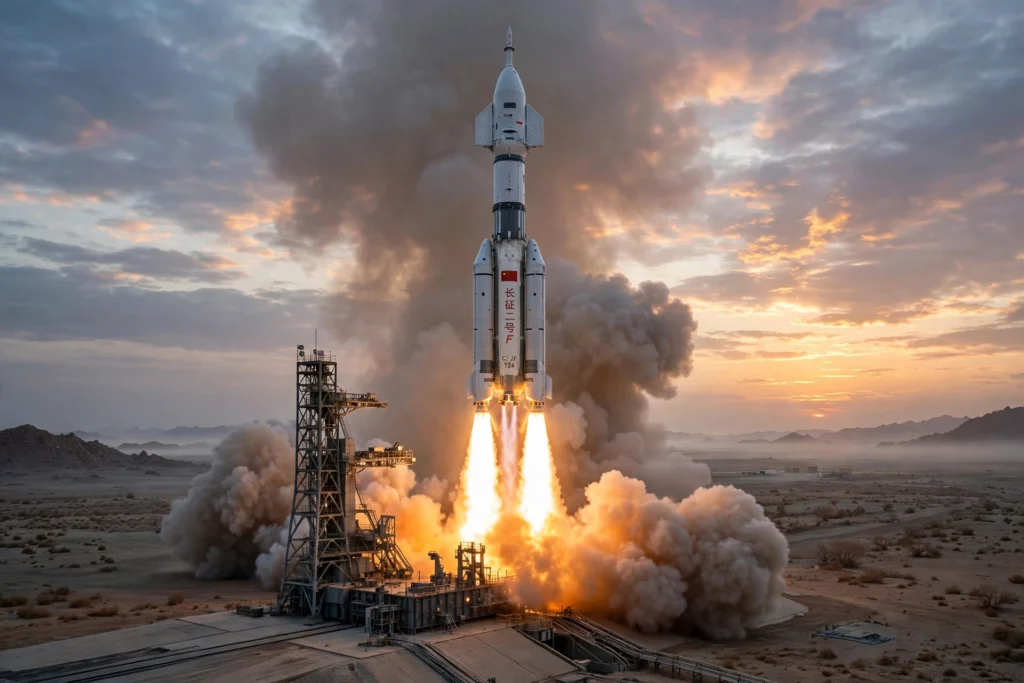
Pakistan has a man in orbit for the first time. China’s Shenzhou-24 spacecraft lifted off before dawn on Wednesday, November 25, 2026, and docked with the Tiangong space station a few hours later, carrying Pakistani payload specialist Muhammad Zeeshan Ali alongside two Chinese astronauts. Ali is the first Pakistani to reach orbit — and the first foreign astronaut ever to visit Tiangong — in a flight that turns China’s space station into a stage for international diplomacy.
A Dawn Launch From the Gobi Desert
The Shenzhou-24 spacecraft, atop a Long March 2F carrier rocket, blasted off from the Jiuquan Satellite Launch Center in northwest China at 8:18 a.m. Beijing time on Wednesday — 00:18 GMT, or 7:18 p.m. Tuesday on the US East Coast.
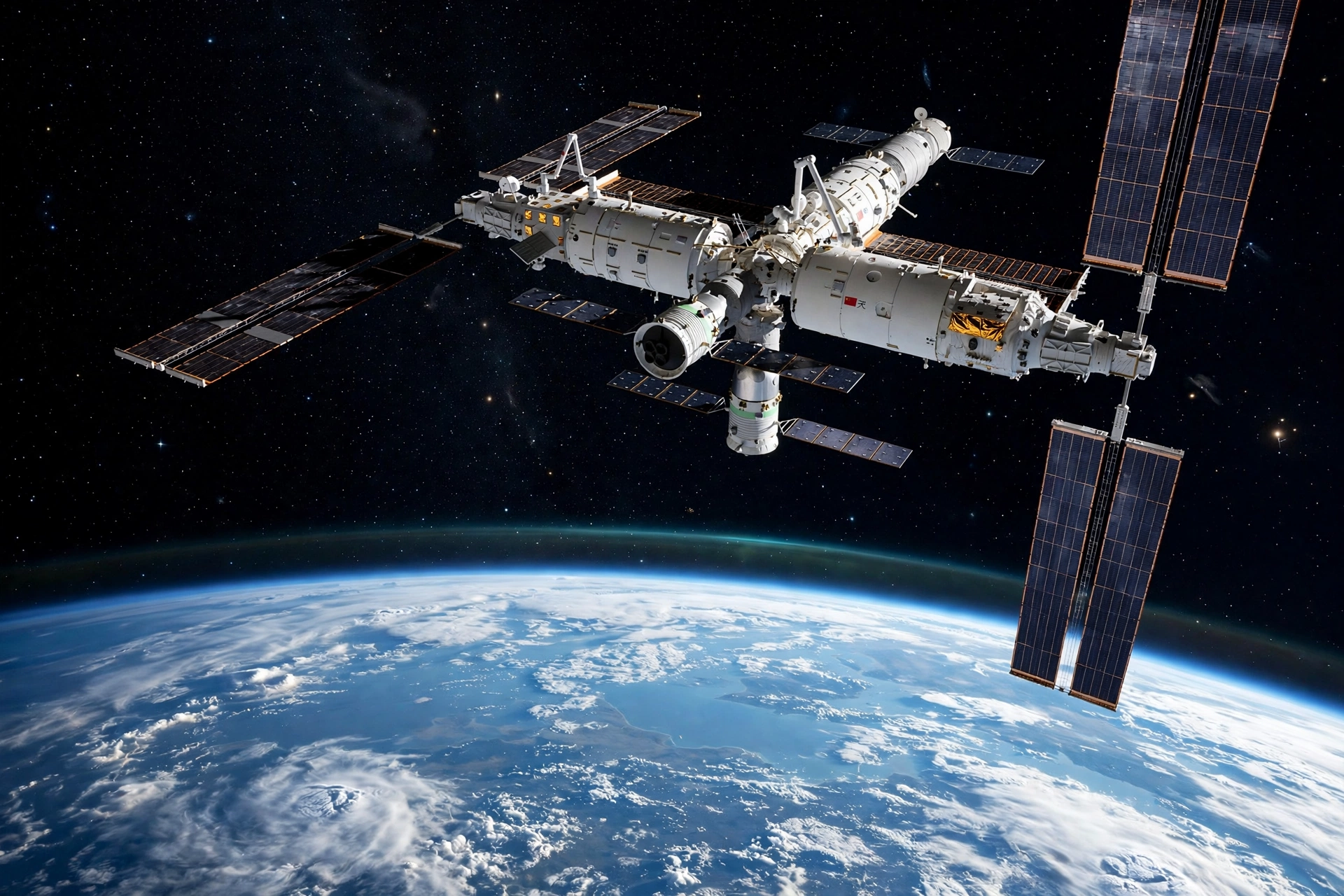
The spacecraft docked with Tiangong at 11:56 a.m. Beijing time, roughly three and a half hours after liftoff, joining the station at its Tianhe module. It was the 18th crewed Chinese spaceflight and the 24th flight of the Shenzhou program overall.
The mission is the first joint flight of Chinese and foreign astronauts in the history of China’s crewed space program, according to the China Manned Space Agency, which announced the crew a day before launch.
Who Is Muhammad Zeeshan Ali?
Ali, 40, is a former Pakistani Air Force pilot who was selected for the mission through a cooperation agreement between China and Pakistan. He will work as a payload specialist and is set to stay at the station for five to ten days, conducting experiments.
To prepare for the flight, Ali trained for seven months in Beijing, where he took intensive Chinese-language classes, learned Chinese songs, read Chinese poetry, practised calligraphy and played table tennis.
“I’m not flying for myself. I carry the name of Pakistan on my shoulder,” Ali told reporters on Tuesday, before the launch.
Back home, the flight was cause for huge celebration. “This is not just one astronaut’s journey, but the journey of 240 million Pakistanis. It is the journey of our younger generation, our scientists and our dreams,” Pakistani Prime Minister Shehbaz Sharif said in a post on X. “This is living proof of the ironclad friendship between Pakistan and China. We are grateful to our brother country, China, for making Pakistan part of this historic mission.”
Ali himself framed the flight as a beginning rather than an end. “This mission is not a finish line; it is a launchpad,” he said, adding that he hoped the next chapter of China-Pakistan space cooperation would grow “from one astronaut and one flight to multiple joint flights to the moon, Mars and beyond.”
A First for Tiangong — and for China
Ali is accompanied by mission commander Tang Hongbo and flight engineer Wu Yi. Tang, who previously flew on Shenzhou-12 and Shenzhou-17, is about to become the first astronaut to visit Tiangong three times. Wu, from China’s third batch of astronauts, is making his first spaceflight.
“Although we come from different countries, our dreams of looking up at the stars are connected,” Tang said at a media briefing before the flight. “Space belongs to all humanity, and exploring the universe is our shared dream.”
This handover will be different from previous ones. Tiangong has been fully operational since late 2022 and can host up to six astronauts when an arriving crew overlaps with a departing one. But this time, Shenzhou-23 commander Zhu Yangzhu will stay on after his crewmates leave, to support Beijing’s study of how the human body copes in space — research China sees as a crucial step towards a planned crewed mission to the moon. By the time he leaves, Zhu will hold the record for the longest single stay in orbit by a Chinese astronaut, about a year.
Ali will return to Earth together with two Shenzhou-23 astronauts, Zhang Zhiyuan and Li Jiaying, aboard the Shenzhou-23 spacecraft.
Ninety Experiments and a Week of Science
More than 90 scientific experiments and technology tests are planned for the Shenzhou-24 mission, covering space life sciences, space material science, microgravity fluid physics and combustion science, fundamental physics, space medicine and new space technologies.
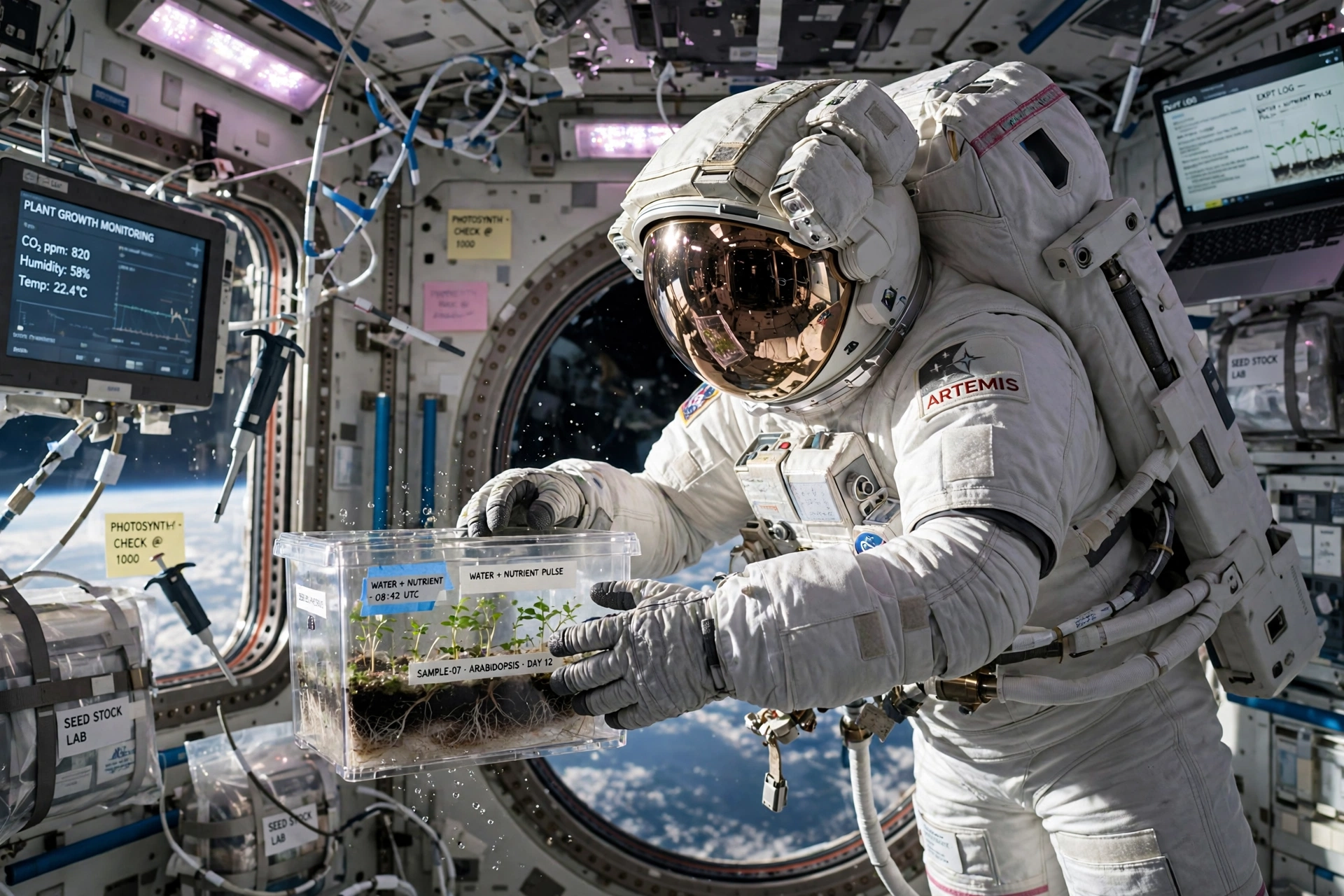
In orbit, Ali will join in the crew’s routine work and focus on joint China-Pakistan space science experiments, including installing experiment samples and carrying out in-orbit tests. Four cooperative projects in biotechnology and materials will be conducted during the mission, and Ali will run an in-orbit experiment on photosynthetic cyanobacteria.
He will also help conduct an experiment looking at how self-healing carbon fibre composites can automatically repair small cracks in spacecraft — research with obvious value for future long-duration missions.
Other work planned for the mission includes building vascular chips and multi-type organ chips to explore how the space environment affects processes such as vascular ageing, optical-lattice quantum simulation experiments, and key tests on a chem-electric hybrid propulsion system using new ionic liquid propellants.
Space Diplomacy in Orbit
The flight lands at a symbolic moment: China and Pakistan are marking the 75th anniversary of diplomatic relations this year, and Pakistan is described by Beijing as its all-weather strategic cooperative partner. The China Manned Space Agency called the mission a landmark achievement in bilateral cooperation.
Space cooperation between the two countries dates back to the early 1990s. China has launched Pakistani satellites, and a Pakistani-built rover is set to fly on a Chinese lunar mission around 2028. Speaking at the launch site, Pakistan’s development minister Ahsan Iqbal said he hoped the flight marked the start of further space cooperation with China, including potentially a joint lunar mission.
“This shows the way forward how developing countries can cooperate to have capability in areas which are very critical for future economic development,” Iqbal said.
China is promoting Tiangong — “Celestial Palace” in Chinese — as a hub for international cooperation while the NASA-led International Space Station faces possible retirement by 2030. The flight also comes in a year of landmark deals between major economies, after the EU and Indonesia signed a landmark trade deal following a decade of talks. Beijing says it looks forward to working with more countries and regions to explore the universe and peacefully use outer space. The message is not only scientific: with space becoming a new arena of great-power rivalry — Western intelligence has warned that Russia could launch a nuclear-armed satellite within weeks — China is using Tiangong to show that its station is open for partners, not just for its own astronauts. Private companies are reaching for orbit too: Google has booked Blue Origin’s New Glenn rocket to launch AI data centers into space in 2029.
The New Race for the Moon
The Shenzhou-24 mission also sits inside a much bigger contest. China’s goal of human presence on the moon by 2030 remains unchanged, even after its Chang’e-7 lunar mission failed to meet launch conditions this year amid adverse weather linked to a tropical storm. China plans to establish a research base on the moon by 2035, together with Russia.
That compares with a US target of 2028 to return humans to the moon, amid a tense race for a moon base — a stepping stone to eventual human exploration of Mars. Washington has warned that Beijing could seek to dominate access to resource-rich areas of the moon. Beijing rejects such allegations, saying it advocates the peaceful use of outer space.
What Happens Next
Ali’s stay aboard Tiangong will last five to ten days, after which he returns to Earth on Shenzhou-23 with Zhang Zhiyuan and Li Jiaying. The rest of the Shenzhou-24 crew — Tang Hongbo and Wu Yi — will remain aboard for the usual months-long rotation, carrying out station maintenance, public outreach and the mission’s full experiment programme.
For Pakistan, the flight is already a national milestone: a pilot turned astronaut in what Ali himself called “a remarkably short span of time,” now working in orbit. For China, it is proof that Tiangong can do something the International Space Station has done for decades — host a guest from another country — and do it on Beijing’s terms. Whether other nations follow Pakistan’s path to Tiangong will be the next test of China’s space diplomacy.
Frequently Asked Questions
Who is the first Pakistani astronaut?
Muhammad Zeeshan Ali, a 40-year-old former Pakistani Air Force pilot. He flew to China’s Tiangong space station aboard Shenzhou-24 on November 25, 2026, as a payload specialist, becoming the first Pakistani — and the first foreign astronaut — to visit the station.
How long will Muhammad Zeeshan Ali stay in space?
He is set to stay aboard Tiangong for five to ten days, conducting joint China-Pakistan science experiments, before returning to Earth aboard the Shenzhou-23 spacecraft with two Chinese astronauts.
Who else is on the Shenzhou-24 crew?
Mission commander Tang Hongbo, who is visiting Tiangong for a third time — a first for any astronaut — and flight engineer Wu Yi, who is making his first spaceflight.
What experiments will the crew carry out?
More than 90 scientific experiments and technology tests are planned, including four joint China-Pakistan projects in biotechnology and materials, an experiment on photosynthetic cyanobacteria, and tests of self-healing carbon fibre composites that can repair small cracks in spacecraft.
Why is this flight significant for China and Pakistan?
It is the first joint flight of Chinese and foreign astronauts in China’s crewed space program, it comes as the two countries mark 75 years of diplomatic relations, and it showcases Tiangong as a hub for international cooperation as the International Space Station nears possible retirement by 2030.
Sources
- Reuters (via 979weve): https://979weve.com/2026/11/24/chinas-shenzhou-24-space-flight-takes-off-with-pakistani-national-as-first-foreign-astronaut/
- People’s Daily (Xinhua): https://peoplesdaily.pdnews.cn/china/er/30053629812
- Wikipedia — Shenzhou 24: https://en.wikipedia.org/wiki/Shenzhou_24