
Google is taking its AI infrastructure off the planet. On November 19, 2026, Google announced it has selected Blue Origin’s New Glenn rocket to launch the first dedicated heavy-lift mission for Project Suncatcher, its long-term experiment to run artificial intelligence in space. The flight is targeted for the first quarter of 2029, and it would put several computing satellites — each carrying Google’s Tensor Processing Units, or TPUs — into sun-synchronous orbit.
It is the biggest step yet for an idea that sounded like science fiction a year ago: data centers that live in orbit, powered by sunlight that never sets.
What Google Just Booked
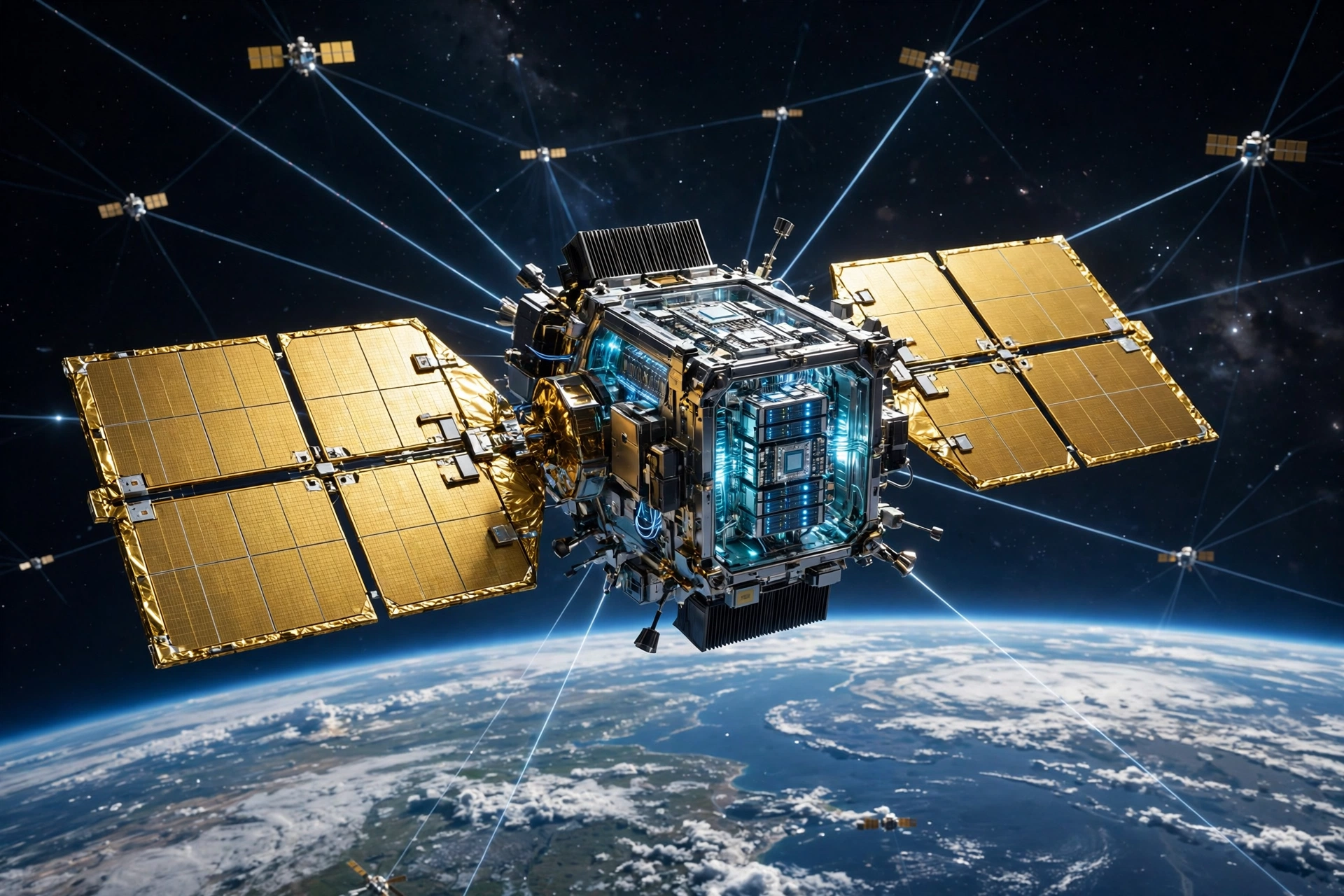
The agreement is a launch services deal between Google and Blue Origin, the rocket company founded by Jeff Bezos in 2000. New Glenn, Blue Origin’s heavy-lift rocket, will deploy the Suncatcher satellites into sun-synchronous orbit — an orbit that keeps the spacecraft in near-constant sunlight.
Each satellite will carry computing capacity roughly equal to a single rack of servers in a conventional data center. That is modest by the standards of a hyperscale data center, but it is a deliberate starting point: Google describes Suncatcher as a research moonshot, not a production cloud region.
“Project Suncatcher is a long-term moonshot to scale AI infrastructure in space by tapping into the abundant solar power in orbit,” said Travis Beals, Senior Director of Project Suncatcher at Google. “This dedicated launch with Blue Origin represents a crucial milestone on our roadmap as we expand the boundaries of what’s possible for the future of compute.”
Neither company disclosed the contract value, the exact number of satellites on the flight, or the payload mass — so the 2029 mission is best read as a launch plan, not a finished system. Read Google’s announcement and the Reuters coverage of the Blue Origin deal for the official details.
Why Put AI in Orbit?
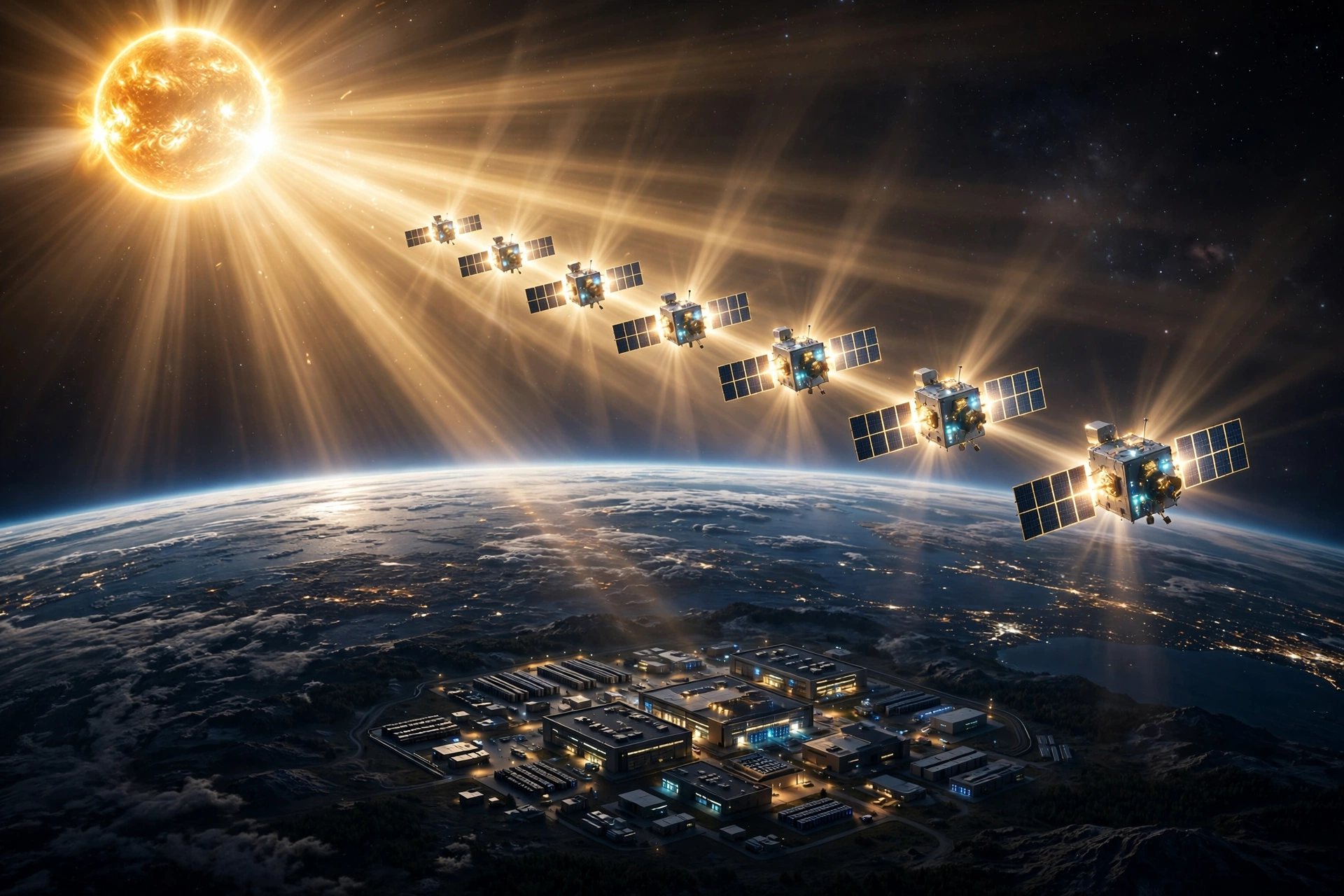
The logic is about power, not speed. AI training and inference are now so electricity-hungry that data centers are straining power grids, land and cooling systems on Earth. In the right orbit, a solar panel can be up to eight times as productive as one on the ground, because it sits above the clouds and the day-night cycle — in sun-synchronous orbit, the panels can collect sunlight almost continuously.
Google’s pitch is that moving some AI computing into orbit could ease that pressure: sunlight in space is abundant and free, and there is no need for the water cooling that ground-based data centers depend on. The satellites would be linked by free-space optical links — laser beams between spacecraft — so the TPUs can work together as one distributed system.
That vision is also why Google keeps expanding where its TPUs run. Just this month, Google’s TPUs are coming to Oracle Cloud in 2027, a deal that puts the same chips behind a very different kind of infrastructure bet — one in orbit, one in a rival cloud.
From Prototype to Rocket: The Road So Far
Suncatcher moved fast from paper to orbit. Google unveiled the system concept in its research blog in November 2025, and on October 1, 2026, it launched a refrigerator-sized prototype satellite with Planet Labs aboard a SpaceX Falcon 9 rocket. On October 30, Google reported the prototype had powered up its TPU hardware and generated the first-ever AI response from an orbit-based, data-center-class TPU, using an onboard Gemma 4 model.
That prototype is small — it can only operate for about 15 minutes at a time — but it proved the core idea: a TPU can run in space. The next step is a planned two-satellite experiment in 2027, which will test the optical links between spacecraft that a real constellation would need. The 2029 New Glenn flight is the step after that: several satellites, launched together, at data-center-rack scale.
Google covered the prototype flight in detail when it first ran AI in orbit, and that earlier coverage is a useful primer on the hardware if you want the backstory.
What New Glenn Brings
New Glenn is Blue Origin’s partially reusable heavy-lift rocket. It can lift 45 metric tons to low Earth orbit inside a seven-meter nose cone — the kind of volume a batch of server-carrying satellites needs. Its first flight reached its intended orbit on January 16, 2025, although the booster was lost during descent.
For Blue Origin, the Suncatcher deal is a major future mission for New Glenn as the company tries to grow its launch business. For Google, it solves the hardest logistical problem in the whole plan: getting heavy computing hardware into orbit cheaply enough to matter. A single Falcon 9 launch costs around $74 million and can barely cover the hardware for a small server room — which is why Google’s cost forecasts depend on launch prices falling sharply by the mid-2030s. Engadget and USA Today have more on the deal.
What Still Has to Be Proved
For all the excitement, Suncatcher remains an experiment with open questions. The satellites have to survive radiation and temperature swings that ground-based servers never face. The optical links between moving spacecraft have not yet been demonstrated — the 2027 mission is designed to test exactly that. And the economics are unproven: Google has not said what the 2029 flight costs, how many satellites it will carry, or when, if ever, orbital computing becomes cheaper than building another data center on Earth.
The chip-supply backdrop matters too. NVIDIA just halted H200 AI chip shipments to China, a reminder that the hardware behind AI is now a geopolitical issue — and Google’s bet on its own TPUs, in orbit or on the ground, is partly a bet on controlling its own supply.
Why This Matters
The 2029 launch will not change how anyone uses AI next year. What it does is put a date on one of the boldest infrastructure ideas in tech: if AI’s appetite for power keeps growing faster than the grid can feed it, the industry will eventually have to look somewhere else for electricity. Google is betting that “somewhere else” might be 650 kilometres up, where the sun never goes down.
It also fits a wider pattern in 2026: AI is escaping the chatbot window and taking over the machine itself. This week alone, Gemini learned to operate Mac apps in the background, and Microsoft’s Copilot Autopilot became an always-on agent that keeps working after you log off. Suncatcher is the same idea, scaled to the extreme — an AI that does not just use your computer, but lives in orbit above it.
Watch the 2027 two-satellite test first. If the laser links work, the 2029 launch becomes a real milestone. If they do not, Suncatcher stays an expensive science project — but a fascinating one.

