Meta closed its Connect 2026 keynote with a “one more thing” — and it was not a phone, a headset, or a pair of glasses. It was a keychain. The Muse Charm is a pocket-sized device built for one job: letting you talk to Muse, Meta’s personal AI agent, without ever touching your phone. About the size of an AirPods case, with a small touchscreen showing a customizable avatar, a fingerprint sensor to start a conversation, and its own 5G connection, it is Meta’s boldest bet yet that AI assistants are about to leave the screen behind and move onto your keyring.
Meta says it is aiming to have the Charm in people’s hands by December, in time for the holidays. But the company has announced no price, no firm ship date, and no full spec sheet — and by its own admission, only a handful of prototype units exist so far. So what exactly is the Muse Charm, what do we actually know about it, and should you wait for one?
What the Muse Charm Is
In Meta’s own words, the Muse Charm is “a delightful and fun device built for you to talk and interact with your Muse.” It takes Muse — the personal AI agent Meta launched as an app on September 8, 2026 — and gives it a body of its own: a small device that combines the agent with Meta’s real-time voice model, so you can press a button, talk, and get an answer without unlocking a phone or opening an app.
TheJusGrow’s explainer separates what Meta confirmed from what is only reported.
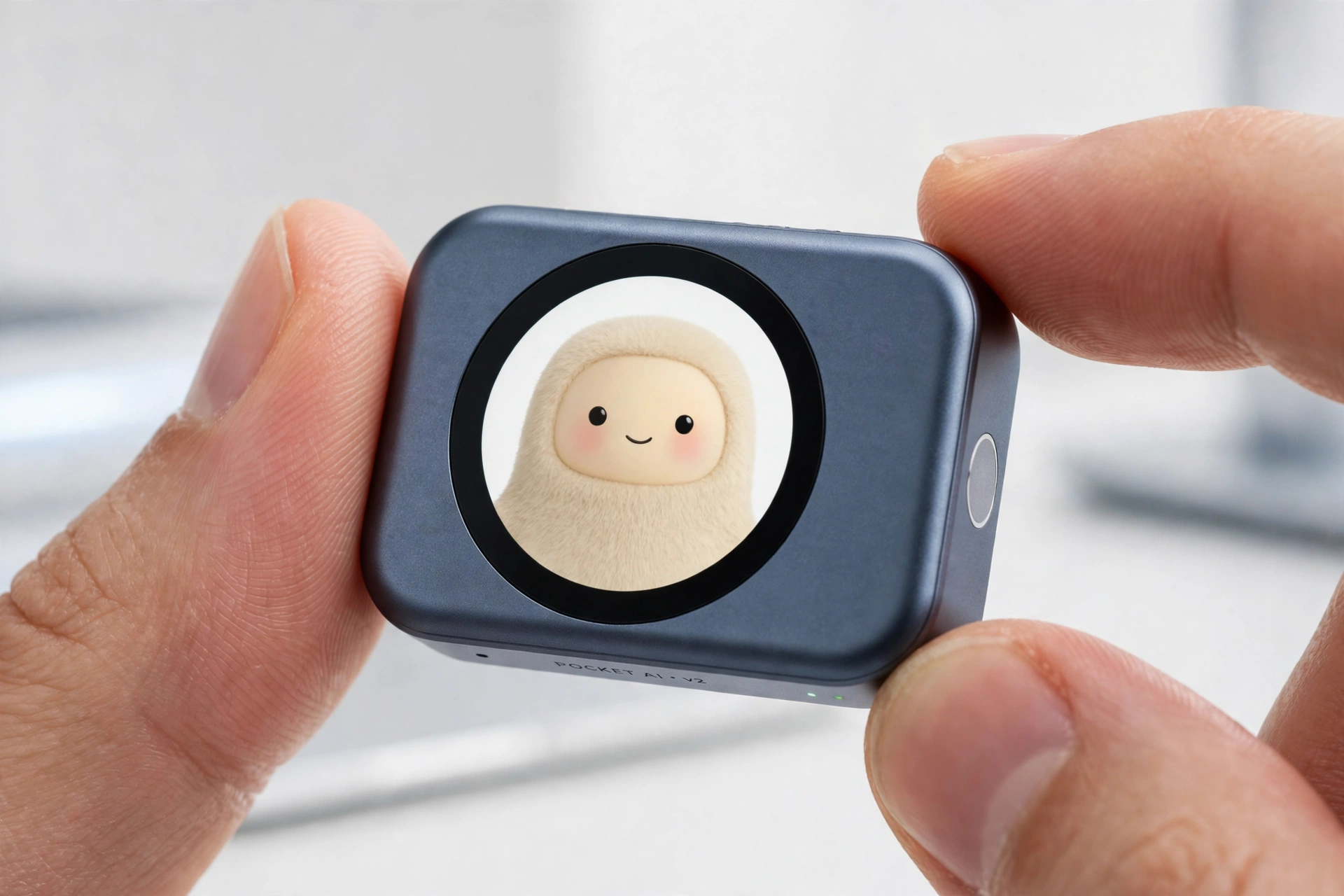
The idea is simple. Phones are general-purpose computers that happen to run AI assistants. The Charm is the opposite: a single-purpose device that exists only to connect you to your agent, by voice, touch, and camera. It hangs from a keychain or slips into a pocket, and Meta describes it as a device that “fits in your pocket” — the first hardware ever built specifically for Muse.
That makes it a very different kind of gadget from the AI wearables we have seen before. It is not a pin you clip to your shirt, and it is not a pair of glasses. It is closer to a Tamagotchi for the AI age: a small companion with a face on a screen that you carry around and talk to.
The Design: A Screen, a Fingerprint Sensor, and an Avatar Named Jolly
What Meta has confirmed about the hardware is deliberately thin. The company’s official Connect recap says almost nothing beyond the concept and a promise of “more to share later this year.” The details we have come from press reporting of the on-stage reveal — and they paint a distinctive picture.
According to Bloomberg’s reporting from the event, the Charm has a roughly 2-inch OLED touchscreen, a fingerprint sensor that doubles as the talk button and power button, speakers and microphones, a 5G modem so it does not depend on your phone for a connection, USB-C charging, and support for music and video playback. Most outlets also report front and rear cameras, which would let Muse see what you are looking at — although at least one outlet reports no cameras at all, so treat the camera setup as unconfirmed until Meta publishes a spec sheet.
The screen is where the Charm gets its personality. It shows Jolly, a customizable Muse avatar that you configure in the companion app — appearance, clothing, and voice. Launch coverage lists a mascot, a mango, a labradoodle, and a piece of toast in sunglasses among the avatar options. Press the fingerprint sensor, and Jolly appears, ready to talk. The device reportedly has a translucent shell you can see the circuitry through, and it hangs off a keychain or a wrist on a lanyard.
It also reportedly carries its own 5G connection, plus Wi-Fi according to some reports, so it works away from your phone. What it cannot do, according to the same reporting, is make phone or video calls — it is a Muse terminal, not a phone replacement. And it requires a Muse account, set up through the Muse app on iPhone or Android.
When It Ships — and What It Will Cost
Here is where the story gets fuzzy. Mark Zuckerberg said at Connect that the device would launch “by December” for the holiday season, according to Bloomberg. Meta’s own materials say only that there will be “more to share later this year,” and the company’s product page offers nothing but a “notify me” email signup. There is no firm release date, and no preorder is open.
The reason for the vagueness is straightforward: the hardware is not finished. Meta’s own hardware team said on stage at Connect that the component layout was still being finalized, and only a handful of units have been built. The Next Web’s reporting puts it plainly — a December target with a few prototypes in existence, and materials still being decided. Treat December as a target, not a promise.
Price is even less certain. Meta has announced nothing. Bloomberg reported that executives indicated pricing in the range of a smartwatch, and some analysts have estimated $99 to $199, but neither figure is confirmed. A single-source spec leak has circulated a $129 to $149 figure, and that should be treated as rumor. Until Meta publishes a price, anything you read about what the Charm costs is speculation — and the same goes for battery life, which Meta has also not announced.
The Drip Wire’s guide tracks the confirmed facts against the rumors.
Why Meta Is Building a Keychain for Its AI Agent
The Charm only makes sense in the context of what Meta announced around it at Connect. The company is pushing Muse into every form factor it can: the agent launched as an app in September, gained real-time voice and expressive avatars, and is coming to Meta’s AI glasses “in the coming months,” activated by saying your agent’s name. Muse’s new real-time voice and expressive avatars already let it join a conversation as a face on a screen; the Charm is the next step — giving that face a device of its own that you carry everywhere.

The strategy is about habit. Meta wants Muse to be the agent you reach for instead of opening an app, and a device that is always on your keychain is easier to reach for than a phone buried in a bag. It is the same logic behind Google’s Gemini smart glasses, which opened for pre-order this week from $395 — put the AI where your hands already are, and remove every step between having a thought and asking the agent about it.
There is a commercial logic too. Muse is not just a chatbot; it is a shopping and task agent with connectors to retailers including Walmart, Best Buy, Sephora, and Gap, plus payment partners like Shop Pay and PayPal. A device that makes it effortless to ask Muse to buy something, book something, or check something is a device that turns the agent into a storefront you carry in your pocket. The parallel with Brave’s x402 agentic payments is hard to miss: the industry is racing to let AI agents spend money on your behalf, and the company that owns the device you talk to has a head start.
Meta has also been expanding what Muse can do on its own. This week the agent gained the ability to place outgoing calls on behalf of paid subscribers in the US — to restaurants, insurers, and other businesses. Each new capability makes a dedicated device more useful, and each new device makes the agent harder to leave.
The Questions Meta Has Not Answered
For all the excitement, the Charm raises questions that Meta has not yet addressed — and the most important ones are about privacy. A device with microphones and (reportedly) cameras that you carry everywhere, designed to listen and see on your behalf, needs clear answers about what it records, where that data goes, and how long it is kept. As of now, Meta has not published privacy, security, or data-handling details specific to the device.
The practical questions matter too. Who pays for the 5G data plan? How long does the battery last? How much of the processing happens on the device versus in the cloud? What happens when the Charm is out of coverage? None of these have answers yet, because the hardware itself is still being finalized.
And then there is the question of whether people actually want a second device for something their phone already does. The AI pin era taught the industry a hard lesson: a dedicated AI gadget has to be dramatically more convenient than a phone to justify its existence, and several have failed that test. The Charm’s advantage is that it is small, cheap (if the smartwatch-level pricing holds), and tied to an agent people already use — but it still has to prove that talking to your keychain beats pulling out your phone.
What to Watch Next
Three things will decide whether the Muse Charm matters. First, the price: if it lands near $99, it becomes an impulse buy and a holiday gift; near $300, it becomes a considered purchase competing with the smartwatch it is priced like. Second, the ship date: a December launch puts it under Christmas trees, but a slip into 2027 would blunt the momentum of the Connect reveal. And third, the spec sheet: cameras, battery life, and the data plan will tell us whether this is a real product or a concept with a logo.
The broader signal is that the AI agent race has entered its hardware phase. Google is putting Gemini in glasses, Meta is putting Muse on a keychain and on glasses, and rival models like Gemini 4 Hydrogen are getting faster and cheaper by the week. Anthropic’s Claude office suite is pushing agents into the workplace at the same time. The agent that wins will be the one that is there when you need it — and Meta is betting that “there” means hanging from your keys.
Conclusion
The Meta Muse Charm is a keychain-sized device that puts the Muse AI agent in your pocket, with a small touchscreen, a customizable avatar, a fingerprint sensor, and its own 5G connection. Meta unveiled it at Connect 2026 and is targeting a December launch, but has announced no price, no firm date, and no full specifications — and only a few prototypes exist. If it ships on time at a smartwatch-level price, it could be the most accessible AI gadget yet. If it slips, it will join a long list of AI hardware that arrived too late. Either way, it is a clear statement of where Meta thinks personal AI is going: off the screen, onto your keyring, and into every moment of the day.