AI agents can now buy their own web searches — and pay for them in crypto, one query at a time. Brave announced on November 12, 2026 that its Search API accepts payments through the open x402 protocol, letting developers and autonomous agents query Brave’s independent search index without creating an account, adding a credit card, or managing an API key. Instead, each search costs $0.005, settled instantly in USDC on the Base blockchain.
It is a small price tag with a big implication: the API key, the standard credential of the web for three decades, is being replaced — at least for machines — by the payment itself.
What Brave Just Launched
The Brave Search API is Brave’s developer tool for building applications on top of its own web index. Until now, using it meant signing up, choosing a plan, and guarding an API key. The x402 integration adds a second front door: endpoints behind the new proxy require payment on every request rather than authentication.
Brave runs its own payment facilitator, which accepts USDC on the Base blockchain. The company says support for other networks and other stablecoins is coming soon. The change covers the LLM Context endpoint — Brave’s API built specifically to give AI agents search context for grounding their answers — as well as the web, news, image, video, and local search endpoints.
Pricing follows Brave’s published API rates exactly: $0.005 per request, or $5 per 1,000 searches, for every covered endpoint. The price is not the news. The credential is. As one independent tester put it after probing the live endpoint, the signed payment is the credential now.
How the 402 Payment Flow Works
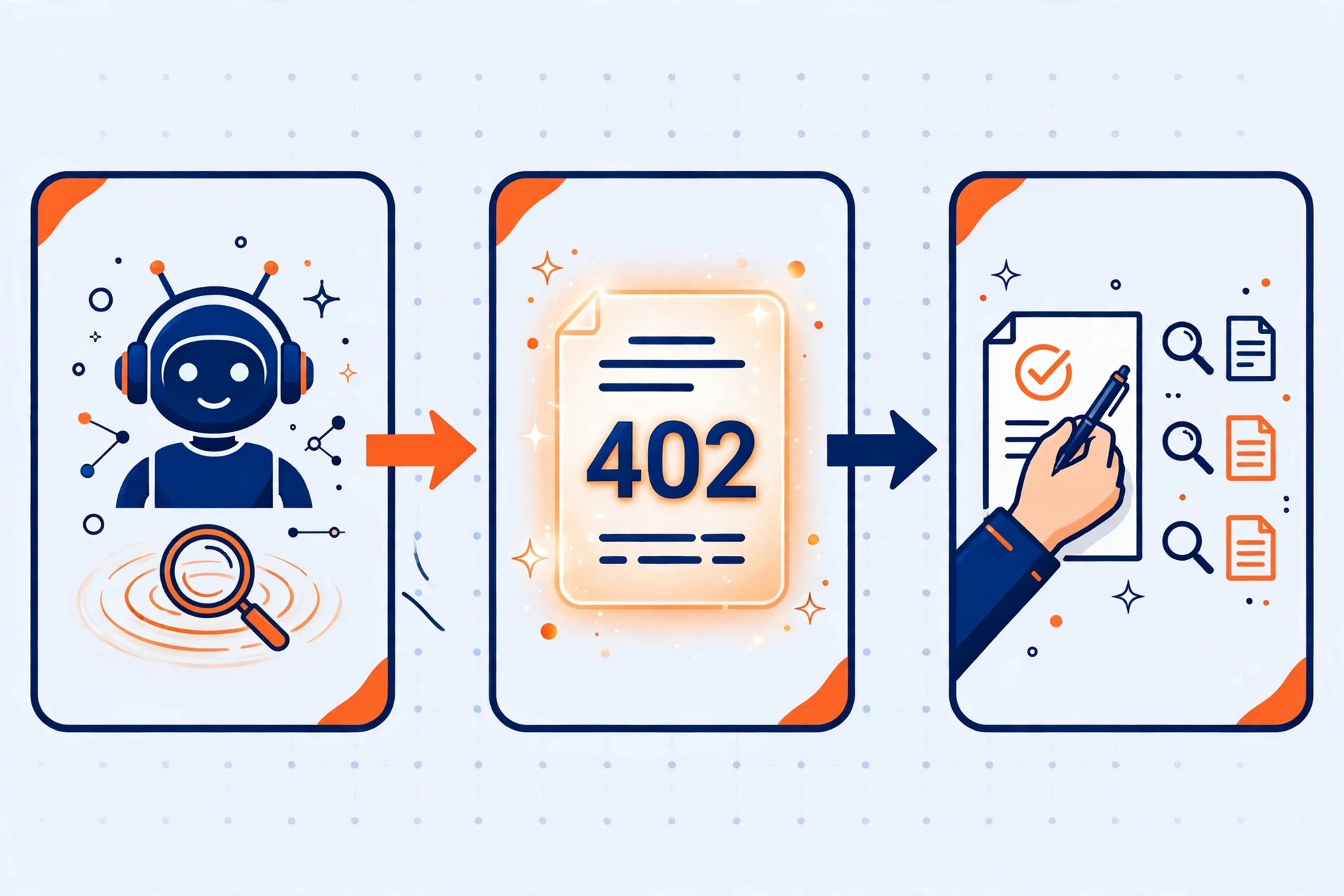
The flow revives one of the web’s oldest unused ideas: HTTP status code 402, “Payment Required,” which has sat reserved in the specification since the early days of the web. Here is how Brave uses it:
First, the agent sends a search request to the x402 proxy at search.agent.s.brave.app with no payment attached. The proxy answers with an HTTP 402 response that states the price of that search and the payment details needed to pay it. The invoice lives in a single base64-encoded header, and the response body is empty.
Next, the agent signs a USDC payment for the stated amount and retries the request with the signed payment attached. An independent probe published on November 13 confirmed the details: the price is 5,000 base units of USDC — $0.005 on a six-decimal token — on Base (chain ID 8453), using an EIP-3009 signed transfer authorization, so the agent signs but never broadcasts its own transaction. The offer expires after 300 seconds.
Finally, once the payment is verified, the search runs and the results come back with a receipt of the transaction that occurred on the Base blockchain. No account exists anywhere in that loop. Fund the agent’s wallet with Base-native USDC and it is ready to search.
Why This Matters for AI Agents
AI agents are becoming the web’s fastest-growing class of user, and they have a problem humans do not: they cannot fill in a signup form, verify an email address, or type in a credit card number. Every API that demands an account is a wall an agent cannot climb on its own. A developer has to provision credentials in advance, rotate them, and guard against leaks.
The x402 model removes that wall. An agent that needs a fact can pay for the search itself, in the moment, with money its operator put in its wallet. That makes search a utility an agent can consume the way a person consumes electricity — metered, per use, with no paperwork.
It also fits a pattern visible across the AI industry this week. Agents are getting their own infrastructure, piece by piece: Google’s Gemini Decisions API gives agents a cheap model for making bounded yes-or-no choices instead of generating free-form text, OpenAI’s Daybreak security agents attack and patch code autonomously, OpenAI’s GPT-6 Cyber security model focuses on AI security, and Salesforce’s Koa decision model is built to make structured decisions inside enterprise workflows. Brave’s move adds the missing piece for the research step: an agent that can decide, act, and now search — all without a human in the loop.
The same shift is reshaping the hardware underneath. AMD’s Instinct MI450X accelerators, announced the same week, are aimed squarely at running the inference workloads these agents depend on. Search, decisions, security, and compute are all being rebuilt for autonomous software at once.
Getting Started: Purl Wallet and USDC on Base

Brave points developers to the simplest path first: install Purl Wallet, a command-line wallet built by Stripe for agents. Set up the wallet, top it up with Base-native USDC, and start querying. A funded wallet and the proxy URL are all an agent needs — the documentation walks through the rest.
For developers who already use the Brave Search API with a key, nothing changes. The keyed API continues to work at the same rates, and the x402 proxy charges exactly what the key-based API charges. The new option is additive: it is for agents and harnesses that would rather pay per call than manage credentials.
A practical example from the independent probe shows how little code is involved. With Purl installed and a funded wallet, a single command buys one web search:
purl --max-amount 5000 'https://search.agent.s.brave.app/res/v1/web/search?q=rust'The –max-amount flag is doing real work there. It caps what the agent can spend on a single call, which is the kind of guardrail that matters when software can spend money on its own.
What to Watch Before You Hand an Agent a Wallet
The launch is real and the endpoint is live, but it is early, and a few limits are worth knowing before you fund a wallet.
First, it is USDC on Base only, for now. If your stack settles on another chain or another stablecoin, you will be waiting for Brave’s promised expansion. Second, Brave says it will cover gas fees for transacting on Base for a limited time — a subsidy, not a permanent feature, so factor real network fees into any long-term cost model.
Third, the independent probe found honest limits in what it could confirm. The tester read the 402 invoice but did not complete a purchase, so the full pay-then-retry loop was verified from Brave’s documentation rather than end to end. The 402 response also never names the facilitator that verifies the payment; Brave’s blog says it runs its own, but the invoice itself does not prove it.
Fourth, and most important for anyone building agents: spending controls are now a security feature. An agent with a funded wallet and no cap can burn through funds on a runaway loop of searches. Set per-call maximums, per-session budgets, and alerts, the same way you would set rate limits on a keyed API. The convenience of “no account” cuts both ways — there is no billing dashboard to catch a mistake after the fact.
Finally, remember what the search results may not be used for. Brave’s API terms restrict using search results to create, evaluate, train, fine-tune, or benchmark AI models or services. Grounding an agent’s answers is the intended use; building a training dataset is not.
The Bigger Picture: Machine-to-Machine Payments Are Arriving
Brave is not alone in betting that machines will soon pay machines. The x402 protocol itself was designed for exactly this: letting software settle tiny payments over HTTP without accounts, cards, or invoices. Other search and data providers have begun accepting x402 as well, and Brave’s own roadmap has pointed toward machine payments for months, including a rebuilt search stack aimed at AI workflows and a token strategy centered on what it calls a transactional attention economy.
What makes this launch stand out is that it comes from a provider with a real, independent search index — not a wrapper around someone else’s results. An agent paying Brave is buying data Brave crawled itself, which is a meaningful distinction when the whole point of grounding is trustworthy, current information.
If the model catches on, the implications go beyond search. Any API an agent needs — maps, weather, company data, code execution — could adopt the same pattern: a 402 invoice, a signed micropayment, and results. The API key would not disappear overnight, but for autonomous software it would start to look like what it is: a credential designed for humans.
For now, the experiment is live, costs half a cent a query, and needs nothing more than a wallet with USDC on Base. That is a low bar for developers curious about the agent economy — and a useful preview of how the web’s plumbing changes when its newest users are not people at all.
Frequently Asked Questions
What is x402?
x402 is an open payment protocol that lets software pay for HTTP requests directly. When a server requires payment, it answers with HTTP 402 Payment Required, stating the price and payment details. The client signs a payment — in Brave’s case, USDC on the Base blockchain — and retries the request with the payment attached.
How much does a Brave Search API query cost through x402?
$0.005 per request, or $5 per 1,000 searches, for the LLM Context, web, news, image, video, and local endpoints. That matches Brave’s published rates for the key-based API. Gas fees on Base are covered by Brave for a limited time.
Do I need a Brave Search API account to use x402?
No. Each request carries its own payment, so no account or API key is needed. You only need a wallet funded with Base-native USDC. Brave recommends Purl Wallet, a command-line wallet built by Stripe.
Which endpoints accept x402 payments?
The LLM Context endpoint, built for grounding AI agents, plus web, news, image, video, and local search. Some endpoints, such as Answers, Autosuggest, and Spellcheck, are not sold through the x402 proxy.
Is this the same as Brave’s regular Search API?
The results come from the same independent Brave search index and the price is the same. The difference is authentication: the key-based API uses an API key tied to an account, while the x402 proxy uses a signed USDC payment as the credential for each individual request.
Sources: Brave’s official announcement, “The Brave Search API now accepts agentic payments via the x402 protocol” (November 12, 2026); Brave Search x402 Proxy documentation; independent probe of the live 402 response published November 13, 2026.