Most of what an AI agent does all day is not writing. It is choosing. Which team gets this request? Which workflow runs next? Is this a yes or a no? Salesforce’s new model, Koa Decisions, is built for exactly that job — and it does it in milliseconds, without calling in a giant language model every time.
Announced on November 6, 2026, Koa Decisions is the next version of HyperClassifier, the routing model that already works inside Agentforce. Salesforce says the new model dramatically expands where decision models can be used across its platform, bringing fast, cheap decision-making to far more workflows than routing alone.
What Koa Decisions Actually Does
Koa Decisions reads a request and a list of categories you define, then makes a decision in a single step. The answer can be a selection from your list, a yes-or-no call, or a score. Salesforce’s data science team built it by applying novel training techniques to Google’s Gemma, an open-weight model — and unlike its predecessor, it now accepts images and audio as well as text.
The practical difference is speed and cost. A general-purpose language model generates its answer one token at a time, which takes time and compute even for a one-word answer. A decision model reads the whole request at once and produces its answer in one step. When the answer is a single choice, that is all the work there is to do.
Salesforce plans to extend Koa Decisions well beyond request routing, into Flows, Apex, and prompt templates for Salesforce builders, plus an API for developers. Pricing and packaging are subject to change, and availability varies by region and is governed by customer agreements.
Decision Models vs Large Language Models: Why Small Wins on Speed
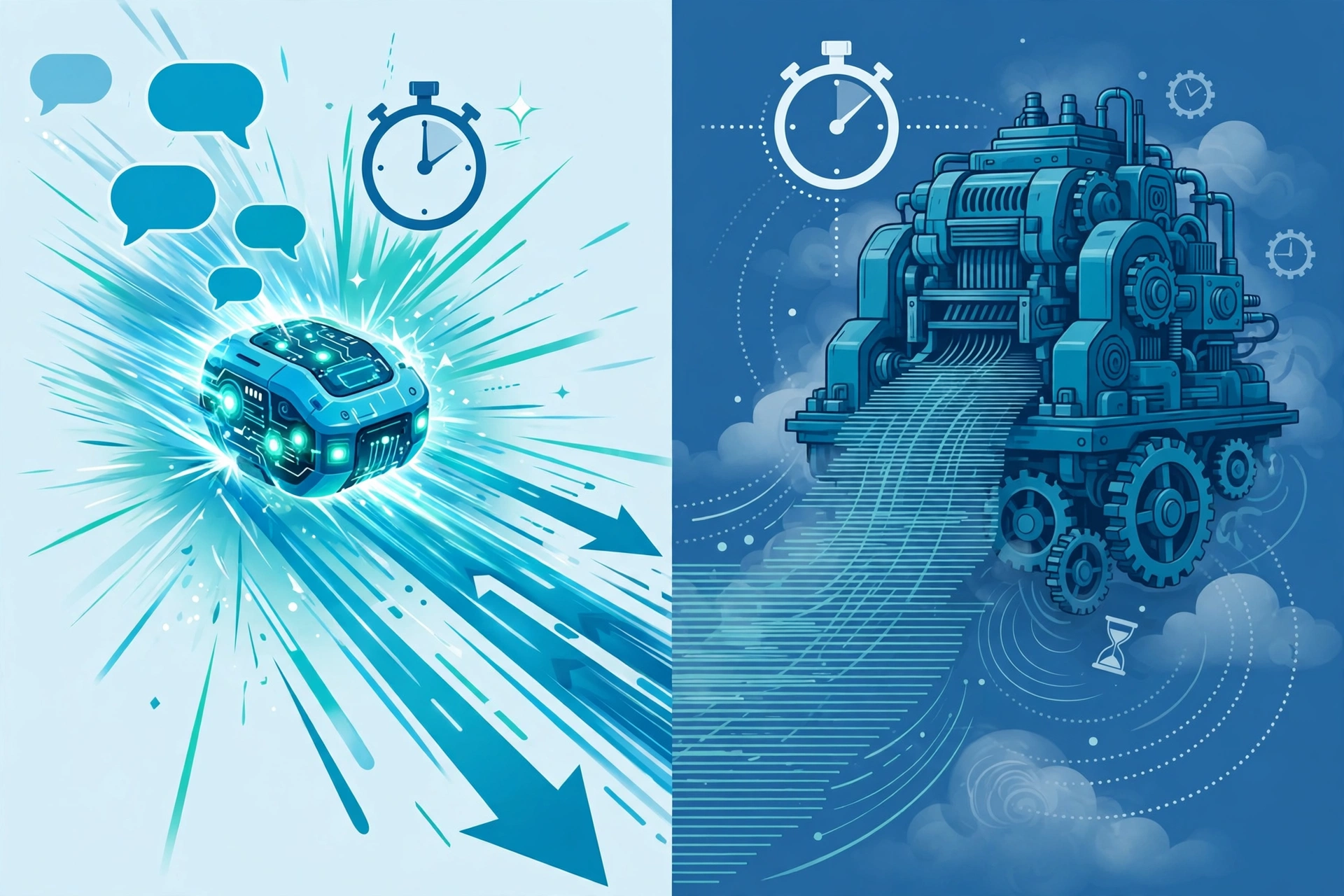
Picture a customer typing “I can’t log in to my account” into a chat window. Should that request go to engineering, accounts, or sales? A general-purpose LLM can work it out, but it is not purpose-built for the task, and it can take more than a second to answer.
A decision model, by contrast, identifies “accounts” in milliseconds and returns a clear answer with a confidence score — no long paragraph, no chain of thought, just the choice, ready for other software to act on immediately.
The numbers make the gap concrete. When Salesforce measured routing requests inside Agentforce, its decision model took roughly 26 milliseconds, compared with about 1.4 seconds for a general-purpose LLM. That is the difference between a routing step users never notice and one they feel on every message.
This is not about replacing large models. It is about not wasting them. As Salesforce puts it, Koa Decisions is built to make the quick calls that keep work moving, saving LLMs for writing and reasoning. When a sales deal starts to slip, a decision model can flag the risk and pick which team should step in, and an LLM can summarize what changed. By the time anyone opens the record, the right team already knows.
Text, Images, and Audio In — One Decision Out

The headline upgrade over HyperClassifier is multimodal support. Koa Decisions can take in a written message, a photo, or an audio clip and still return a single decision. That matters because real customer requests are rarely clean text: they arrive as screenshots of error messages, photos of damaged products, or voice notes.
Salesforce’s research team reports 85.5% accuracy on a production intent-routing benchmark, with responses in about half a second and median speed as much as approximately 7.5 times faster than the frontier models tested under identical serving conditions. The underlying technique treats classification, yes-or-no checks, and scoring as constrained generation with single-token outputs — the model is forced to answer in the format the workflow needs, nothing more.
The predecessor, HyperClassifier, was fine-tuned on GPT-OSS-20B and could classify across as many as 200 labels. Koa Decisions builds on that production record with a different foundation — Google’s open-weight Gemma — and a broader input range.
Try It Yourself: No Salesforce Account Required
You do not need to be a Salesforce customer to see how a decision model behaves. Anyone can sign up for a free Trailhead account and run the Koa Decisions demo. The walkthrough is deliberately simple: click “Route a support request” and the model sends the default request to engineering, accounts, or sales, showing a confidence score for each option.
Then add a fourth option under Choices — “Returns,” for example — and change the request to “I need to send back the order that arrived yesterday.” The model picks Returns, with no retraining. In Salesforce’s demo, the first routing came back with a 95% confidence score; after the new category was added, Returns scored 99.5%.
That no-retraining step is the quiet revolution here. Software has classified requests for decades, but it used to take a custom predictive machine learning model: define the outcome, gather and label data, train, check accuracy, repeat. For many enterprise customers, getting from idea to production took months. A decision model starts from a language model that has already learned how “send back the order” relates to “returns,” so a team can add a category and sometimes reach production in hours.
The Bigger Picture: Decision Models Are Having a Moment
Koa Decisions does not arrive in a vacuum. In mid-September, TypeSafe AI came out of stealth with Jev, a model built to pick from a set of options. A month later, OpenAI made its Decisions API generally available, and several other AI companies have released decision models of their own. The industry is converging on the same insight: agents spend most of their time deciding, not generating, so the deciding deserves its own purpose-built model.
Koa Decisions also joins the wider Koa family of Salesforce models, which includes a separate reasoning model built with NVIDIA. That model, announced on September 15, 2026, is Salesforce’s first CRM reasoning model: built on NVIDIA Nemotron 3 Super, trained on synthetic scenarios drawn from nearly three decades of CRM experience, with no customer data used in training. It is in pilot with customers including 1-800Accountant, Baxter Credit Union, Formula 1, UChicago Medicine, and Xero, with general availability expected in winter 2026 in US regions.
The split is deliberate. Koa the reasoning model handles multi-step CRM work — qualifying opportunities, resolving cases, using tools. Koa Decisions handles the fast, single-step calls underneath it. Together they sketch Salesforce’s model strategy: small, specialized models for the routine, bigger reasoning models for the complex, and frontier partner models like Claude and Gemini for everything else.
What to Watch
Three things will decide whether Koa Decisions matters beyond the announcement. First, the rollout: Salesforce says it plans to bring the model into Flows, Apex, and prompt templates, but the timeline for each surface is not yet public. Second, accuracy in the wild: an 85.5% benchmark score is strong, but enterprise categories are messier than benchmarks, and the confidence scores will need to be good enough that teams trust the routing without a human in the loop. Third, cost: the whole pitch is that decision models are cheaper per call than frontier LLMs, and Salesforce will need to show that saving clearly once the model reaches real workflows.
For now, the demo is the honest test. It takes minutes, it needs no Salesforce account beyond a free Trailhead sign-up, and it shows the core idea more clearly than any announcement can: a request goes in, one decision comes out, and the agent gets on with its work.
Related Reading and Sources
- Perplexity Teammates brings always-on AI agents to ongoing work — read our coverage of Perplexity’s agent launch: https://inspireviraltimes.com/perplexity-teammates-always-on-ai-agents-work/
- Anthropic’s Claude can now read bank accounts in read-only mode — see how agents are entering personal finance: https://inspireviraltimes.com/claude-personal-finance-read-only-bank-accounts/
- OpenAI Images 2.6 makes AI image generation faster, with GIFs and two new API models: https://inspireviraltimes.com/openai-images-2-6-faster-image-generation-gifs-api-models/
- Elon Musk predicts AI could make salaries and cash irrelevant — what the future of work might look like: https://inspireviraltimes.com/is-ai-going-to-make-salaries-and-cash-irrelevant-what-elon-musk-predicts-about-the-future-of-work-and-money/
- Salesforce’s official announcement, “Less Reasoning. More Doing. Meet Koa Decisions.”: https://www.salesforce.com/news/stories/koa-decisions-salesforce-decision-models/?bc=OTH
- Unite.AI on Koa Decisions’ image and audio support and benchmark results: https://www.unite.ai/salesforce-introduces-koa-decisions-with-image-and-audio-support/
- Salesforce and NVIDIA announce Koa, the first CRM reasoning model, built on Nemotron: https://www.businesswire.com/news/home/20260915610040/en/