Google has a new answer for one of the most expensive habits in AI development: asking a giant language model to write out a full response every time your software only needs a yes, a no, or a pick from a list. On November 11, 2026, Google DeepMind announced the Gemini Decisions API, a new endpoint powered by a purpose-built model called Gemini Decision 1. Instead of generating text token by token, it scores your options in a single forward pass and returns probabilities and confidence scores — up to 1,000 questions about the same input, answered in one request.
It is a small, fast, deliberately narrow model, and that narrowness is the point. Where a general-purpose model like Gemini 4 Carbon is built to reason, write and create, Gemini Decision 1 only judges. For the thousands of small decisions inside an AI agent’s workflow — which tool to call, whether a message breaks policy, which model should handle a query — that trade-off could make agents dramatically faster and cheaper.
What the Gemini Decisions API Actually Does
The Decisions API is a new endpoint in the Gemini Developer API (v1beta), available through Google AI Studio. You send one shared multimodal input — text, images, audio, video or PDFs, up to 256K tokens — along with up to 1,000 independent questions about that input. Gemini Decision 1 evaluates every candidate answer in a single pass and returns a probability and a confidence score for each one, with no output tokens generated at all.
That design solves a real bottleneck. In a typical agent loop, every small judgment — “is this email spam?”, “which of these five tools fits?”, “how risky is this action?” — currently costs a full generative call, complete with token-by-token decoding and an output bill. The Decisions API collapses those judgments into one cheap, fast request. Google says the shared input is billed once per request no matter how many questions you evaluate, and each question only adds its own instruction and criteria tokens.
Three Question Types in One Request
You can mix all three question types against the same input in a single request, and every answer comes with a confidence score from 0 to 1, so your code can route ambiguous cases to a fallback or a human reviewer.
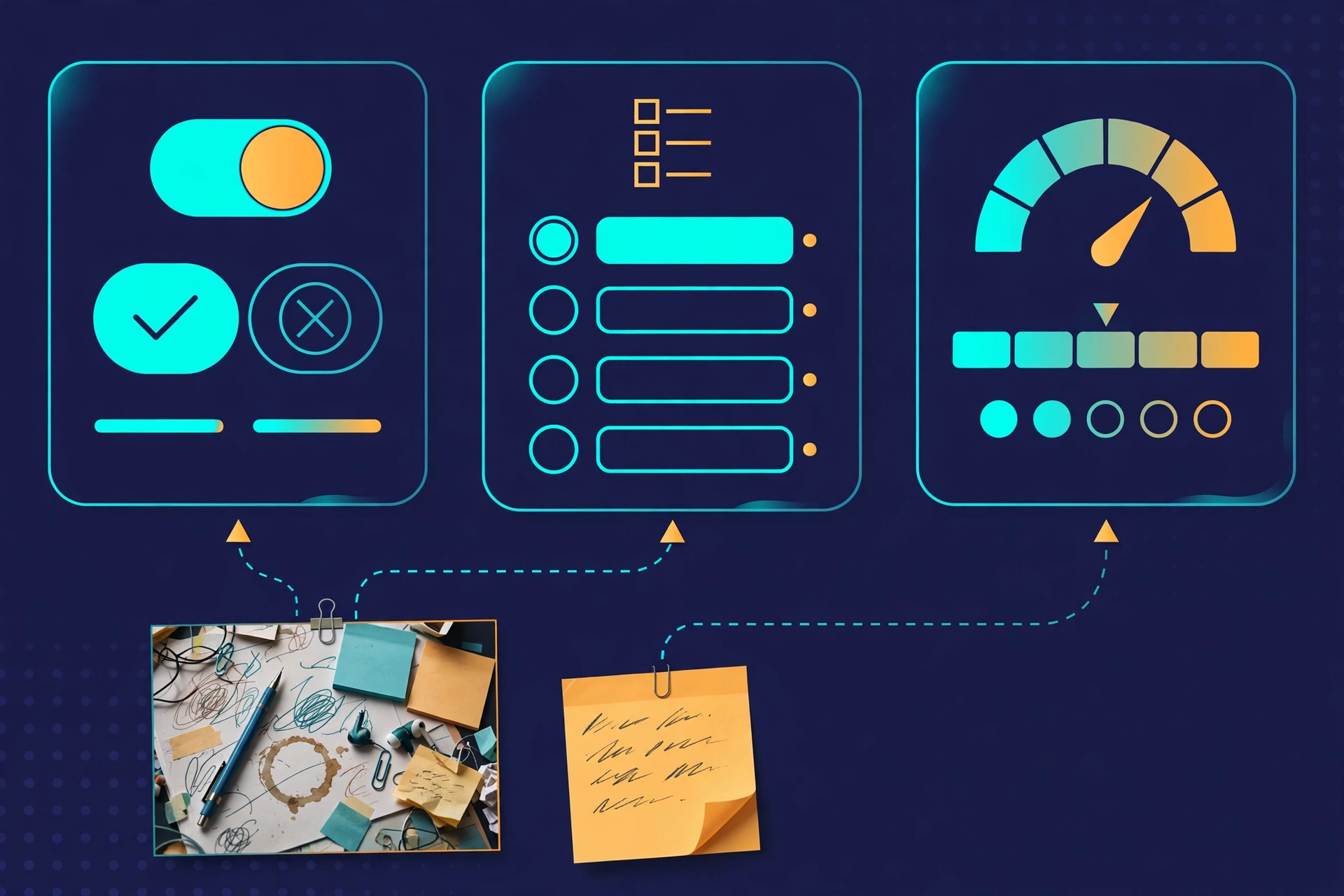
- noul (yes/no): Estimates the probability that a yes/no condition holds, with optional true and false description criteria. Ideal for policy checks and safety filters.
- choice (multiple choice): Selects from 2 to 255 choices, returning the winner and normalized probabilities for every candidate. Ideal for tool selection and model routing.
- score (ordered rubric): Grades inputs across an ordered rubric starting at 0, returning a continuous weighted score and per-level probabilities. Ideal for quality grading and content scoring.
Google’s own example makes the idea concrete: a photo of a breakroom counter plus a short text note is checked in one request for whether there is an uncleaned spill, which cleanup action fits, and how severe the mess is — three different question types, one shared input, one pass.
Speed, Price and Calibration
The headline numbers are striking. Gemini Decision 1 keeps median model compute at 50–100 milliseconds, with 150–250 ms end-to-end latency, and Google says that latency stays nearly flat from 1 to 100 questions per request for inputs up to 16K tokens. Pricing is $0.10 per 1M input tokens with zero output tokens billed, and a no-cost tier is available in Google AI Studio for prototyping. Google claims the setup is nearly five times cheaper across its benchmark suite than Gemini 3.5 Flash-Lite with the Interactions API.
On accuracy, Google reports that Gemini Decision 1 leads across its benchmark suite spanning agent routing, reasoning, ranking and multimodal understanding, with the lowest calibration error of the models it compared. VentureBeat’s coverage notes it scored 92.2% on JevBench, ahead of GPT-6 Luna at 90.9% and Jev 1.14 at 90.0%, with a calibration error of 0.0250 — roughly half of Jev’s 0.0494. One caveat worth noting: the independent Artificial Analysis Decision Index v2.1 ranked it ninth of 18 decision models at launch, and Google’s latency figures are based on inputs up to 16K tokens, well below the 256K maximum. Real-world performance at full context remains to be proven.
How Google Is Already Using It
The most convincing part of the launch is that Google is already running the Decisions API inside its own products as a low-latency control plane:

- Gemini Notebook uses it as a real-time router, directing incoming queries to the optimal model tier and thinking level — serving everyday queries with up to 40% lower latency while reserving deep reasoning models for complex tasks.
- Stitch uses it in a rapid canvas experiment to generate playable wireframes of a product flow in seconds and apply voice or tap edits almost instantly.
- CC from Google Labs uses it to pick the right emoji reaction from a palette of more than 200 options in a fraction of a second.
- Google Search uses it as a safety layer for MCP tools, detecting adversarial behavior and content against adversarial evaluations within the latency envelope.
That last use case connects to a wider trend: as agents gain the ability to call tools and act autonomously, the safety layer around them matters as much as the model itself. Google’s OpenShell security runtime and the governance controls in platforms like Commvault and Zscaler’s agent recovery tools are all responses to the same problem — agents that act fast need guardrails that act just as fast.
How It Compares With OpenAI’s Decisions API
Google is not first to this idea. OpenAI made its own Decisions API generally available on October 22, 2026, running on GPT-6 Luna. The two products share the same core concept — closed-set judgments instead of generated text — but differ in the details: Google’s model handles up to 1,000 questions per request with a 256K-token shared input, while OpenAI’s offering is built around its own model and endpoint conventions. TeamOrRouter’s explainer highlights the key technical distinction: Gemini Decision 1 uses a separate /v1beta/decisions endpoint and cannot be called through the standard :generateContent method, so existing Gemini integrations will need code changes to adopt it.
For developers, the choice will come down to ecosystem and benchmarks rather than concept. Google’s integrations are rolling out across OpenRouter, LangChain, Vercel, LiteLLM, Pydantic AI, Pipecat, LiveKit and OpenCode, alongside the google-genai SDKs (version 3.2 or later). Support for Gemini in Google Cloud is listed as coming soon — for now, it is Gemini Developer API only.
Who Should Use It — and Who Should Not
The Decisions API is built for the smallest, most numerous calls in an agent’s workflow: routing, tool selection, policy checks, safety filters and grading. If your application makes hundreds of small judgments per session — a customer-service agent triaging tickets, a content pipeline scoring submissions, a coding assistant picking the right tool — it could cut both latency and cost significantly. It also fits teams building AI decision models and always-on AI coworkers that need a fast, cheap judgment layer under a more capable reasoning model.
It is not a replacement for a general model. Gemini Decision 1 cannot reason, explain itself, or generate text — it only judges. If you need a chain of thought, a written answer, or multi-step reasoning, you still need a generative model. And because it returns probabilities rather than explanations, teams working in regulated domains should plan for auditability: a confident-looking score is not the same as a defensible decision.
How to Try It
Developers can start today by grabbing an API key in Google AI Studio and using the no-cost tier for prototyping. Google ships three demo apps — Doorstep Parcels, Speed Sketch and Find the Zoo Keeper — plus Python, JavaScript and REST guides in the Decisions API documentation. The free tier lists limits of 200 requests per minute, 50,000 input tokens per minute and 10,000 requests per day, which is generous enough to prototype a real routing or grading pipeline before spending anything.
The bigger story is structural. Not every problem needs a full response from an LLM, as Google’s own announcement puts it — and for the first time, Google is selling a model that agrees. If the Decisions API delivers on its latency and calibration claims at scale, the judgment layer of the AI stack may soon be the cheapest part of it.
Frequently Asked Questions
What is the Gemini Decisions API?
A new endpoint in the Gemini Developer API that answers closed-set questions — yes/no, multiple choice and rubric scores — instead of generating text. It is powered by the Gemini Decision 1 model (gemini-decision-1).
How many questions can it answer in one request?
Up to 1,000 independent questions about a single shared multimodal input of up to 256K tokens, all scored in one forward pass.
How much does the Gemini Decisions API cost?
$0.10 per 1M input tokens, with zero output tokens billed. A no-cost tier is available in Google AI Studio for prototyping.
How fast is Gemini Decision 1?
Google reports 150–250 ms end-to-end latency (50–100 ms of model compute) for inputs up to 16K tokens, staying nearly flat from 1 to 100 questions per request.
Can I use it in Google Cloud?
Not yet. It is available through the Gemini Developer API (v1beta) in Google AI Studio, with support for Gemini in Google Cloud listed as coming soon.