Why Databricks Is Changing How We Store and Analyze Data
For years, data teams have lived with an awkward split. On one side sits the data warehouse: fast, structured, and great for BI, but expensive and rigid. On the other sits the data lake: cheap, flexible, and able to hold anything, but prone to turning into a swamp of unreliable files. Most organizations ended up running both, with pipelines copying data between them and teams arguing over which copy was the truth.
The lakehouse is the architecture that tries to end that argument. Databricks has been its most visible champion.
The problem with two systems
The classic two-tier setup looks like this: raw data lands in a lake (S3, ADLS, or GCS), gets transformed, and then a subset is loaded into a warehouse for analysts. Data scientists, meanwhile, pull from the lake to train models. This creates familiar headaches:
- Duplication and drift. The same data lives in multiple places, and the copies disagree.
- Latency. Every hop between systems adds delay, so dashboards lag behind reality.
- Cost. You pay for storage twice and for the engineering effort to keep the systems in sync.
- Siloed workloads. BI lives in the warehouse, ML lives in the lake, and governance has to be built twice.
What is a lakehouse?
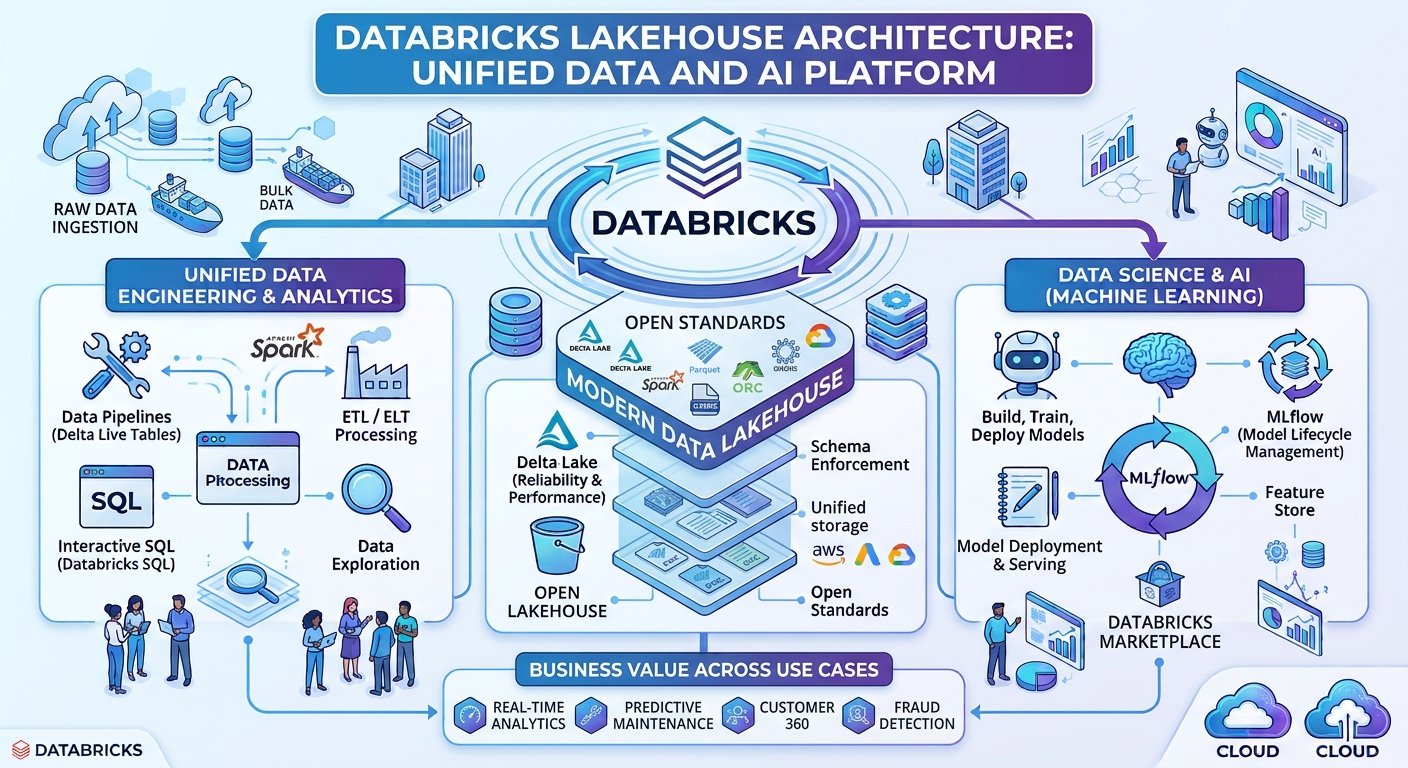
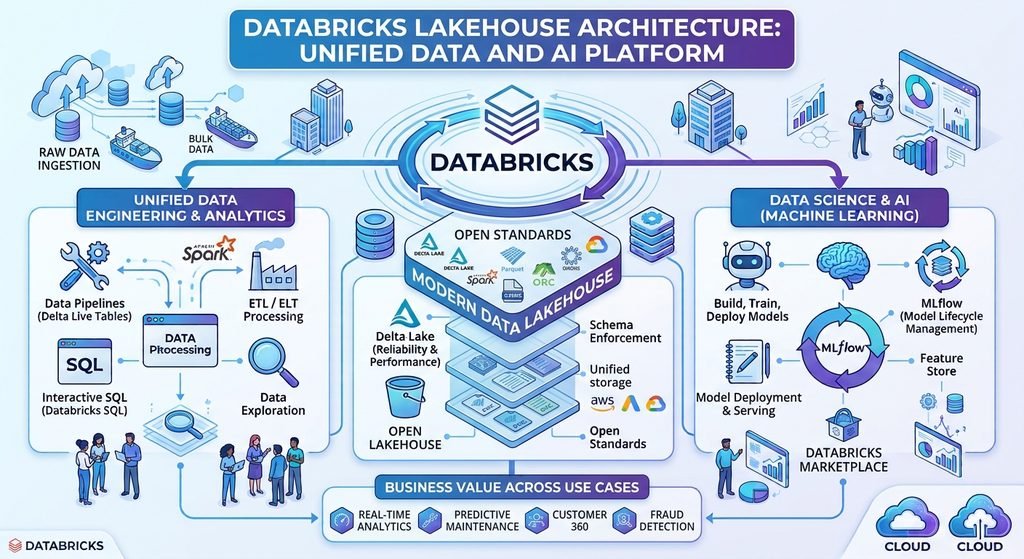
A lakehouse combines the low-cost, open storage of a data lake with the reliability and performance features of a data warehouse, in a single system. Instead of copying data into a proprietary warehouse, you add a transactional metadata layer on top of files in cloud object storage. That layer gives you the guarantees warehouses are known for, while the data stays in open formats. The core ingredients are:
- Cheap, scalable object storage that holds structured, semi-structured, and unstructured data.
- Open file formats, typically Parquet, so you aren’t locked into one engine.
- A table format with ACID transactions, such as Delta Lake, Apache Iceberg, or Apache Hudi.
- A high-performance query engine that can serve SQL analytics, streaming, and ML from the same data.
- A unified governance layer for access control, lineage, and discovery.
Where Delta Lake fits
Raw Parquet files on object storage have no concept of a transaction. If a job fails halfway through a write, readers can see partial or corrupted data. Delta Lake, the open-source storage layer originally created by Databricks, fixes this by maintaining a transaction log alongside the data files. That log enables several things:
- ACID transactions, so concurrent readers and writers see consistent data.
- Schema enforcement and evolution, so bad data doesn’t silently corrupt a table.
- Time travel, so you can query a table as it existed at an earlier version, which is useful for audits and debugging.
- Efficient upserts and deletes (MERGE), which are essential for CDC pipelines and compliance requests.
- Unified batch and streaming, with the same table serving as both a streaming sink and a batch source.
The medallion pattern
A common way to organize a lakehouse is the medallion architecture, which moves data through progressively cleaner layers:
- Bronze: raw data, ingested as-is from source systems. It’s append-only and preserves history.
- Silver: cleaned, deduplicated, and conformed data. This is where you join, validate, and standardize.
- Gold: business-ready aggregates and feature tables that power dashboards, reports, and ML models.
The pattern gives teams a clear contract about data quality at each stage and makes pipelines easier to debug, because you can always trace a gold-layer number back to its raw origin.
Why Databricks is driving the shift
Databricks didn’t invent the idea of combining lakes and warehouses, but it has done the most to turn it into a practical platform. A few things stand out:
One platform for many workloads. SQL analytics, data engineering, streaming, and machine learning run on the same data. An analyst and a data scientist can work from the same governed tables instead of exporting extracts.
Unity Catalog for governance. Centralized permissions, lineage, auditing, and discovery across data and AI assets address one of the biggest weaknesses of traditional lakes. You define access once and it applies everywhere.
Performance on open data. The Photon engine and features like data skipping, Z-ordering, and liquid clustering narrow the gap between lake storage and warehouse speed, without moving data into a proprietary format.
Openness. Because data lives in open formats in your own cloud storage, you keep control of it. Interoperability between table formats has also improved, which reduces the fear of lock-in.
A natural home for AI. Since the data for analytics and ML already sits in one place, feeding models, building feature pipelines, and grounding generative AI applications in governed enterprise data becomes much simpler.
Trade-offs worth knowing
The lakehouse isn’t magic, and it’s worth going in with clear eyes:
- It’s not automatically cheaper. Compute costs can climb quickly without cluster policies, autoscaling discipline, and monitoring.
- Governance still takes work. Unity Catalog provides the tools, but you still need clear ownership, naming conventions, and access models.
- Data modeling still matters. A lakehouse doesn’t excuse a messy schema. Poorly designed tables are slow in any architecture.
- Migration is a project. Moving off an entrenched warehouse involves rewriting pipelines, retraining teams, and validating results.
- Dedicated warehouses haven’t disappeared. For some workloads, especially highly concurrent, low-latency BI, a purpose-built warehouse may still be a good fit. The two worlds are converging, but not identical.
Getting started
If you’re evaluating a lakehouse, a pragmatic path looks like this:
- Pick one high-value use case rather than attempting a big-bang migration.
- Land raw data in bronze with Delta tables and build up silver and gold layers incrementally.
- Establish governance early, including catalogs, schemas, ownership, and access policies.
- Set cost guardrails with cluster policies, budgets, and usage monitoring from day one.
- Measure the outcome: fewer pipelines, fresher data, faster time to insight.
The bottom line
The lakehouse reflects a simple idea: stop moving data between systems to serve different teams, and bring the capabilities to the data instead. By pairing open storage with transactional reliability, strong governance, and a unified engine, platforms like Databricks make it realistic for analysts, engineers, and data scientists to work from a single source of truth.
That doesn’t make every data warehouse obsolete overnight. But for organizations drowning in duplicated data, brittle pipelines, and siloed tools, the lakehouse offers a credible path to something simpler.