Enterprise customer service is getting a new kind of AI coworker — one that is built to be governed, not just deployed. On November 12, 2026, NiCE (Nasdaq: NICE) launched the next generation of its NiCE Cognigy platform, a system for building and running AI agents across entire customer journeys, with AI-assisted development, reusable skills, full visibility into every decision an agent makes, and native voice-to-voice conversation.
The launch lands at a moment when the question in enterprise AI has shifted. A year ago, the challenge was getting an agent to work at all. Now it is getting agents to work at scale, under the controls large organizations depend on — and doing it without turning every deployment into a custom engineering project. NiCE’s answer is a platform designed around how agents actually reason and act, pairing autonomous behavior with the structured workflows, safeguards and audit trails that regulated industries expect.
“Great AI Agents come from teams that can spend their time on what the agent does for customers,” said Philipp Heltewig, Chief AI Officer at NiCE. “AI Assist guides setup, testing and improvement. Skills built once work across every agent. Tracing shows every decision. We designed the next generation of NiCE Cognigy around that, so enterprises can scale AI Agents with the visibility and control production demands.”
What the Next Generation of Cognigy Adds
The release is built around five core capabilities, each aimed at a different bottleneck in enterprise agent deployment.
First is the Agentic Experience Studio, a redesigned development environment where teams go from an idea to a working AI agent faster. It ships with default speech-to-text, text-to-speech and large language models, plus ready-made resources, so new projects are productive from day one. Premium speech and language models from Deepgram, ElevenLabs and Anthropic are natively available for teams that want them.
Second is AI Assist, an AI companion that works across the whole agent lifecycle — guided setup, best practices, building, testing and improving agents over time. It can build alongside developers, debug agents, run simulations and explain concepts, which means smaller teams can ship agents that used to require specialist expertise.
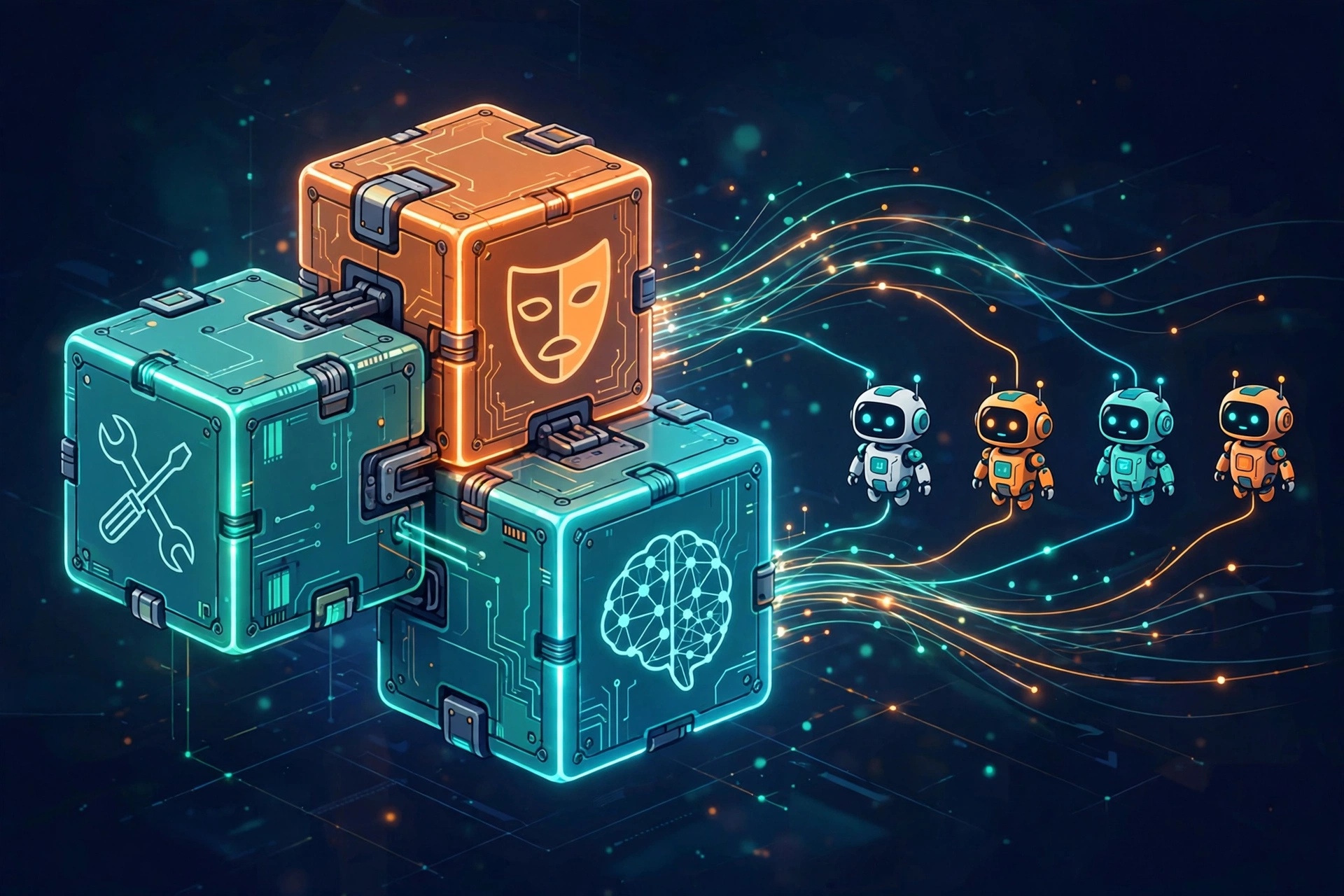
Third is the new agent model itself: agents built from skills, tools and personas that teams create once and reuse across every agent. Those agents coordinate specialized sub-agents for complex work and connect with external agents — including customers’ own personal AI agents — through open standards such as MCP and A2A.
Fourth is tracing: full visibility into every step an agent takes, from the data and tools it uses to the decisions it makes. And fifth is native voice-to-voice support, with speech-to-speech models that process audio end to end for faster, more lifelike conversations.
Reusable Skills: Build Once, Use Everywhere
The most consequential idea in the release may be the simplest one: build a skill once, reuse it everywhere.
In the new Cognigy, a skill bundles instructions with the tools needed for a particular task — checking an order status, verifying an identity, processing a return — and that skill can be dropped into any agent. Teams improve a skill over time and every agent using it gets better. An agentic harness wraps those skills with guardrails, trusted knowledge and governance rules, so reuse does not mean losing control.
That model mirrors a broader shift in how enterprises are thinking about agents. The industry is moving from one-off chatbots toward shared, governed agent infrastructure — the same direction seen in recent moves to govern and recover AI agents across enterprise systems, where the emphasis is on oversight and resilience rather than raw capability alone. The new Cognigy is designed for that world: agents that coordinate across a complete customer journey instead of automating a single task in isolation.
The open-standards angle matters here too. By connecting through MCP and A2A, Cognigy agents can reach enterprise systems, tools and external agents without proprietary lock-in. That includes a scenario NiCE calls out explicitly: customers arriving with a personal AI agent of their own, which the enterprise agent must be able to talk to.
Tracing Every Decision an Agent Makes
If reusable skills are about speed, tracing is about trust — and it is the feature that will matter most to regulated industries.
Tracing in the new platform exposes the steps behind an agent’s output: which skills were activated, which tools and models were called, how many tokens were used, how long the first token took, and why a fallback was triggered. The platform also keeps safeguards, execution traceability and an audit history across both AI and human changes, giving teams a common record for debugging and oversight.
That level of visibility is becoming table stakes as agents take on higher-stakes work. It echoes the same governance push behind NVIDIA handing its OpenShell runtime for securing autonomous AI agents to the CNCF — the industry is converging on the idea that an agent you cannot inspect is an agent you cannot safely deploy. NiCE’s version of the answer is to make the inspection native to the platform rather than an afterthought.
The evaluation toolkit reinforces the same point. Teams can run simulations and side-by-side multivariate comparisons to pressure-test variations of an agent before selecting a version for production, rather than discovering problems in live customer conversations.

Voice-to-Voice: Agents That Talk Like People
Voice is where the new platform may be felt most directly by customers. Native speech-to-speech models process audio end to end, which NiCE says lets agents reason and call tools while speaking — reducing dead air and sustaining more fluid exchanges when customers interrupt.
That is a meaningful step past the older pattern of bolting a speech layer onto a text agent. When an agent can listen, think and respond in the same continuous stream, the conversation feels less like a phone tree and more like a person. For contact centers handling millions of calls, even small improvements in that experience translate into measurable outcomes.
The model-billing change is equally practical. Default AI models are now included in the conversation price, with nothing to configure and no separate model contract. Teams can add premium third-party models in a few clicks with usage-based billing, or keep working with their own model contracts. Removing the contracting friction is a small detail that removes a real barrier to starting.
Hybrid by Design: Autonomy Where It Fits
One of the smartest choices in the release is that it does not force a single philosophy. NiCE Cognigy combines autonomous AI agents with the structured flows, safeguards and governance enterprises rely on, so each organization decides where agents act on their own and where defined processes apply.
That hybrid design matters because not every step of a customer journey should be autonomous. A refund above a threshold, a medical query, a regulated financial disclosure — these are places where predictability and compliance matter more than flexibility. The platform lets teams apply autonomy selectively rather than all or nothing, which is the same pragmatic balance enterprises are striking elsewhere: Databricks turning Genie into an always-on AI coworker still keeps it governed by Unity Catalog, and Salesforce’s Koa decision model pairs a small, fast model with enterprise controls rather than raw autonomy.
“Enterprises get the most from AI agents when building, improving, and governing them are part of the same process,” said Ian Jacobs, VP and Lead Analyst at Opus Research. “Reusable skills and AI assistance throughout the lifecycle can accelerate the path to production, while visibility into how agents make decisions gives organizations the oversight and control they need to operate confidently at scale.”
For existing Cognigy customers, the next generation is included as part of NiCE’s continued product development. Everything already in production keeps running unchanged, and teams can adopt the new capabilities whenever they are ready — no launch-driven migration of live systems.
Frequently Asked Questions
What is NiCE Cognigy?
NiCE Cognigy is an enterprise platform for building, deploying and managing AI agents for customer service. The next generation, launched November 12, 2026, adds AI-assisted development, reusable skills, decision tracing and native voice-to-voice interaction.
What are reusable skills in Cognigy?
A skill bundles instructions with the tools for a particular task. Teams create a skill once, reuse it across every AI agent, and improve it over time — so every agent using it gets better without rebuilding it.
How does tracing work in the new Cognigy?
Tracing shows every step behind an agent’s output, including activated skills, tool and model calls, token use, time to first token and fallback reasons, plus an audit history across AI and human changes.
Which models does the new Cognigy support?
Default speech-to-text, text-to-speech and language models are included in the conversation price. Premium models from Deepgram, ElevenLabs and Anthropic are natively available with usage-based billing, and teams can keep their own model contracts.
Do existing Cognigy customers have to migrate?
No. The next generation is included for existing customers, production deployments keep running unchanged, and teams can adopt the new capabilities whenever they are ready.
The Bottom Line
NiCE’s next-generation Cognigy is less a feature release than a statement about where enterprise AI agents are heading: from impressive demos to governed, reusable, inspectable infrastructure. The combination of AI-assisted building, reusable skills, full decision tracing and native voice gives contact centers a faster path to production — and the visibility to stay in control once agents are live.
The timing is no accident. As customers start arriving with personal AI agents of their own, the enterprise agent can no longer be a walled garden. It has to connect, explain itself and stay governed, all at once. That is the bet NiCE is making — and for enterprises weighing where to put their next agent investment, it is a bet worth watching closely.