Most large organizations don’t have a data problem. They have a fragmentation problem. Data sits in warehouses, lakes, operational databases, and SaaS tools. Analysts, data engineers, and ML teams each use different tools, with separate security models and separate copies of the truth. Then AI arrives, and the cracks widen: models need clean, governed, current data, and agents need context and guardrails.
Databricks was built to close those gaps. This article explains what it is, how it works, and why so many enterprises have standardized on it.
What Is Databricks?
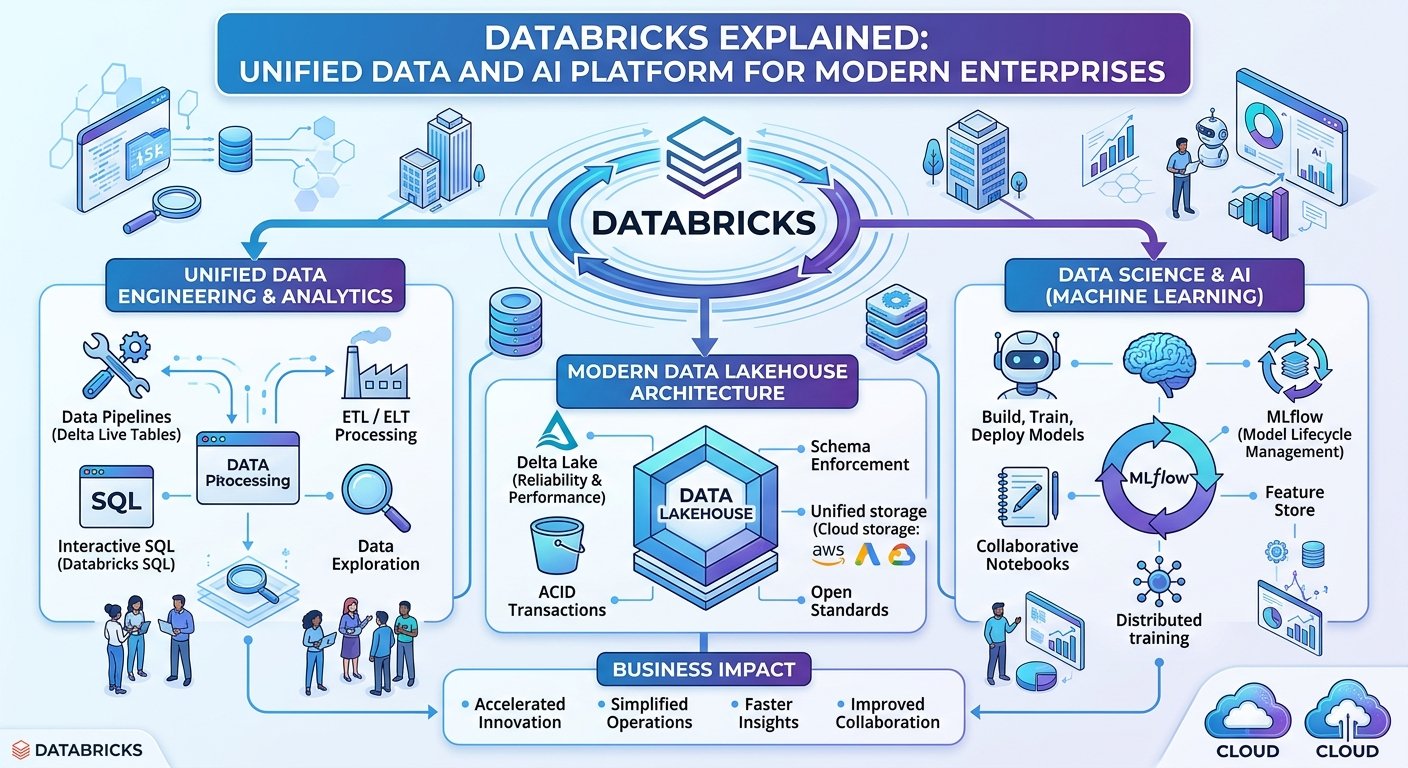
Databricks is a cloud-based data and AI platform, available on AWS, Azure, and Google Cloud. It was founded by the creators of Apache Spark, and it pioneered the lakehouse architecture: a single system that combines the low-cost, flexible storage of a data lake with the reliability, performance, and governance of a data warehouse.
The company now describes its product as a Data Intelligence Platform, meaning a platform where AI is embedded throughout, from how you write code to how you govern data to how you build production agents.
The Core Idea: The Lakehouse
Traditionally, enterprises ran two parallel systems:
- Data lakes held raw, unstructured, and semi-structured data cheaply, but lacked transactions, quality guarantees, and fast SQL.
- Data warehouses delivered fast, reliable analytics on structured data, but were costly, rigid, and poorly suited to machine learning.
Moving data between them meant duplicated pipelines, stale copies, and inconsistent definitions. The lakehouse collapses this into one architecture:
- Open storage in your own cloud object store, using open formats.
- Delta Lake as the table layer, adding ACID transactions, schema enforcement, time travel, and efficient updates on top of files.
- One governance layer across all of it.
- Multiple engines (SQL, Spark, ML, streaming) working on the same single copy of data.
The practical payoff: BI dashboards, streaming pipelines, and model training all read from the same governed tables, with no copy-and-reconcile step in between.
The Platform at a Glance
1. Data Engineering and Ingestion
Databricks provides managed ingestion connectors, declarative pipelines, and orchestration under the Lakeflow umbrella. You describe the transformation you want, and the platform handles dependency management, incremental processing, retries, and data quality expectations. Batch and streaming use the same programming model, so teams don’t maintain two codebases for “real-time” and “nightly.”
2. Databricks SQL and Business Intelligence
For analysts, Databricks SQL offers a serverless, warehouse-style experience with standard SQL, dashboards, and connectors to tools like Power BI and Tableau. Natural-language analytics through Genie lets business users ask questions of governed data in plain English, with answers grounded in the definitions your data team has curated.
3. Data Science and Machine Learning
Notebooks, scalable compute (including GPUs), MLflow for experiment tracking and model lifecycle, feature management, and model serving give data scientists an end-to-end path from exploration to production. Because the data already lives in the lakehouse, there is no export step before training.
4. Generative AI and Agents
This is where Databricks has been investing most heavily. Agent Bricks is its platform for building, evaluating, deploying, and governing AI agents on enterprise data. At its June 2026 Data + AI Summit, Databricks expanded Agent Bricks into a comprehensive developer agent platform, and reported that over 100,000 agents have been built on it since launch. Related capabilities include a Supervisor Agent for coordinating multi-agent systems, managed agent memory, and isolated sandboxes for running agent code with downscoped data access.
Databricks also offers models from multiple providers inside the platform. Its partnership with OpenAI, for example, makes OpenAI models natively available in Agent Bricks and the broader Data Intelligence Platform, and Gemini access supports multimodal inference on governed data without moving it.
5. Operational Databases and Apps
A newer part of the story is Lakebase, a managed Postgres service integrated with the lakehouse. Per the release notes, Lakebase became generally available in early 2026, and by mid-year it was SOC 2 Type 2 compliant. The idea is to let applications and agents work with transactional data and analytical data in one governed environment, rather than syncing between separate systems. Databricks Apps lets teams host internal apps and agent front ends directly on the platform.
Unity Catalog: The Governance Backbone
If one component explains why enterprises choose Databricks, it’s often Unity Catalog. It provides a single place to manage:
- Access control, down to table, column, and row level, including attribute-based policies.
- Lineage, so you can trace a dashboard number or model feature back to its source.
- Discovery and metadata, including tags, glossaries, and business metrics.
- Auditing of who accessed what.
- Governance for AI assets, such as models, functions, and agent tools.
Governance has also become the foundation for AI. Databricks announced semantic capabilities in Unity Catalog (glossary, domains, and metrics) so that humans and agents share one definition of business terms, and a Unity AI Gateway for governing agent and model usage, with controls such as budget caps. As agents begin acting on enterprise data, “who can do what, at what cost” matters as much as model quality.
Open by Design
Databricks emphasizes open standards: Delta Lake, Apache Spark, MLflow, and support for Apache Iceberg compatibility, plus Delta Sharing for exchanging data with partners without copying it. For enterprises wary of lock-in, data staying in open formats in their own cloud storage is a meaningful reassurance, though the surrounding platform services are, of course, Databricks-specific.
Why Enterprises Adopt It
- One platform, fewer seams. Fewer tool handoffs means fewer duplicated pipelines, reconciliation headaches, and security gaps.
- Governed AI readiness. Models and agents are only as good as the data and context they can reach. Having data, semantics, access control, and AI tooling in one place shortens the path from pilot to production.
- Scale and performance. Built on Spark and optimized engines, it handles petabyte-scale workloads, with serverless options to reduce infrastructure management.
- Multi-cloud flexibility. Consistent tooling across AWS, Azure, and Google Cloud helps organizations with multi-cloud strategies.
- Collaboration across roles. Engineers, analysts, scientists, and business users work against the same data and definitions.
Common Use Cases
- Customer 360 and personalization: unify transactional, behavioral, and third-party data.
- Real-time analytics and fraud detection: streaming ingestion plus ML scoring.
- Supply chain and operations optimization: forecasting on combined internal and external signals.
- Life sciences and healthcare analytics: integrating clinical, genomic, and real-world data under strict governance.
- Enterprise AI assistants and agents: knowledge assistants, document extraction, and multi-agent workflows over proprietary data.
- Security analytics: Databricks has also moved into this area with Lakewatch, a lakehouse-native, agentic SIEM.
Considerations Before You Commit
No platform is a fit for everything. Weigh these honestly:
- Cost management matters. Consumption-based pricing (Databricks Units) rewards good governance of clusters, jobs, and queries. Without FinOps discipline, bills can surprise you.
- Skills and change management. Moving from a legacy warehouse is as much an organizational shift as a technical one.
- Pace of change. The platform is evolving quickly, with many features in Beta or Public Preview at any given time. Check release status before depending on a capability in production.
- Ecosystem overlap. If you already run Snowflake, Microsoft Fabric, or a hyperscaler’s native stack, evaluate where Databricks complements them and where it duplicates them.
Getting Started
- Pick a high-value, bounded use case rather than a full migration.
- Establish Unity Catalog first: naming, ownership, access model, and tagging conventions.
- Land data in Delta tables with declarative pipelines and quality checks.
- Add consumption layers: SQL dashboards, then ML or agent use cases on the same governed data.
- Set cost and governance guardrails early, including budgets and monitoring.
- Explore hands-on: Databricks offers a Free Edition for learning and experimentation.
The Bottom Line
Databricks’ bet is that the future of enterprise data is not a collection of specialized tools stitched together, but a unified platform where data, governance, and AI share the same foundation. As organizations move from analyzing data to deploying agents that act on it, that unification, especially around governance, is increasingly the point.
Whether Databricks is the right center of gravity for your stack depends on your workloads, skills, and existing investments. But if your goal is to turn fragmented data into governed, production-grade AI, it deserves a serious look.
Product details reflect Databricks’ announcements and release notes through mid-2026; features and availability change frequently, so verify current status in the official documentation.
Related reading
More on data, cloud, and AI in practice: how companies scale to millions of users with AWS Cloud, microservices architecture on AWS, building agentic AI systems in Python, and the AI engineer roadmap from beginner to job-ready. For authoritative background, see Databricks documentation and Delta Lake, the open-source lakehouse storage framework.