Meta’s personal AI agent just became a lot more human. On November 5, 2026, Meta began rolling out real-time voice conversations and expressive avatars in the Muse app in the United States, turning the text-based assistant into something you can talk to — and look at — like a phone call. The feature, previewed at Connect 2026 on September 23, is now live on mobile, web and Mac, and it arrives at a moment when every major AI company is racing to make its assistant feel less like a chatbot and more like a companion.
The launch is part of a remarkable afternoon for consumer AI. Within about 90 minutes of Meta’s announcement, Perplexity launched its always-on Teammates agents and Anthropic opened Claude’s Personal Finance beta — three different visions of the personal AI agent, all landing on the same day. Meta’s answer is the most sensory of the three: give the agent a voice, a face and the ability to listen while you are still talking.
What Meta Just Launched
The rollout adds two linked capabilities to the Muse app: Muse Realtime Voice and Muse Realtime Avatar. Together they let users hold a spoken, real-time conversation with their Muse and watch an animated avatar react as it speaks. The avatar’s facial expressions and gestures are designed to match the tone of the conversation, signalling that the assistant is listening and responding rather than simply playing back a recorded reply.
To start a call, users tap the phone icon in the top-right corner of the Muse app. From there, the conversation works much like an ordinary voice call: Muse answers out loud, and users can interrupt mid-answer to redirect it. Meta says the experience is rolling out now in the US Muse app, with no date yet given for the other countries where Muse is available — Canada, Japan and Singapore, where the app arrived at the end of October.
Meta introduced Muse itself on September 8, 2026, as a personal AI agent that plans, books and buys through the apps it is connected to. The voice and avatar update is the biggest change to that product since launch, and it reframes Muse from a text assistant into a conversational presence.
How a Voice Call With Muse Works
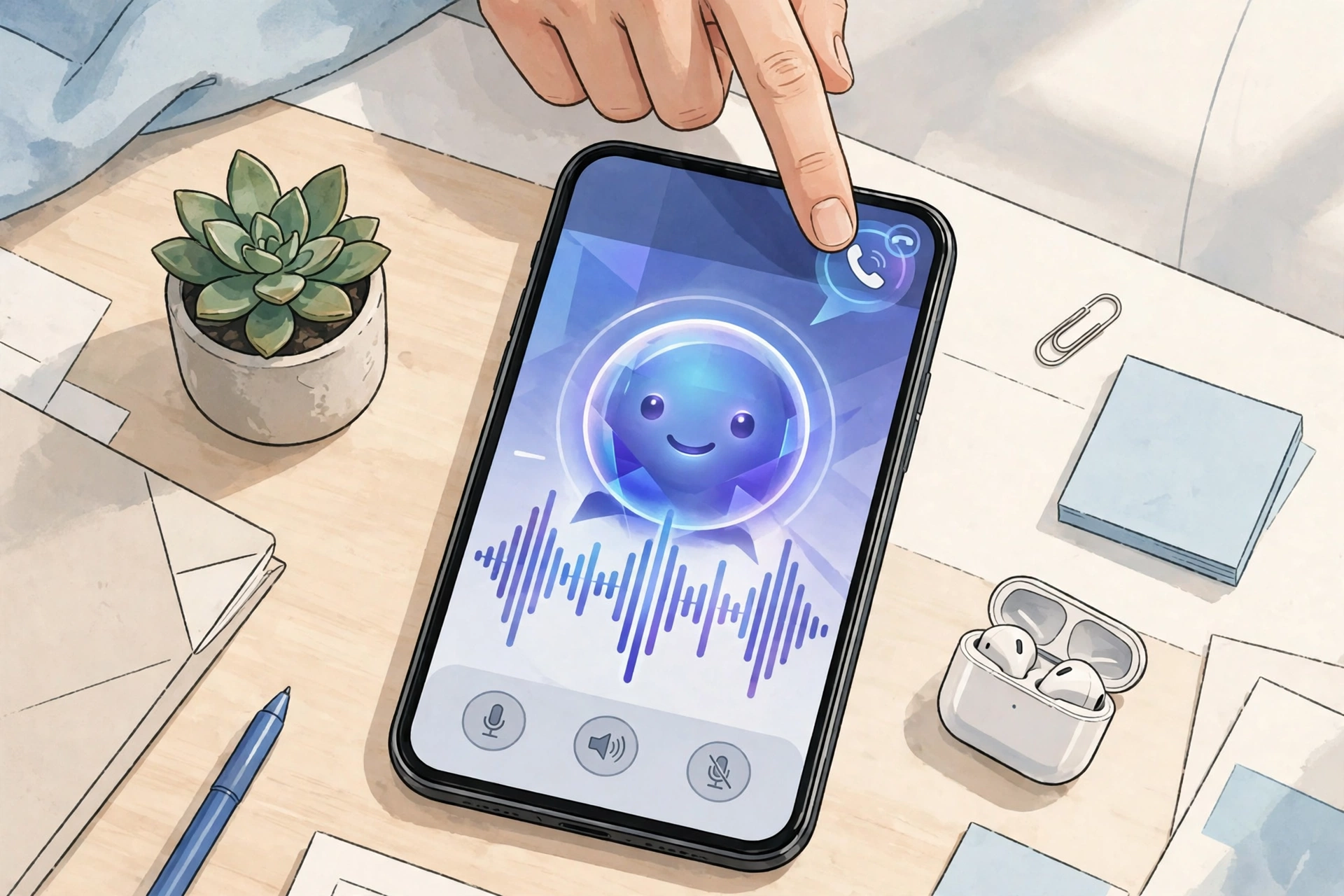
There are three ways to face your AI, according to Meta’s announcement. Users can talk voice-only, keep an avatar displayed beside the conversation, or switch to a full-screen face-to-face view. In every mode, the conversation is built for fluid exchange: Muse can respond while the user is still speaking, and it can be interrupted at any point.
That interruptibility matters more than it sounds. Most voice assistants still work in turns — you speak, you wait, it answers. Muse’s real-time system is designed to behave like a person on a call, reacting while you talk and adjusting as the conversation shifts. The avatar reinforces that feeling, using expressions and gestures that follow the tone of what is being said, whether the user is brainstorming, asking for help or simply thinking out loud.
Voice conversations can also run in the background while Muse carries out ongoing tasks, so a spoken request can keep working after the call itself has moved on. It is the same always-on direction the industry is heading in — Perplexity’s always-on Teammates agents, launched the same afternoon, take a similar approach to background work — but Meta is betting that a voice and a face will make the experience feel natural enough for everyday use.
The Technology Behind the Real-Time Avatar

Under the hood, Muse Realtime Voice and Muse Realtime Avatar are a single streaming system, according to a technical account from Meta AI Research. The voice model produces speech tokens that carry both the content of the reply and the way it should be delivered. The avatar is an audio-driven Diffusion Transformer conditioned on that token stream, along with reference media such as a portrait or illustration and a rolling window of recent video latents, so the face it generates stays in sync with the voice.
The numbers Meta reports are striking. The avatar streams 448-by-768 portrait video at 25 frames per second, with approximately 870 milliseconds of latency from the end of a user’s turn to the first byte of the synchronized voice-and-video response. Meta also reports that a single Nvidia GB200 chip can serve 12 concurrent real-time avatar sessions — a figure that hints at how the company plans to scale the feature to millions of users without the cost spiralling.
Meta says generated avatar video includes a durable, invisible Meta Video Seal watermark, applied without adding real-time latency. The research team cautions that its demo examples illustrate the model’s capability and do not all reflect avatars available in the Muse app itself. Muse is for users aged 18 and older.
Hundreds of Voices and a Customizable Avatar
Muse does not have one voice. Meta says users can choose from hundreds of voices, offered as styles, and change them at any time. The avatar is equally flexible: Meta’s default character has been nicknamed Jolly, but users can customize their Muse into a person, an animal or another character entirely.
That customisation is part of a broader design push. Meta published a follow-up post on November 6, 2026, about designing the Muse app to fit each user, and the avatar is the most visible expression of that idea. An assistant that looks and sounds the way you want it to is easier to trust with personal tasks — which is exactly what Meta needs if Muse is to handle planning, booking and buying on a user’s behalf.
The trade-off is that Meta’s announcement leaves several questions unanswered, including details on pricing beyond the free tier, data retention, conversation review practices and parental controls. Muse remains free with a usage limit, according to Meta’s subscriptions help page, with a Power plan at $20 a month and a Maximum plan at $100 a month for heavier use.
Where You Can Use It — and Where You Can’t Yet
For now, the rollout is US-only. Voice and expressive avatars are beginning to roll out first in the US Muse app, and Meta has given no date for Canada, Japan or Singapore. The iPhone app’s version 14.3 lists voice mode and expressive avatars in its release notes, while the Android app’s latest update, dated November 4, does not yet mention them — so Android users may see the feature arrive a little later.
The launch also highlights how quickly the AI assistant race is moving. The same week brought Google’s Gemini Omni 1.2 Flash video model, which generates and edits 15-second AI video clips, and OpenAI’s Images 2.6 image model, which speeds up image generation and adds GIF support. Voice, video and image generation are converging into a single multimodal contest, and Meta’s move puts a face on its entry.
What’s Next: AI Glasses and Muse Charm
The app is only the first stop. Meta says voice conversations with Muse are coming soon to AI Glasses and to Muse Charm, a pocket-sized device built around real-time voice interaction with the agent that was previewed at Connect 2026. Gadget Review reports Meta is planning expansion to AI glasses and Muse Charm by the end of 2026, with additional details promised later in the year.
That roadmap makes the strategy clear. Meta wants Muse to be available wherever you are — on your phone, on your laptop, on your face and in your pocket — with the same voice and the same avatar following you between devices. If the glasses and Charm versions land as planned, Muse would become one of the first AI agents designed from the start to live across screens and wearables rather than inside a single app.
What This Means for the AI Assistant Race
The deeper story of this launch is not the avatar itself but what it signals. AI assistants are competing on presence now, not just intelligence. A model that can reason is table stakes; the differentiator is becoming how naturally it can hold a conversation, how quickly it responds, and whether users feel comfortable talking to it out loud.
Meta’s technical choices reflect that bet: sub-second latency, a face that reacts in real time, hundreds of voices and a character you can reshape. The company is also leaning on its hardware advantage — 12 live sessions per GB200 chip — to make the economics work at scale. And the timing, landing within minutes of rival launches from Perplexity and Anthropic, shows how crowded this race has become: Claude’s Personal Finance beta, which connects the assistant to users’ bank accounts, takes the opposite approach, betting on usefulness over personality.
For users, the practical question is simpler: does talking to an AI feel better than typing to one? Starting November 5, US Muse users can find out for themselves. Tap the phone icon, pick a voice, and see whether a face makes the assistant feel more like a helper — or just more like a novelty. The answer will shape where every AI company goes next.
Related reading and sources
- Meta Newsroom — “Give Your Muse a Voice” (November 5, 2026)
- Unite.AI — “Meta Brings Real-Time Voice and Expressive Avatars to Muse”
- Gadget Review — “Meta Rolls Out Real-Time Video Calls With Customizable Muse AI Avatars Across the United States”
- Perplexity’s always-on Teammates agents
- Claude’s Personal Finance beta
- Google’s Gemini Omni 1.2 Flash video model
- OpenAI’s Images 2.6 image model