
AI video has spent the last year getting cheaper and longer in small steps. On November 5, 2026, Google DeepMind took one of the bigger steps: Gemini Omni 1.2 Flash, a video generation and editing model that is now generally available across the Gemini API and Gemini for business. The headline numbers are easy to grasp — native clips up to 15 seconds, up from 10, and 720p generation at $0.07 per second, 30% less than Omni 1.1 — but the more consequential changes are in how the model behaves: it holds onto references better, edits in conversation instead of starting over, and speaks more naturally.
For the first time, Gemini Omni is generally available rather than a preview, backed by Google Cloud’s enterprise infrastructure and security, with Provisioned Throughput for high-volume work. That matters because it turns a demo-grade capability into something a business can put into a production workflow — product videos, virtual try-ons, and ads made in volume, not one at a time.
Fifteen Seconds Changes What a Clip Can Do
The jump from 10 to 15 seconds sounds modest until you try to tell a story in it. Google’s launch post, written by DeepMind product manager Anish Nangia, makes the point directly: at 15 seconds, a single generation can hold a complete story, a product explainer, or a full social ad spot. Duration can be set in one-second increments anywhere from 3 to 15 seconds, so a creator chooses the length a scene actually needs instead of stretching or trimming to fit a fixed cap.
Longer clips only work if the video holds together across them, and that is where Omni 1.2 Flash’s consistency work comes in. Google says the model maintains stronger character, object, and scene consistency from the first frame to the last, with less visual drift or morphing across motion and camera transitions. Whether interpolating between a first and last keyframe or extending a clip into a longer sequence, products, characters, props, and environments are meant to stay consistent from shot to shot.
Reference Adherence: The Feature Underneath the Feature
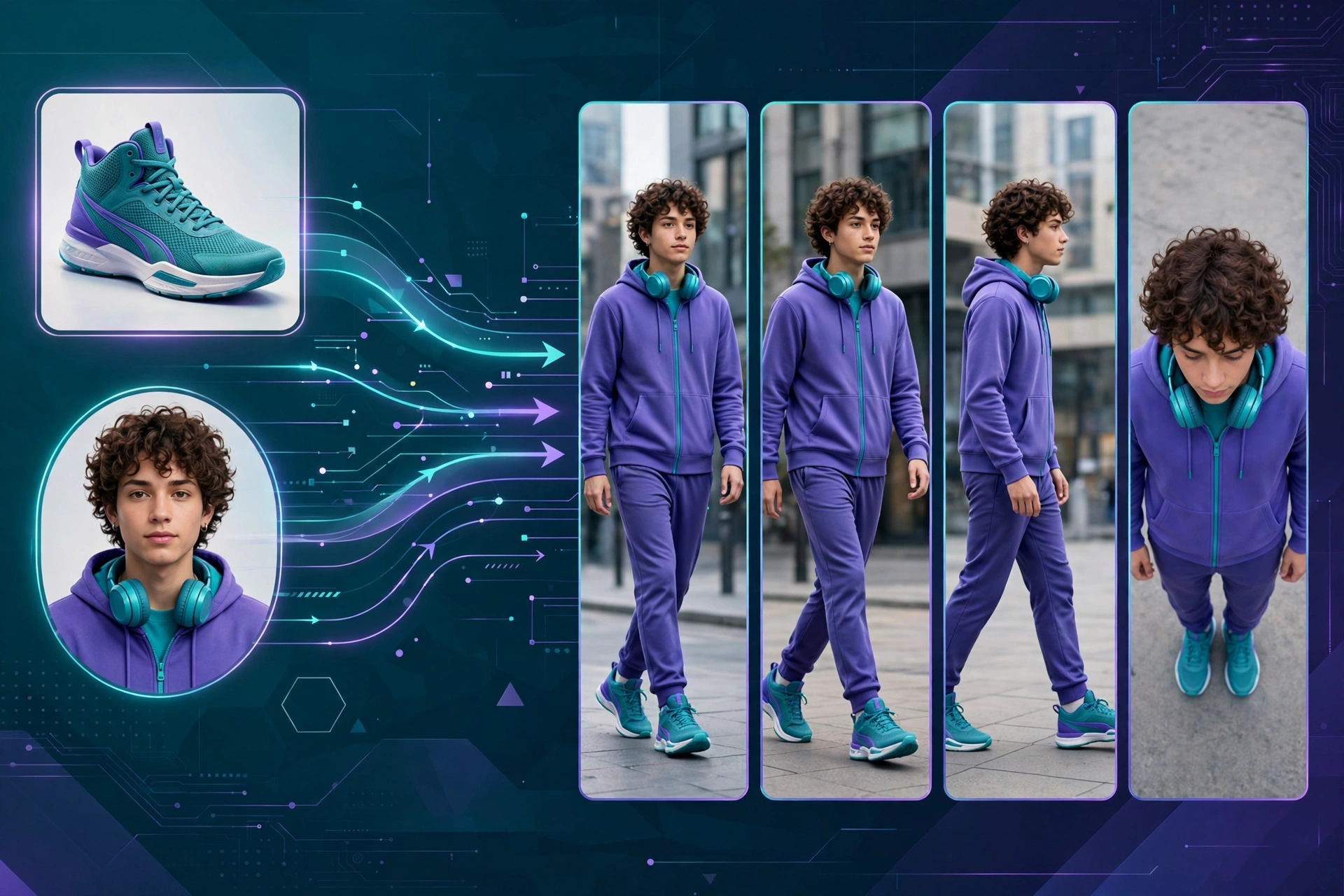
The capability Google emphasises most after length is reference following. Omni 1.2 Flash accepts a combination of character, product, or style images, short motion clips of up to three seconds, and audio cues — and holds onto those details from start to finish. Faces, garments, packaging typography, and brand colours stay consistent across camera angles, which is what makes it practical to turn existing product photography or character sheets into virtual try-on clips, catalog spins, and branded video ads.
Google’s own example is a virtual try-on sequence built from one model photo plus front-and-back product shots of three outfits: a 15-second sequence across 360-degree turns and match cuts that keeps the model’s identity and each garment’s cut, drape, and back details consistent. Another example builds an exhibition poster layer by layer from a single static reference, locking materials, shadows, and typographic details through the final frame where Omni 1.1 drifted. For brands, that kind of fidelity is the difference between a fun demo and a usable asset.
Edit in Conversation Instead of Starting Over
The second big workflow change is multi-turn conversational editing, now working across full 15-second clips. Instead of re-generating an entire clip when one detail is wrong, you refine the same clip turn by turn — swapping a product or background, changing the lighting or weather, or switching the aspect ratio. That makes it easy to produce ad variants for different audiences and placements without re-briefing or re-generating from scratch.

Google’s demonstration starts from one generated clip and swaps the background turn by turn — from a striped pavilion tent to an oak forest, a stable with a white horse, a market fair, and a stone castle — while keeping both characters’ performances, armor reflections, and camera framing intact. The economics reinforce the workflow: draft fast at 360p or 720p, fix a detail with a follow-up edit instead of re-generating the whole clip, and upscale only the creations you keep to 1080p or 4K.
More Natural Speech and a More Cinematic Camera
Omni 1.2 Flash also improves the audio side of generated video, with more fluid, natural-sounding dialogue, clearer lip-sync, and distinct multi-speaker conditioning. Conditioned on one scene image alongside character, mouth, and one-second voice references, the model routes each sampled voice to the right character with expressive lip-sync — useful for multi-character dialogue in Flow, video explainers in Gemini for business, and polished videos with avatars, music, and narration in Google Vids.
Camera control gets a similar upgrade. The model can direct complex, continuous camera movements — sweeping FPV flythroughs, dramatic zoom-outs, and orbits — with significantly fewer unwanted jump cuts, steadier scale, and a more polished, cinematic look. Google’s example is a single continuous FPV drone flight across a piazza, through bronze doors, and up through the Pantheon’s coffered dome to the oculus, with zero jump cuts.
The Price: $0.07 a Second, and Free Clips in Google Vids
At 720p, a second of video now costs $0.07 — 30% less than Omni 1.1 — so a full 15-second clip costs about $1.05 at that resolution before editing or upscaling. Google Cloud’s announcement notes similar savings at other resolutions. For businesses, Provisioned Throughput is available for high-volume work, and every output carries an imperceptible SynthID watermark for provenance.
The consumer entry point is deliberately generous. In Google Vids, anyone with a Google account or a Google Workspace subscription can generate up to three 15-second videos per month at no additional cost, with the rollout reaching domains within one to three days of November 5. In the Gemini app, 15-second video is rolling out to Google AI Ultra subscribers. Developers can prototype in Google AI Studio and build with the Gemini API, and businesses can try it in the Google Cloud console.
Creative platforms are already building on it. Photoroom uses Gemini Omni Flash to power its Video Ad Maker and Product Animator, and its CEO Matt Rouif said version 1.2 brings “15-second videos, a top user request” — and that with general availability and SLAs, the company “can rely on it in production for our sellers and enterprise customers.” Artlist, FLORA, invideo, Krea, Picsart, Runway, and QuickFrame AI are among the other customers Google cites, using the model for everything from video-to-video restyling to complete 15-second CTV ads in a single generation.
What It Still Cannot Do — and Why That Honesty Matters
Google is unusually candid about the model’s limits: development is ongoing to improve fast sports action, rapid script changes, and complex physics. Those are the known hard cases for video models generally, and naming them in a launch post is a useful signal for anyone planning real work on the model. A 15-second clip of a product spin is a solved problem; a 15-second clip of a fast break in a basketball game is not yet one.
The other honest caveat is about access. Audio references are gated behind allowlisting on Google Cloud, and the 15-second Gemini app rollout is limited to Ultra subscribers for now. Availability also varies by product: generation and editing up to 10 seconds are open more broadly in Flow, while 11-to-15-second clips, extension, and upscaling sit behind subscription tiers there. Check the live limits in the product you use before planning a project around them.
Why General Availability Is the Real News
Longer clips and a lower price are easy to headline, but the structural change is general availability itself. A preview model is something you experiment with; a generally available model with SLAs, Provisioned Throughput, and enterprise security is something you build a pipeline around. That is the shift Google is selling — and the customer list, from Photoroom’s product ads to QuickFrame’s CTV spots, is the evidence that businesses are already doing it.
AI video is converging on a pattern: longer, cheaper, more consistent, and edited in conversation rather than regenerated from scratch. Omni 1.2 Flash moves all four at once. The test now is whether the consistency holds up outside Google’s curated demos — on a real product catalog, a real brand’s typography, a real script. If it does, the 15-second clip becomes the default unit of AI video, and the five-second teaser starts to look like a relic.
Related Reading and Sources
- OpenAI’s new image model shows how fast AI media is moving — our coverage of OpenAI Images 2.6: https://inspireviraltimes.com/openai-images-2-6-faster-image-generation-gifs-api-models/
- Salesforce’s Koa Decisions shows the other side of fast AI — a decision model built for milliseconds: https://inspireviraltimes.com/salesforce-koa-decisions-ai-decision-model/
- Tencent’s sovereign AI private cloud puts AI infrastructure under enterprise control: https://inspireviraltimes.com/tencent-cloud-enterprise-sovereign-ai-private-cloud/
- Wizard Cyber’s CYBERSHIELD AI brings agentic AI into the security operations centre: https://inspireviraltimes.com/wizard-cyber-cybershield-ai-agentic-soc/
- Google’s official Gemini Omni 1.2 Flash launch announcement: https://blog.google/innovation-and-ai/technology/developers-tools/introducing-gemini-omni-1-2-flash/
- Google Cloud’s announcement of general availability: https://cloud.google.com/blog/products/ai-machine-learning/gemini-omni-1-2-flash-generally-available
- TechRepublic: Google’s new AI video model creates 15-second clips at 30% lower prices: https://www.techrepublic.com/article/news-google-omni-1-2-flash-video/

