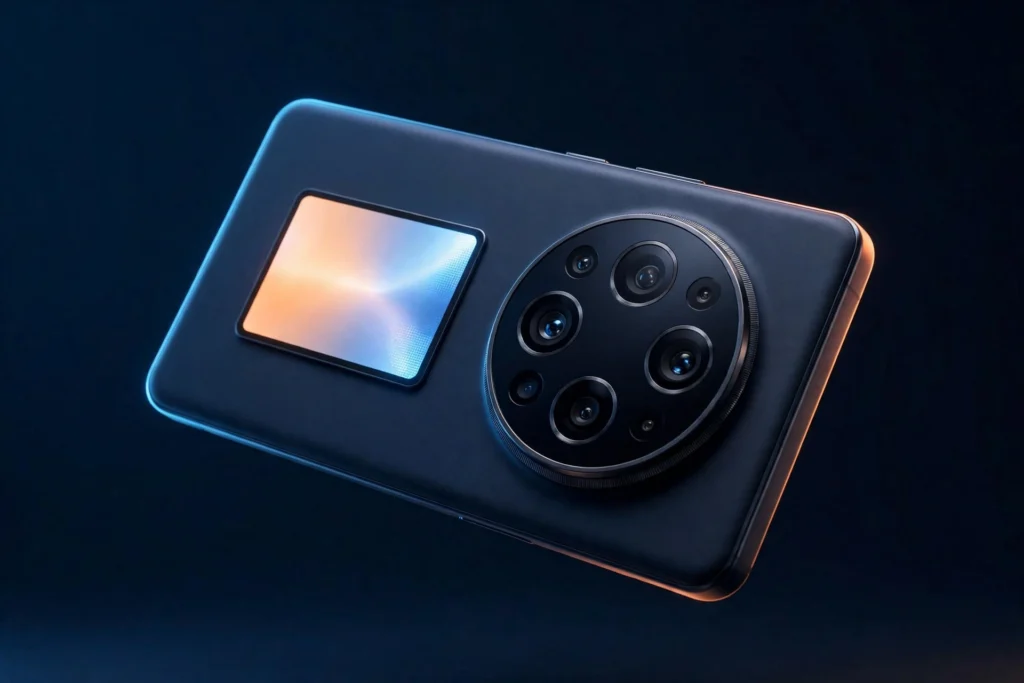
Honor has unveiled the Honor 700 series in China, and it is one of the most unusual phone launches of the year. All three models — the Honor 700S, Honor 700 and Honor 700 Pro — ship with a second screen on the back, a 200MP main camera and a 9,000mAh battery, all inside a body just 7.96mm thick. The lineup was announced at a launch event in Wuhan on November 23, 2026, with pre-orders open in China and first sales starting November 27. Honor has not confirmed a global launch yet, so for now the series is a China-only affair — but the ideas in it say a lot about where smartphone design is heading.
A Second Screen on the Back: Floating Island
The headline feature is a 1.59-inch rear display that Honor calls Floating Island. It sits beside the camera module rather than replacing it, and the glass is shaped to flow seamlessly into the rear panel. The screen is more than a gimmick: it shows notifications, flight information and music controls, and it can be personalised with wallpapers and an AI sticker engine that turns a one-line prompt into artwork for the back of the phone.
The most practical use is photography. Flip the phone around and the rear display becomes a viewfinder, so you can frame a shot with the main camera instead of the front camera. That is a trick other brands have tried before — usually on one expensive flagship — but Honor has put the rear screen on every model in the range, including the cheapest one. It is a sign that the company sees the second display as a core feature, not a one-off experiment.
A 200MP Camera That Takes Its Own Selfies

Every phone in the series shares the same 200MP main camera, built around a 1/1.56-inch sensor with optical image stabilisation. The Honor 700 and 700 Pro add a 12MP ultrawide camera and a 50MP periscope telephoto with 3.5x optical zoom, while the 700S makes do with the 200MP main and a 12MP ultrawide. The 700 and 700 Pro also support an optional 200mm telephoto converter lens that Honor first introduced with its Magic 9 series.
The rear display changes what the main camera is for. Paired with a soft-light ring around the camera, the 200MP sensor effectively becomes the selfie camera — a big step up from the small front sensors most phones rely on. For anyone who posts a lot of photos or video, that alone may be the series’ most useful feature. The front display, meanwhile, is a 6.57-inch 1.5K LTPS AMOLED panel with a 120Hz refresh rate, up to 8,000 nits of peak brightness and high-frequency PWM dimming aimed at reducing eye strain.
A 9,000mAh Battery in a 7.96mm Body

The battery is the other number that stops you scrolling: 9,000mAh in every model, using Honor’s Qinghai Lake battery technology. For comparison, most flagship phones still ship with batteries in the 5,000–5,500mAh range. Fitting nearly double that capacity into a 7.96mm body weighing 208–213 grams is the kind of engineering that only became possible with newer silicon-carbon battery chemistry, and it is fast becoming a signature of Chinese phone makers.
Charging is 80W wired across the lineup, the Pro adds 50W wireless charging, and all three support 27W reverse wired charging to top up other devices. Honor has not published official battery-life figures yet, but a 9,000mAh cell should comfortably deliver two days of normal use — the kind of endurance that makes battery anxiety a non-issue for most people.
Three Chips, Three Price Points
The three models are separated mainly by their processors. The Honor 700S runs Qualcomm’s Snapdragon 7 Gen 4, the Honor 700 steps up to the Snapdragon 8s Gen 4, and the Honor 700 Pro gets the flagship Snapdragon 8 Gen 5. All three also carry Honor’s own C3 radio chip for better signal stability, and run MagicOS 11 based on Android 17. Durability is strong across the range, with IP68, IP69 and IP69K dust and water resistance ratings.
Pricing in China starts at ¥3,599 (about $530) for the 700S with 12GB of RAM and 256GB of storage, ¥3,999 (about $590) for the Honor 700, and ¥4,599 (about $675) for the Honor 700 Pro in the same configuration. Introductory and government-subsidised prices are lower still for eligible buyers. That puts even the Pro well below the price of a typical Western flagship — though, as ever with China-only launches, import costs and warranty questions would change the maths for buyers elsewhere.
A Phone That Checks Your Health
One quieter addition deserves attention: the Honor 700 and 700 Pro include a PPG sensor on the rear display. Place a finger on the screen for 60 seconds and the phone reports heart rate, blood oxygen levels and heart rate variability, along with an assessment of stress and emotional state. It is not a medical device, and it will not replace a smartwatch for continuous tracking, but it turns the phone’s second screen into a quick health check — a genuinely new use for a rear display.
Price, Availability and the Global Question
Pre-orders are open in China now, with general sales beginning November 27, 2026. The open question is whether the series ever leaves China. Honor has not announced international plans, and its recent launches have sometimes stayed home. That would be a shame: the combination of a rear display, a 200MP camera and a 9,000mAh battery at these prices is exactly the kind of package that would stand out in Western markets, where phone design has felt increasingly samey.
Whether or not it goes global, the Honor 700 series is a useful preview of the next wave of smartphones. Second screens, silicon-carbon batteries and health sensors built into the body are all ideas that could spread quickly — and, like the recent wave of AI-first gadgets such as Nothing’s first AI device, OpenAI’s first AI device and Genspark’s SecondBrain VoicePad, it shows hardware makers still believe a bold new form factor can win attention. As with Apple’s Siri AI rollout and Google’s AI Mode, the software matters as much as the hardware — but on the Honor 700 series, it is the hardware that does the talking.
Sources: TechRepublic’s launch coverage, FoneArena’s full specifications, Notebookcheck’s report on the Honor 700S.