Most AI gadgets ask you to learn a new way of working. The SecondBrain VoicePad asks for less: five buttons, your voice, and a desk. Genspark launched it on Kickstarter today, November 24, 2026, and it is the most practical piece of AI hardware to appear this month — not because it does something no software can do, but because it removes the friction between thinking something and getting it into your computer.
The idea is simple. Instead of opening an app, finding the right tab and typing out a prompt, you press a key and say what you want. The VoicePad types clean, punctuated text straight into whatever app you are in, filtering out filler words and false starts along the way. Press another key and an AI agent takes over — summarising your meeting, drafting a document, or building a slide deck. It is a remote control for the AI tools you already use.
What the VoicePad Actually Is
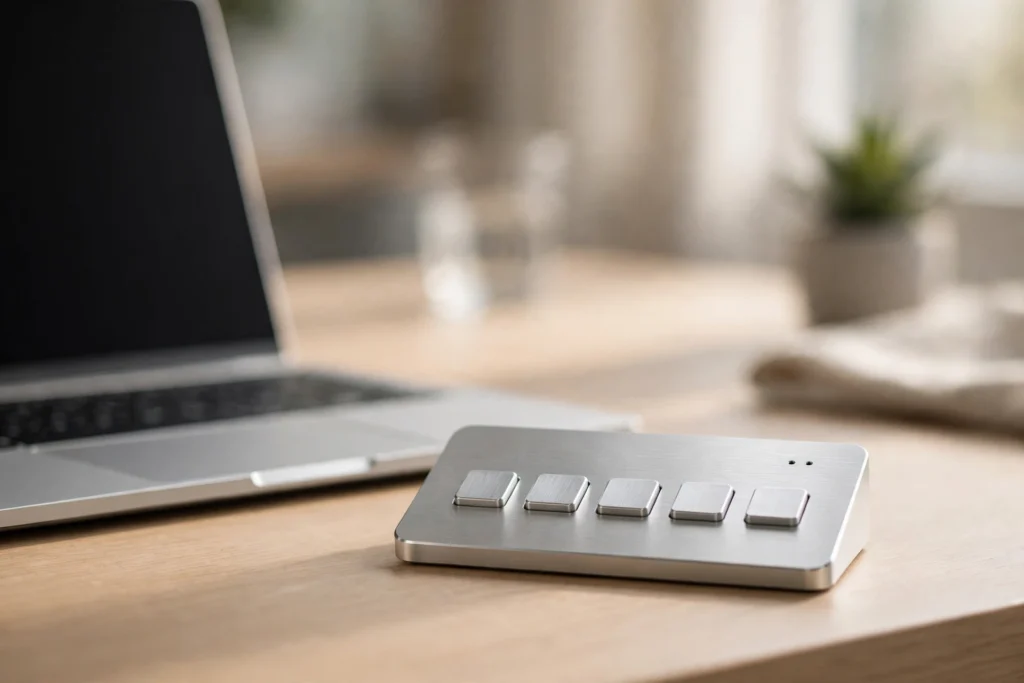
The VoicePad is a compact desk accessory: a CNC-machined aluminum body weighing just 85 grams, with about 20 hours of battery per charge, connecting to Windows PCs and Macs over Bluetooth or USB-C. It sits beside your keyboard, comes with a magnetic mount, and can even record on its own with no computer attached.
The hardware is deliberately simple. Five large, individually programmable keys use tactile CHERRY MX Ultra Low Profile switches with 1.8 mm of total travel — the kind of switch you would expect on a good mechanical keyboard, shrunk into a desk pad. Two built-in noise-canceling microphones handle voice capture. There is no screen, no speaker doing the talking, and no AI running on the device itself. Everything clever happens in the free Genspark Super App, which the VoicePad is built to drive.
That is worth stating plainly, because it defines what the gadget is and is not. It is a beautifully made input device for Genspark’s software, not a standalone computer. If you do not use Genspark’s tools, it is an expensive macro pad. If you do, it is the fastest way to reach them.
Five Keys, Any App, Any AI

Each of the five keys can be programmed in the companion software to do a different job. A key can launch an app — ChatGPT, Claude, Notion, YouTube or local software — trigger an everyday shortcut such as Enter, Copy or Paste, or spin up a specialised AI agent like a meeting notes summariser. Genspark’s own pitch is that each AI assistant gets its own key: ChatGPT, Claude, Gemini and Grok, one press away.
The same idea extends to the apps you live in. One key can open Slack, Notion, Figma or Zoom, and the VoicePad is pitched at five kinds of desk work in particular: salespeople get CRM notes and a follow-up email after a call, designers open Figma and give feedback by voice, creators turn one spoken idea into a script and a content brief, students speak notes straight into Notion, and project managers get a meeting summary, tasks and a project update when the call ends.
The speed argument is Genspark’s headline claim: you talk about four times faster than you type — roughly 160 words a minute of natural speech against about 40 words a minute of typing. Treat that as the company’s marketing number, not a measured benchmark, but the direction of travel is hard to argue with. Dictation has always been faster than typing; the reason most people do not use it at work is that it feels awkward in a shared office. That is the problem the VoicePad’s microphones are built to solve.
Voice agents are getting cheaper and better — OpenAI’s GPT-Live-1.1 voice agents now cost far less when nobody is talking.
The Whisper Voice Advantage

Voice AI has a social problem in the workplace. Barking commands at a machine while colleagues try to focus feels rude, and leaning into a laptop to dictate quietly usually means the laptop hears half of it. The VoicePad attacks that directly with a dual-microphone array designed for what Genspark calls “whisper voice” — speak quietly and naturally, and the device still picks up every word.
The two noise-canceling microphones sit close to your mouth when the pad is on your desk, and reviewers who have tried pre-production units report they can pick up a whisper at close range. If that holds up in real offices, it changes the calculus: voice stops being something you use when nobody is around and becomes something you use all day.
The meeting feature is the clearest example. Press once and the meeting takes its own notes, even across languages, with a clean summary sent the moment the meeting ends. The VoicePad can record offline and on its own, so you can take it into a meeting room without a laptop and still come back with notes.
One Press, Finished Work
The VoicePad’s real pitch is not dictation — it is delegation. It is deeply integrated with the Genspark Super App and Workspace ecosystem, and a single press can launch any Genspark agent. The Meeting Notes Agent records a discussion and sends a summary when it ends. The Super Agent takes a bigger task, breaks it into steps, hands each one to the right subagent, and delivers finished decks, documents and spreadsheets.
Genspark’s demo makes the point in two sentences. Say “Make a 6-slide deck on our Q3 results” and you get a finished slide deck. Say “Compare our top five competitors in a sheet” and you get a finished sheet. That is the same agent-first direction the whole industry is moving in: Meta’s Muse agent now shops and acts inside other apps, and Google Gemini’s Computer Use brings agents to the Mac desktop. The VoicePad is hardware built for that world — a physical button for an agent workflow.
There is also a quieter idea underneath it. Everything you record — notes, prompts, meetings — goes into Genspark Workspace, which uses it to learn how you work and take routine admin tasks off your plate. It is the same philosophy as Genspark’s earlier SecondBrain Note, which captured voice context on the go; the VoicePad brings that idea to the desk. How much of your working life you want one company’s workspace to learn is a question worth asking before you buy in — but for people already living in Genspark’s tools, it is the point.
Price, Kickstarter Deal and What’s Included
The VoicePad makes its debut on Kickstarter today, with the campaign running through December 2026 and ending on December 29. The regular retail price is $169, and Kickstarter backers are expected to pay between $119 and $149. Early birds who reserved ahead of launch can get a VIP price of $99 with a refundable $9.99 deposit. The first units are expected to ship in January 2027, in pledge order.
Every VoicePad comes with a generous bundle of service allowances. Unlimited real-time voice input and text translation are included for 365 days from first activation, after which dictation falls back to the free plan limit of 4,000 words per week. Transcription and AI summary come to 300 minutes per month for the lifetime of the product, and each device includes 1,000 one-time Genspark Super Agent credits, valid for 365 days. Power users who want more can step up through Genspark’s subscription tiers, from Free to Plus at $24.99 a month, Pro at $249.99 a month, and Team or Enterprise plans.
The Honest Caveats
Three things are worth knowing before backing. First, the $119 to $149 Kickstarter range is the expected price, not a confirmed one — it appears in press coverage but not in Genspark’s official campaign materials, so the final pledge tiers are what count. Second, this is Kickstarter, with all the usual crowdfunding reality: the campaign ends December 29, shipping is expected in January 2027 but that is an estimate, and backing a project does not guarantee you will receive the product. Third, the VoicePad has no AI of its own, so everything beyond recording depends on Genspark’s software and an internet connection — and details of cloud processing and data retention have not been fully spelled out.
The comparison with the rest of this year’s AI hardware is instructive. Nothing’s first AI device is a screenless gadget with a talk button, unveiled for December 8, and OpenAI’s first AI device is reportedly an audio headset rather than a pen — while OpenAI’s Jony Ive device has been delayed past 2026 by software troubles. The VoicePad is more modest than any of those: it does not try to be a new computer. It tries to be the fastest way to talk to the computers you already have, and it is shipping — or at least, taking pledges — today.
Why It Matters
The VoicePad matters because it answers the question every AI gadget has to answer: why hardware, when software could do this? The answer here is friction. Typing a prompt takes effort, opening the right app takes clicks, and dictating in an open office takes nerve. Five physical keys and a whisper-sensitive microphone remove all three at once. That is a small idea, but it is the kind of small idea that actually changes how people work — if the hardware lives up to the promise and the agents behind it deliver.
For anyone who spends the day in Genspark’s tools, or who has been waiting for a reason to start, the Kickstarter price makes this an easy gadget to watch and a reasonable one to back — with eyes open about crowdfunding. The rest of us should watch what happens in January, when the first units ship and the whisper test meets a real open-plan office.
Sources: the official VoicePad product page, Notebookcheck’s hands-on look and Digital Trends’ report.