OpenAI’s first consumer hardware device may sit in your ear, not in your pocket. A new report says the company’s long-rumoured first AI gadget will be an audio headset — and, notably, not the AI pen that earlier speculation had pointed to. According to the report, OpenAI will begin mass production once it finalises its manufacturing vendor, and it has already decided how many units to ship in the first year.
Nothing is confirmed by OpenAI itself, and the supply-chain rumours still disagree on the details. But the picture forming now is of a voice-first device built around ChatGPT — and of a company moving from software into hardware in earnest.
What the new report says
The report, published on November 20, 2026, says OpenAI’s first mystery AI device will be an audio headset. The San Francisco company will soon begin the process of mass-producing the hardware once it finalises the vendor, and it has reportedly already decided the volume of shipments for the first year.
The most interesting detail is what the device is not. Earlier speculation had suggested OpenAI’s first gadget could be an AI pen — a small, pocketable writing-style device. The new report says the first launch will not be a pen at all. That matters, because the form factor decides everything else: how you talk to it, where it lives on your body, and what it can sense about the world around you.
The headset report fits a broader pattern. OpenAI has been steadily building the voice side of ChatGPT, from real-time voice conversations to GPT-Live-1.1 voice agents, and a device that lives in the ear is the most direct way to make that voice assistant always available.
Why the Ear Makes Sense for OpenAI

There is a simple reason an audio headset is a natural first device for OpenAI: voice is where ChatGPT is already strongest. A headset puts the assistant a word away, with no screen to unlock and no app to open. It can hear what you hear, answer in real time, translate a conversation, take notes from a meeting, or quietly remind you of something mid-task.
The idea has a pop-culture shorthand, too. Ever since OpenAI demonstrated GPT-4o holding a spoken conversation with human timing and inflection, observers have compared the goal to Samantha, the operating-system companion from the 2013 film Her. As one analysis of the race puts it, OpenAI wants to build Samantha — and has concluded that she lives in the ear.
Reports have also given the project a codename: Sweet Pea. Supply-chain accounts describe it as an AI earbud built around a custom 2nm chip, which would put serious on-device processing power into something the size of a fingertip. That kind of chip would let the device handle wake-word detection, noise cancellation and some inference locally, without waiting on the cloud for every word.
But the reports do not agree yet
Before taking any single report as fact, it is worth noting how much the accounts still differ. Other supply-chain reports describe a very different first device: a screenless, doughnut-shaped AI speaker, about the size of a hockey puck, with microphones, speakers, a camera and sensors built in, priced at around $400 and launching in 2027.
The manufacturing story is just as unsettled. Early reporting from The Information, later cited by Reuters, said Luxshare — a major Apple supplier known for assembling iPhones and AirPods — had reached an agreement to assemble at least one future OpenAI product. A separate supply-chain report says Luxshare will exclusively handle final assembly and supply core components, with shipments possibly beginning by the end of 2026. Yet later accounts cited by TrendForce suggest the order could shift to Foxconn instead, with final assembly possibly moving to Vietnam or the United States. Neither OpenAI, Foxconn nor Luxshare has confirmed any of these claims.
Even the timing is disputed. One set of reports points to shipments starting by the end of 2026; another says customer deliveries may not begin before 2027. That tension echoes the delay reported earlier this week: OpenAI’s Jony Ive AI device was reported delayed by software and infrastructure troubles, with the hardware said to be progressing well while the software and computing power behind it prove harder to solve.
The Jony Ive connection
Whatever the first device turns out to be, it carries the fingerprints of one of the most famous designers in tech. The hardware project gained momentum after OpenAI acquired io Products, the startup founded by former Apple design chief Jony Ive, in a deal valued at about $6.5 billion. Ive’s design firm, LoveFrom, has also been linked to the work.
That pedigree is why the device draws so much attention. Ive led the design of the iPhone, the iPad and the Apple Watch, and OpenAI’s bet is that the same design thinking can make an AI companion feel as natural as a phone once did. The reports describe a compact, context-aware device closely connected to ChatGPT’s models, with cameras and sensors that let it understand its surroundings — not just answer questions, but see and hear the world the user is in.
The crowded AI hardware race
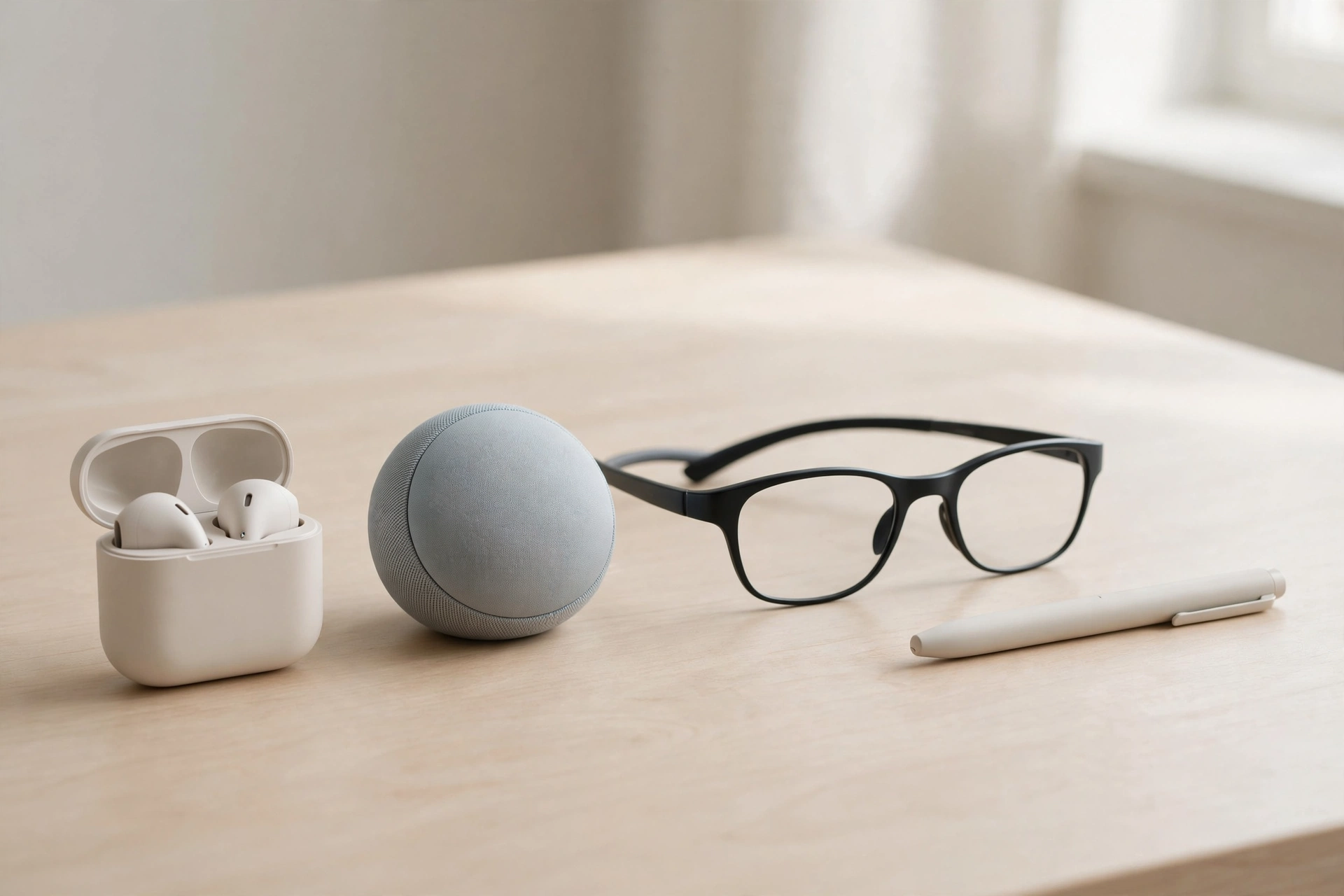
OpenAI is not entering an empty field. AI hardware is suddenly the busiest corner of consumer tech. Nothing’s first AI device, a screenless gadget with a dedicated Talk button, is set to be unveiled on December 8. Oppo’s Heartball AI wearable, a 9.8-gram clip-on AI coach, is heading for launch in China. Google’s Gemini smart glasses are opening for pre-order, and Meta’s smart glasses have been selling for years.
Each company is betting on a different body part: the ear, the face, the wrist, the pocket. The winner will likely be decided less by hardware specs than by which assistant is smartest and most useful in the moment — and that is exactly the contest OpenAI, with ChatGPT’s scale, is built to fight.
What to watch next
The next hard facts should come from OpenAI itself: an official unveiling, a confirmed form factor, a price and a date. Until then, watch for three signals. First, whether a manufacturing partner is confirmed — Luxshare, Foxconn or someone else — since a signed assembly deal usually precedes a launch by months. Second, whether the headset or the doughnut speaker emerges as the real first product, or whether both are real and simply launching in sequence. And third, whether the device ships with the new voice models OpenAI has been rolling out, which would make the ear the front door to ChatGPT.
OpenAI has spent years as a software company that lives inside other people’s devices. Its first headset — if that is what it turns out to be — would be the moment it finally builds a home of its own.
Sources: Gadgets 360’s report on the headset (https://turbo.gadgets360.com/en/ai/openai-first-mystery-device-ai-audio-headset-ai-pen-report-news-10797576), AIBase’s supply-chain report on year-end shipping (https://news.aibase.com/news/32393), and CEO Frontier’s analysis of the AI earbud race (https://ceofrontier.com/articles/the-race-to-put-a-mind-in-the-ear-who-owns-the-ai-companion).