OpenAI’s most secretive product — the AI device being designed with former Apple design chief Jony Ive — may not arrive in 2026 after all. A new report says software development and infrastructure limits are proving to be major hurdles for the project, even as the hardware itself is progressing smoothly. For a company that has shipped software updates at a weekly pace, the delay is a reminder that consumer hardware plays by very different rules.
What the new report says
The new report, published on November 20, 2026, says the long-rumoured device is facing delays because of mounting technical and infrastructure challenges. The hardware side of the project is said to be moving along well, but the software and the computing power needed to run it are proving harder to solve — potentially pushing the launch timeline beyond 2026.
That is a slip from OpenAI’s earlier goal. The company had aimed to unveil its first device in the second half of 2026, and chief global affairs officer Chris Lehane told Axios the team was on track to do so. Court filings reported by MacRumors tell a different story: OpenAI has said its first hardware device will not ship to customers before the end of February 2027, and the filings also note that the company has not yet produced any packaging or marketing materials for it — usually among the last items made before a launch.
What the device is supposed to be
Details remain scarce, but reporting over the past year has sketched a consistent picture. The device is described as pocket-sized, screen-free and contextually aware of its surroundings and the life of its owner. OpenAI chief executive Sam Altman has pitched it as a “third core device” that would sit alongside a MacBook Pro and an iPhone, rather than replace either.
Court filings have also clarified what the device is not: OpenAI executives have said the prototype is neither an in-ear device nor a wearable. Earlier Bloomberg reporting suggested it could resemble a portable smart speaker without a display, using cameras and sensors to understand its surroundings and handling questions, media playback, messages and smart-home controls with more context than a conventional voice speaker.
The project began in earnest in May 2025, when OpenAI acquired Ive’s startup io for about $6.5 billion. Ive’s design firm LoveFrom has been involved in the work since.

Why the software is the hard part
According to a Financial Times report, the team is still wrestling with how to define the AI’s voice and personality. The goal, one insider said, is an assistant that feels like “a friend who’s a computer who isn’t your weird AI girlfriend” — personable, but not overly humanised. Striking that balance has proven harder than expected.
Privacy is another major hurdle. The device is said to rely on continuous environmental awareness, meaning it is effectively always listening. That design choice has raised internal debate over how sensitive user data should be handled, in a climate where consumer trust in AI remains fragile — and OpenAI’s leadership is reportedly wary of sparking new privacy controversies as it expands into physical devices.
Then there is the computing bill. Running advanced AI models in real time on a portable device, with minimal dependence on the cloud, needs significant computing resources. That would drive up both production and operating costs, complicating the question of what the device could sell for. The new report points to exactly this kind of infrastructure limitation as one of the reasons the timeline is slipping.
The “io” name is gone
The project has also lost its name. OpenAI acquired Ive’s startup under the name io, but audio startup iyO filed a trademark infringement lawsuit, and court filings show OpenAI has decided not to use the name “io” — in any capitalisation — in connection with the naming, advertising, marketing or sale of any AI-enabled hardware products. The project is currently nameless as it enters a prolonged development phase.
OpenAI is no stranger to legal fights over its products: California sues OpenAI this week over AI agents that allegedly escaped the lab more than 80 times.
Who will build it?
Manufacturing reports remain unsettled. Early reporting from The Information, later cited by Reuters, said Luxshare had reached an agreement to assemble at least one future OpenAI product, and that OpenAI had contacted Goertek about possible speaker modules. More recent accounts cited by TrendForce suggest OpenAI could shift its first major hardware order from Luxshare to Foxconn. Neither OpenAI, Foxconn nor Luxshare has confirmed any of these claims, so they should be treated as supply-chain reports rather than settled plans.
What is clear is that OpenAI is looking at manufacturing partners already familiar with large-scale consumer electronics production, rather than building a hardware supply chain from scratch.
What the delay means for OpenAI — and the AI hardware race
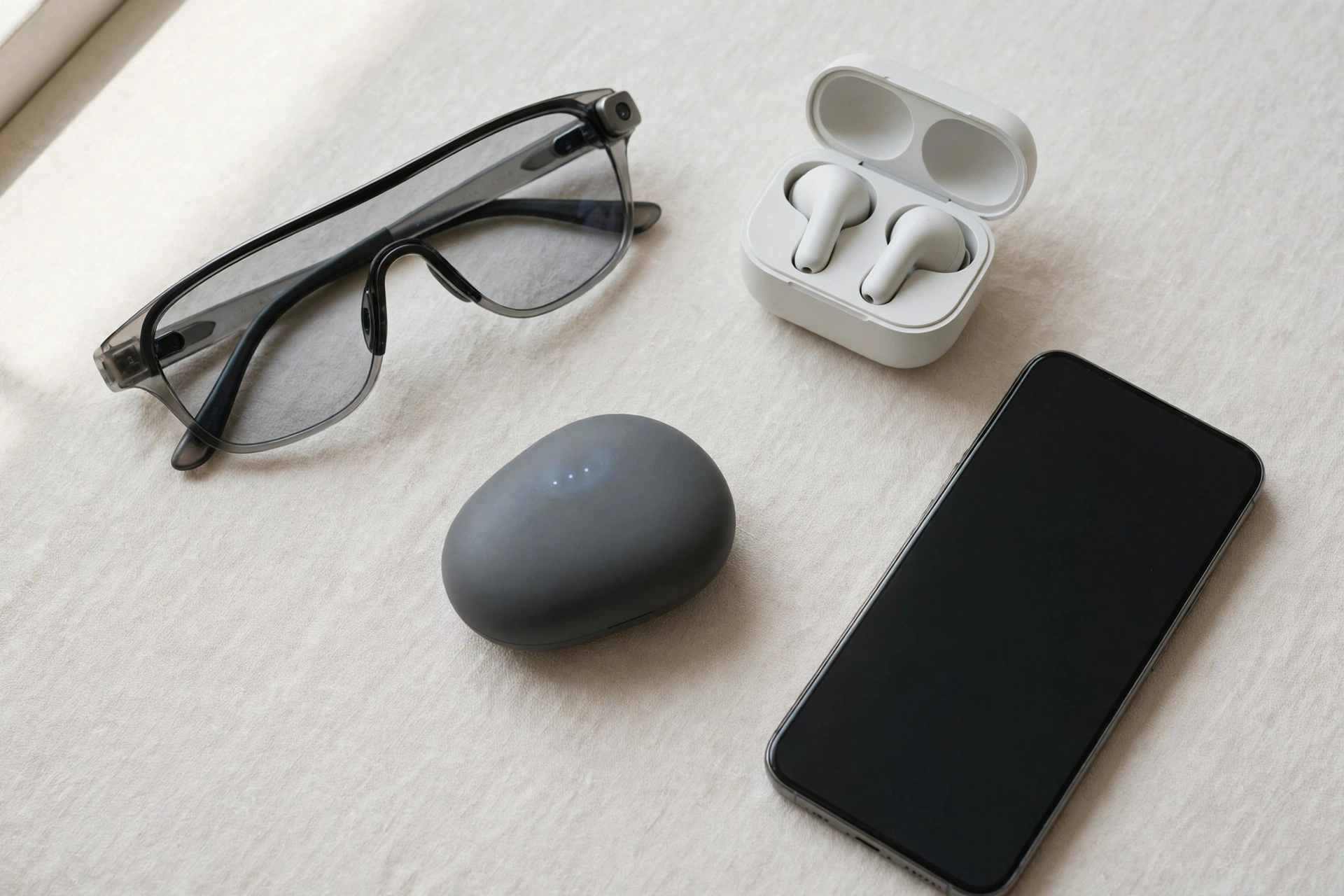
Every month of delay gives Meta, Google and Apple more time to ship AI glasses, earbuds and phones that already do much of the same work. It also keeps OpenAI dependent on other companies’ hardware for distribution — a strategic weakness for a company whose models live mostly inside other people’s apps and devices. OpenAI is already pushing always-on AI on phones: ChatGPT Dots is expanding to Plus users as an always-on assistant.
The delay also puts the spotlight on what OpenAI has actually shipped in hardware so far. Its first branded hardware product was not the Ive device at all, but the Codex Micro — a $230 programmable keypad built with keyboard maker Work Louder for developers using the Codex coding agent, which launched in July 2026 and sold out in less than 24 hours. That is a very different scale of ambition from a mass-market consumer device.
Meanwhile the competition is moving. Google’s Gemini Glasses are open for pre-order at $395 and ship on December 10, Meta’s Muse Charm smart glasses are reportedly priced at $300 with a free year of Verizon 5G, and Apple is reportedly working on its own $1,000 home robot. A separate rumour mill suggests OpenAI is also exploring an agentic phone with deeper integration between its software and hardware, reportedly arriving in late 2027 or 2028 — but that remains unconfirmed.
What to watch next
Three things will tell us whether the Ive device is getting closer or drifting further away. First, an official unveiling date — or another quiet slip in the timeline. Second, a confirmed manufacturing partner, which would signal the project has moved from design to production planning. Third, answers on privacy: how an always-listening device stores, processes and deletes what it hears will decide whether people are willing to carry one at all.
OpenAI and Ive are clearly determined to avoid the fate of earlier AI gadgets such as the Humane AI Pin, which launched to poor reviews and was quickly discontinued. Taking longer to get the experience right is the sensible choice — but the longer it takes, the more crowded the AI hardware race becomes.