Another day, another sea of placards spilling out onto Europe’s streets. On Friday, tens of thousands of young people walked out of schools and universities and filled city squares across more than 25 countries, in a coordinated youth-led day of action against the rising cost of living, underfunded education and what protesters call a rush to rearmament.
The demonstrations continued into Saturday in several European cities, with students in France and Spain turning out again to demand better school conditions and lower living costs. Organisers billed the action as an “international youth strike” under the slogan “Fight for Our Future, Not Their Wars” — and the crowds that answered suggest a generation that has decided to be heard.
A Continent-Wide Day of Action
Young demonstrators mobilised in central squares and capitals spanning the continent on Friday. In Britain, students from more than 350 schools, colleges and universities were expected to walk out, according to Socialist Students, one of the groups taking part — and multiple student groups marched toward London’s Parliament Square, where protesters showed up in their hundreds.
In Germany, the campaign group “Gen Z regelt” — “Gen Z takes charge” in German — said it was organising protests in 73 cities and towns. Roughly 4,000 people attended a protest in Berlin’s monumental Alexanderplatz square, while the Cologne protest drew fewer than the 5,000 expected, though still in the thousands, according to police. In Austria, around 2,000 people gathered in Vienna, where police dispersed the gathering after confrontations, using pepper spray and detaining around 20 people, according to Austrian daily Der Standard.
The US embassy in France warned that multiple groups had planned protests for Saturday and Sunday, which could trigger travel disruption including last-minute metro and rail closures.
Italy at the Centre: Unions Join the Students
Italy saw the widest demonstrations of the day. The country’s largest trade union, CGIL, said protesters demonstrated in over 100 squares, including Milan’s Piazza del Duomo, and called on its members to observe a nationwide general strike. Workers demanded higher wages and pensions, measures against rising costs, and increased funding for education and healthcare.
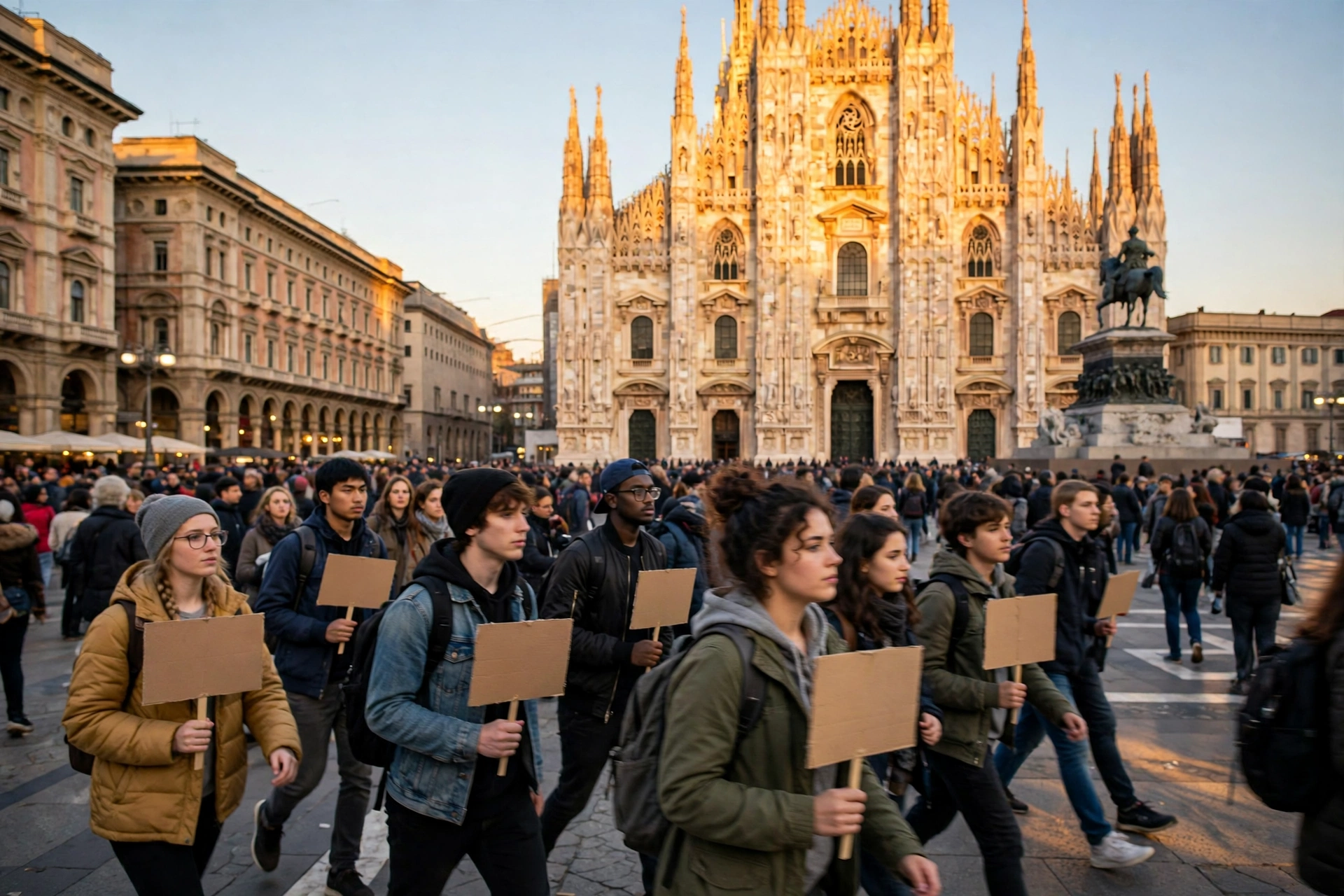
The head of CGIL, Maurizio Landini, claimed more than 1 million people participated in the protests in Italy, though that figure could not be confirmed. “Today is also a very important day because young people are taking to the streets not just in Italy but across Europe,” Landini said on Friday, according to Reuters. “The demand for change is growing.”
In Rome, Genoa, Bologna and Milan, protesters called for an end to rearmament and more investment in public services, chanting “Money for schools, not war” and “We want to live life without the high cost of living.” A strike by transport workers in Italy on Saturday was expected to disrupt train lines. Giorgio Airaudo of CGIL described the international day of action as a “beautiful day when students, workers and retirees came together to say no to war and rearmament.”
Germany’s “Gen Z regelt” Movement
The German protests were organised under the banner “Gen Z regelt”, a youth-led movement that emerged in October 2026 and first took to the streets on October 31, when demonstrations were held in 34 cities including Berlin, Frankfurt, Cologne and Munich. The movement, organised largely through TikTok, campaigns for greater public investment in education, measures against the rising cost of living and social inequality, climate protection, and opposition to compulsory military service.
On November 20, the movement organised protests in 73 German cities, with more than 20,000 people registered to attend. “I’m certainly not happy that there are cutbacks everywhere, not at my university, nor in the broader education system or in schools. That’s why I’m here: to take a stand and push for a change, because things cannot go on like this,” university student Jasmin Hamadi said at a protest in Cologne.
What Young People Are Demanding
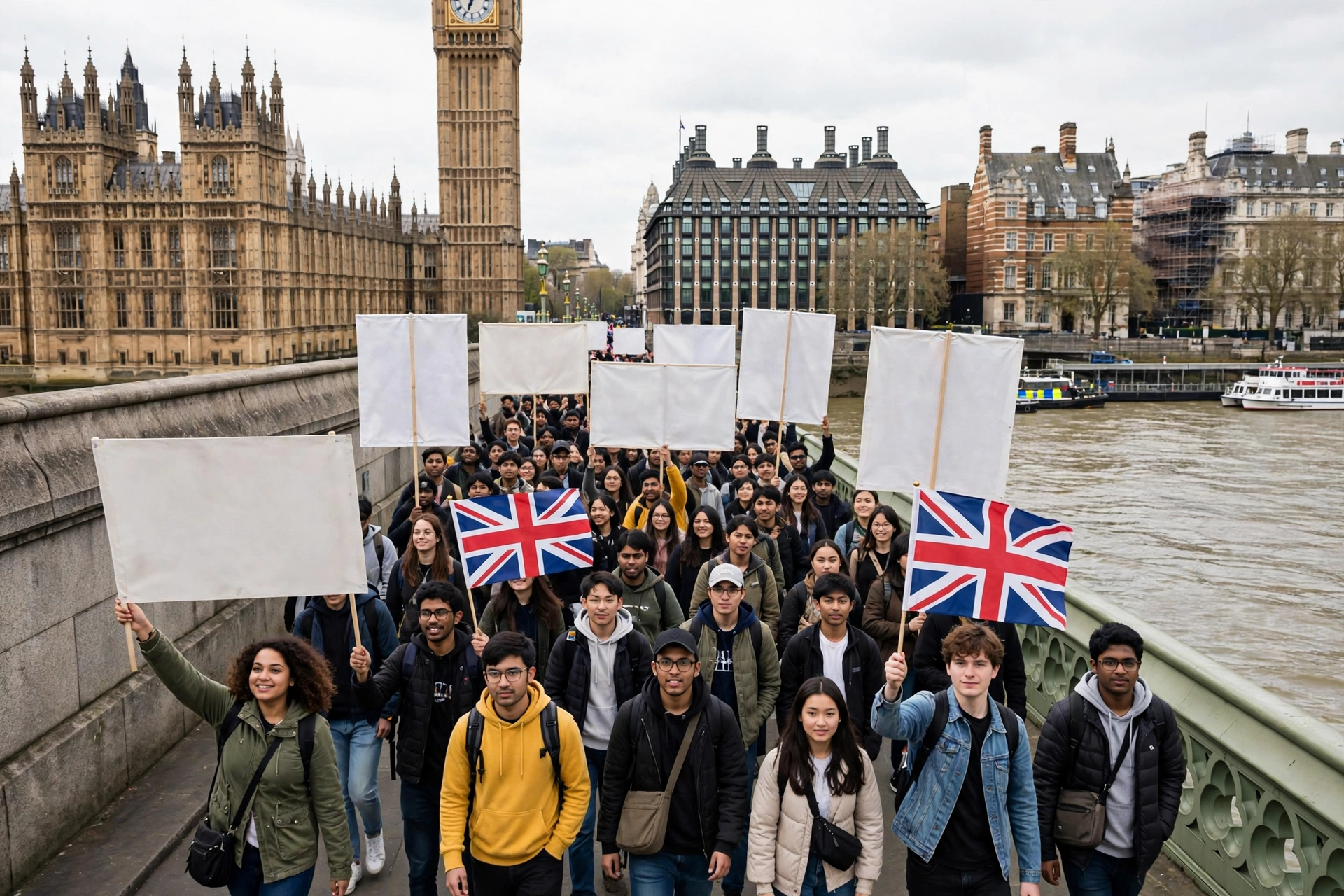
The demands differ slightly from country to country, but the core grievances are shared: the sky-rocketing cost of living, rising tuition fees, underfunded education systems, high youth unemployment, the climate crisis, and fears that governments are failing to future-proof against unregulated artificial intelligence. Many protesters also waved Palestinian flags and criticised what they cast as leaders’ complicity in Israel’s war in Gaza — a charge that echoes the findings of international courts, after the International Court of Justice found Myanmar responsible for genocide against the Rohingya in a landmark ruling this week.
Above all, the protests target military spending. “Young people will not sit quietly while our schools, colleges and universities are cut and billions are found for war,” said Adam Powell-Davies, the national chair of Socialist Students. “Fight for our future, not their wars.”
The mood was captured on one cardboard sign in London: “I wasn’t skipping lectures, I was working to survive.” In Paris, Evelyn, a 25-year-old American student, put the stakes bluntly: “A lot of us who are Gen Z are kind of looking at our futures, both in terms of the cost of living, the climate crisis that is impending, the fact that we could be seeing billions of people dying from climate change. If we leave decisions up to the people who are making decisions now, it’s a future of death.”
The frustration is not limited to Europe. The same week, the US Senate rejected a war powers resolution on Iran by 48 votes to 51, a reminder that debates over military action and military spending are live on both sides of the Atlantic. And as climate talks in Antalya ran into overtime over a draft deal that dropped all mention of fossil fuels, young protesters in Europe were making the same point in the streets: the climate crisis, they say, is being crowded out by other priorities.
A Year of Youth Protest — and What Comes Next
The November 20 actions are part of a wider wave. Over the past year, Gen Z anti-government protests have touched parts of Europe, the Global South and the Americas, and their demands have often evolved as the movements gathered momentum. In Serbia, student-led protests culminated in the toppling in an election last month of long-time leader Aleksandar Vucic. There has also been unrest in Albania, and the French protests that inspired Friday’s wave have at times been marred by violent confrontations with the police and looting.
Friday’s marches were largely peaceful, drawing moderate crowds of hundreds or thousands in most cities — far more muted than the French demonstrations that inspired them. But the organisers, a coalition of more than 50 youth and student groups, have already called for further action, and the weekend’s follow-up protests in France and Spain suggest the movement is not a one-day event. The protests also come as UK and EU leaders work through a UK-EU reset deal agreed in Brussels, a reminder that Europe’s politics are in flux well beyond the streets.
A generation whose adolescence was marked by the Covid-19 pandemic, climate change and wars in Ukraine, Gaza, Sudan and Iran now fears world leaders are risking their futures by curbing funding for public services in favour of increased military spending. Whether governments answer with policy or with platitudes will decide whether Friday’s marches were a moment — or the start of a movement.
Frequently Asked Questions
Why are Gen Z protesting in Europe?
Young people are protesting over the rising cost of living, tuition fees, underfunded schools and universities, high youth unemployment, the climate crisis and increased military spending, which they say comes at the expense of public services.
How many countries took part in the youth strike?
Organisers said the international youth strike took place in at least 25 countries, including Britain, Germany, Spain, Italy, France and Croatia, with more than 50 youth and student groups involved.
Were the protests peaceful?
The marches were largely peaceful, drawing moderate crowds of hundreds or thousands in most cities. In Vienna, police used pepper spray and detained around 20 people after confrontations.
What happens next?
Protests continued in France and Spain over the weekend, and organisers have called for further action. The movement’s next test will be whether governments respond to its demands on education funding, living costs and military spending.
Sources
- Reuters — Student protests held across Europe with demands from school funding to climate: https://www.reuters.com/world/student-protests-held-across-europe-with-demands-school-funding-climate-2026-11-20/
- CNN — Gen Z are protesting across 25 European countries – why?: https://www.cnn.com/2026/11/20/europe/gen-z-youth-protests-europe-intl
- Wikipedia — Gen Z regelt: https://en.wikipedia.org/wiki/Gen_Z_regelt