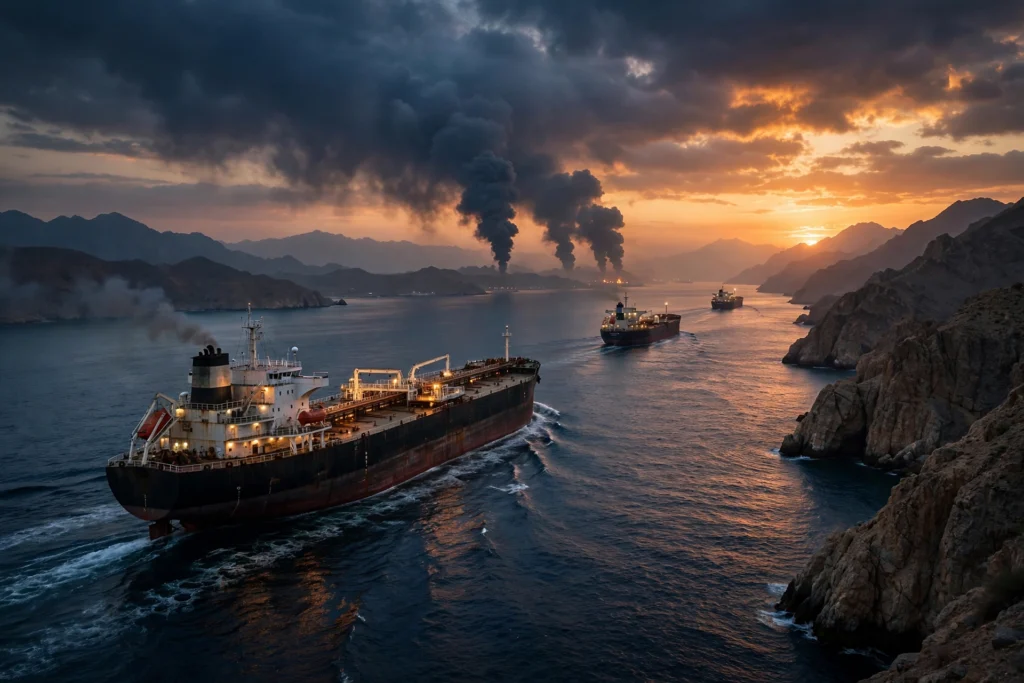
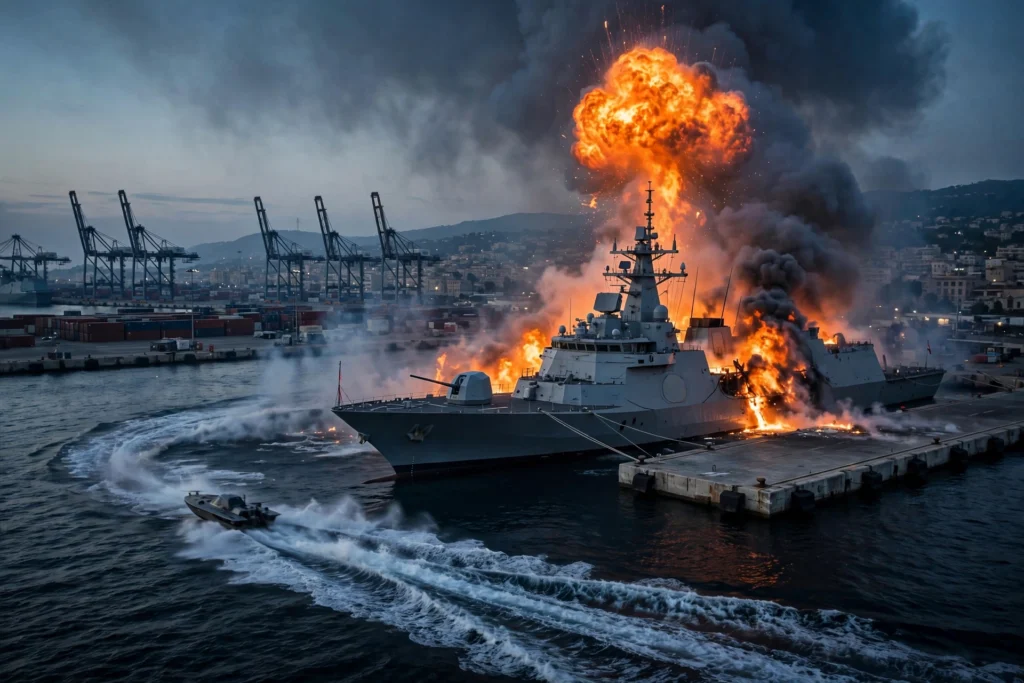
Ukraine has sunk one of Russia’s newest warships — not in the Black Sea, but in a Libyan port on the far side of the Mediterranean, some 1,700 kilometres from Ukraine’s southern coast.
President Volodymyr Zelensky confirmed on Monday that seven Ukrainian-made naval drones sank the Russian corvette Merkury in the eastern Libyan port of Benghazi early on Sunday, destroying a combat helicopter aboard the ship and hitting a second Russian vessel, the cargo ship MV Angara. The audacious operation, carried out in a foreign harbour a thousand nautical miles from home, marks the most dramatic expansion yet of a war that has already spilled far beyond Ukraine’s borders.
“We continue operations in designated waters,” Zelensky wrote — a warning that more strikes far from the front lines are coming.
How the Attack Unfolded
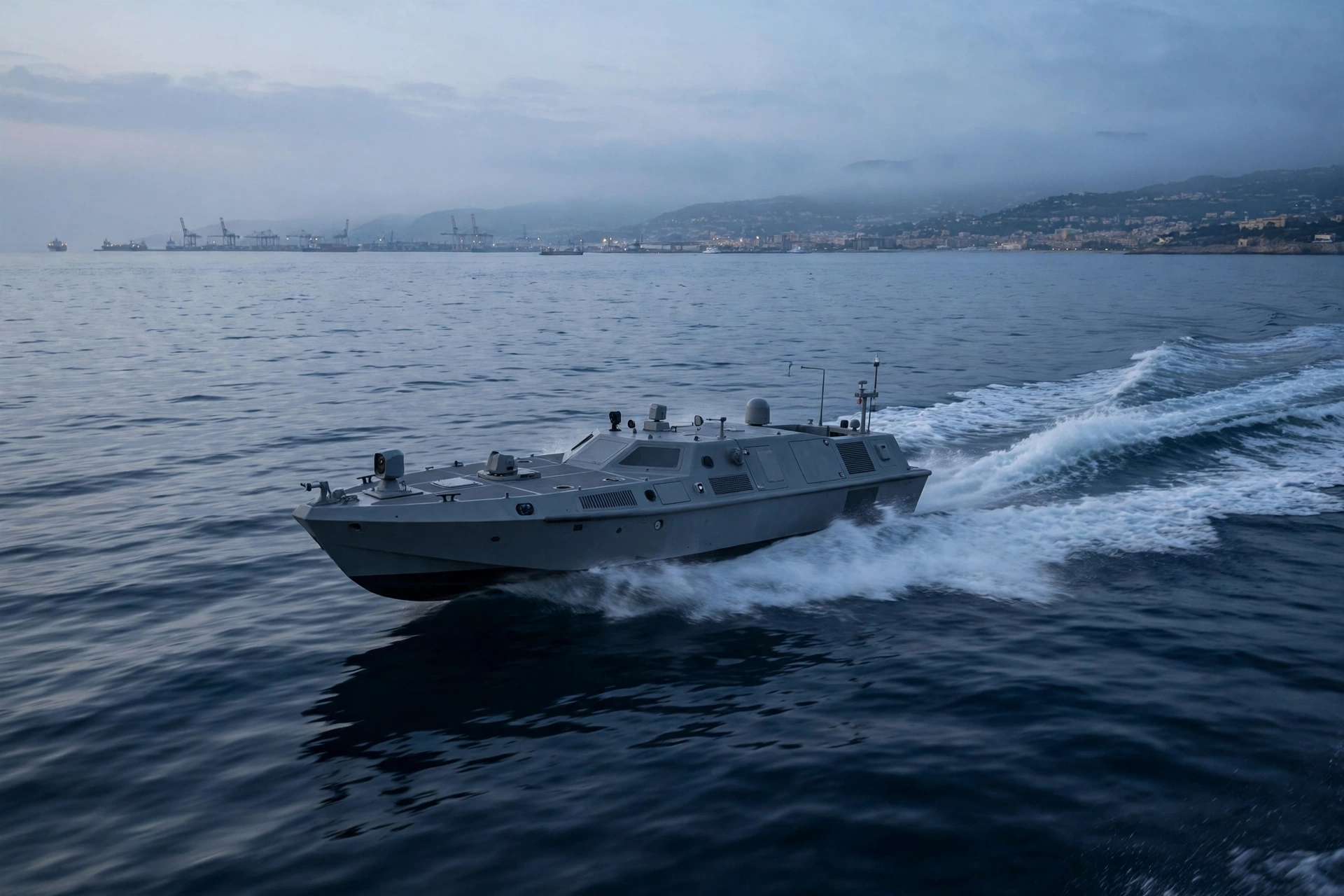
The attack came before dawn on Sunday, November 22. According to Ukraine’s Security Service (SBU), the drone boats were “transported to the designated location and launched from a so-called ‘mothership'” in the Mediterranean, then sped toward their targets in Benghazi harbour.
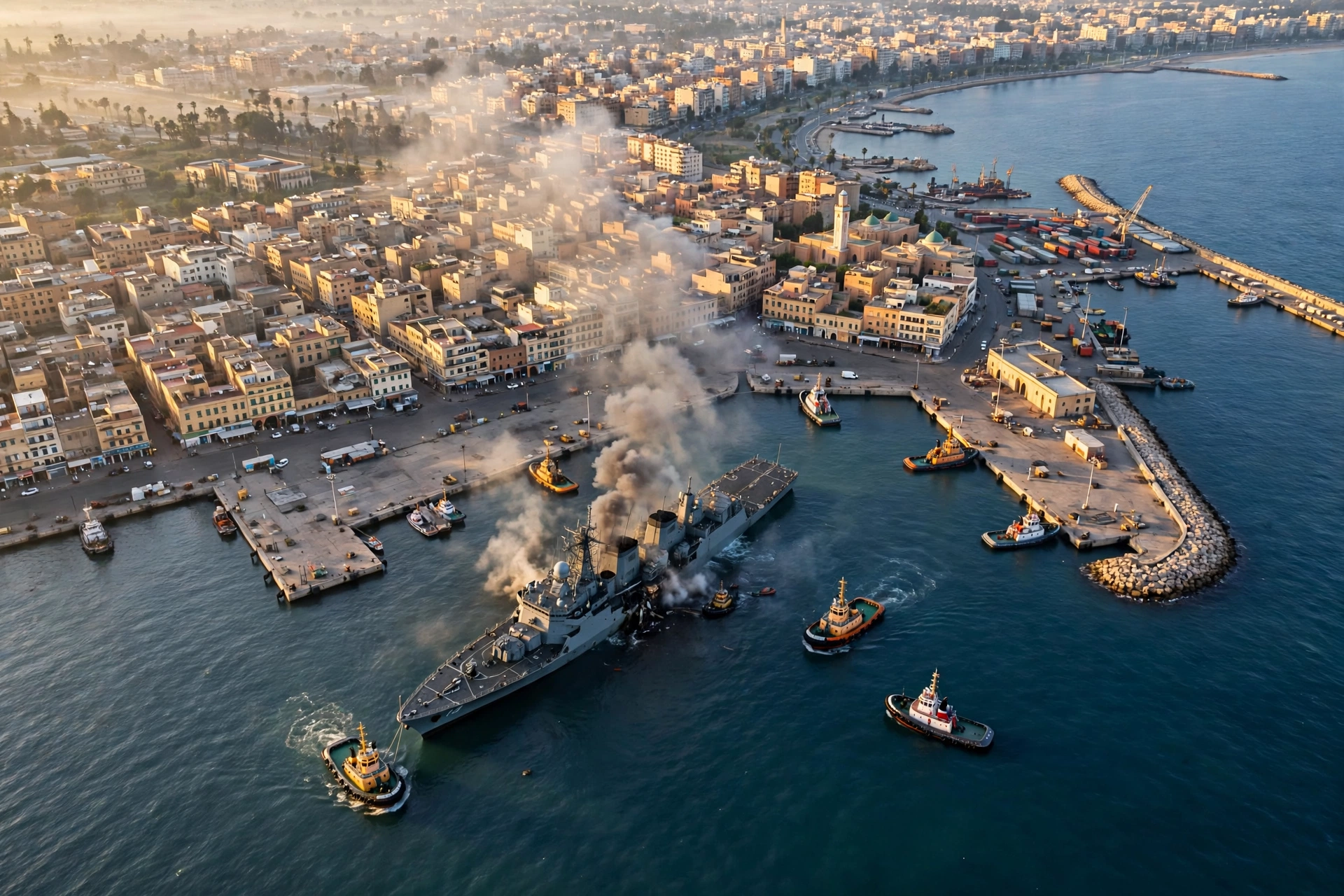
Dramatic footage released by Zelensky showed the sea drones racing across dark water toward the docked warship. One clip captured the Merkury already burning as a drone slammed into its hull, triggering a huge fireball. Satellite images taken afterwards by the company Vantor showed the vessel submerged, slumped against the dock.
Most of the seven drones targeted the corvette, a Ukrainian military official said, while at least one struck the MV Angara, a dry cargo vessel Kyiv says Russia used to transport weapons. The Angara was left ablaze, though the full extent of the damage to it remained unclear.
The drones came under fire on their approach — helicopters and automatic weapons mounted on motorboats tried to intercept them, according to the SBU — but enough got through. “Despite all the enemy’s efforts to counter the attack, the Russian corvette Merkury was sunk,” Zelensky said, adding that a Ka-27 combat helicopter was “also destroyed along with the corvette.”
The eastern Libyan authorities said their forces had destroyed four of the naval drones. The SBU said its uncrewed vessels “reached their objective, located their targets, and successfully struck them.”
The Merkury: One of Russia’s Newest Warships
The loss is a serious blow to the Russian navy — and an embarrassment. The Merkury was a Steregushchiy-class corvette, 344 feet long and displacing 1,800 tons, commissioned only in May 2023. It incorporated some of Moscow’s latest shipbuilding technology, including radar-absorbing materials and a hull designed to reduce its radar signature.
Estimated to have cost up to $350 million, the ship also carried symbolic weight: President Vladimir Putin personally championed its name and hailed it as a symbol of Russia’s growing naval strength. It joined Russia’s Mediterranean squadron in 2024.
The Merkury had stopped in Benghazi for several days to refuel and resupply under a maritime cooperation agreement, according to the Institute for the Study of War, escorting cargo ships that can carry military supplies to Russia. Libya’s eastern Government of National Stability said the ship was in port to refuel before returning to Russia.
The Merkury joins some 40 other Russian naval vessels lost in the war, most notably the guided-missile cruiser Moskva, the flagship of Moscow’s Black Sea Fleet, sunk by a Ukrainian missile attack in April 2022.
A Second Strike in the Baltic Sea
The Benghazi attack was not an isolated operation. A day earlier, on Saturday, a Russian cargo vessel was struck by suspected Ukrainian drones in international waters in the Gulf of Finland — roughly 2,000 miles from Benghazi.
The Sparta II was left burning, and emergency services from Finland, Russia and Estonia worked together to put out the blaze in a rare instance of cooperation between Russia and its NATO-member neighbours. The damaged vessel was later towed back to the Russian port of St Petersburg.
In an interview published on Tuesday, Zelensky confirmed that Ukraine was responsible for that strike too, saying the Sparta II was a legitimate target because it was carrying weapons. The Kremlin called the Baltic attack “very dangerous” and “an escalation of tension in the region.”
Together, the two weekend operations showed Ukraine striking Russian shipping at both ends of Europe on the same weekend — and doing so days after a historic summit involving US President Donald Trump, Russian President Vladimir Putin and Chinese leader Xi Jinping failed to make any progress toward ending the war.
Libya Condemns the Attack; Kyiv Calls It Self-Defence
Libya, which has been split between rival governments since the 2011 overthrow of Muammar Gaddafi, reacted angrily. The UN-recognised Government of National Unity in Tripoli condemned the operation on Monday and demanded an official explanation from Kyiv, saying Libya would not accept being drawn into the Russia-Ukraine conflict.
The eastern government in Benghazi, which controls the port and is backed by military commander Khalifa Haftar — whose Libyan National Army has close ties with Russia — said it had launched a joint investigation with Russia into the incident. It insisted it was not a party to the war and would not allow Libyan territory to become an “arena for settling scores.” Eastern officials also said there were indications the naval drones had been launched from western Libya, and asked the United Nations to investigate allegations that Ukraine has deployed military experts there.
The UN Support Mission in Libya called for an independent investigation into the attacks.
Kyiv was unapologetic. On Tuesday, Ukrainian Foreign Minister Andrii Sybiha said the operation was a legitimate act of self-defence under Article 51 of the United Nations Charter, arguing that both Russian naval vessels and cargo ships transporting military equipment were valid targets.
“Ukraine is not ‘dragging’ anyone into the war or ‘transferring’ the war anywhere,” Sybiha said. “Ukraine respects the sovereignty and territorial integrity of Libya. We emphasize that Ukraine’s actions are aimed at countering Russian armed aggression and are not intended to harm Libya or its people.”
He added that international law does not limit self-defence to the territory where the aggression takes place — and that Russia was the one endangering third countries by using their civilian infrastructure for its military purposes.
Moscow, for its part, has not acknowledged losing the ship. Asked about the strikes on Monday, Kremlin spokesman Dmitry Peskov said Russia had “taken note” of Zelensky’s statement. “Our Defense Ministry is handling this,” he said. Russia’s defence minister has not commented publicly on the attack.
Why Benghazi Matters: Russia’s African Footprint
The strike landed in the middle of Russia’s growing military presence in Africa. After the fall of its longtime ally Bashar al-Assad in Syria in 2024, Moscow has worked to consolidate its position in Libya, using the country as a hub to project influence across North Africa and the Mediterranean.
Moscow has provided military support to Haftar’s forces for years. A 2021 United Nations report documented the rapid expansion of Russia’s Wagner Group in Libya, growing from an estimated 800–1,200 personnel to around 2,000 by mid-2020. After Wagner leader Yevgeny Prigozhin died in a suspicious plane crash in 2023, the Kremlin folded its African operations into the newly established Africa Corps, which operates in Libya, Mali, Sudan and the Central African Republic.
The Merkury and the Angara were part of that logistics chain, supplying Russia’s African operations. “It is also important that without these ships in those waters, it will be more difficult for Russia to fuel conflicts and instability in that region as well,” Zelensky said in his evening address on Monday.
Ukraine, meanwhile, has been quietly building its own presence on the continent. CNN has previously reported on Ukraine’s operations in Libya, Mali, Chad, Niger, Sudan and Burkina Faso as Kyiv tries to counter Russia’s growing influence in Africa, particularly in the mineral-rich, coup-prone Sahel region. One Ukrainian naval drone operator deployed in Libya told CNN earlier this year that his unit was using a military base in Misrata, a city east of Tripoli, as a launchpad to attack Russia’s shadow fleet in the Mediterranean in exchange for training local forces.
Asked about the weekend attacks on Monday, the operator said: “We are doing what we can. And we can [do] a lot.” The attacks took a lot of time to plan but were “not that difficult” to execute, he added. “It was a good day.”
A War With No Safe Routes
The Benghazi operation fits a pattern of Ukrainian strikes far beyond the front lines. In December 2025, Kyiv carried out its first strike on a Russian shadow fleet tanker in international waters in the Mediterranean, using aerial drones. In March 2026, a Russian liquefied natural gas carrier sank off the Libyan coast after an attack that Putin blamed on Kyiv.
“The Defense Forces of Ukraine have once again demonstrated that the Russian military fleet and its logistics networks have no safe routes, even far beyond the Black Sea,” the SBU said.
Naval analyst Carl Schuster told CNN that the attack signals a shift in naval warfare. “We are looking at a new era of maritime unconventional warfare,” he said, noting that protecting ships in foreign ports is difficult for any navy — and that Ukraine’s large merchant fleet can “provide a lot of seemingly innocent launch platforms” for attacks like the one in Benghazi.
The operation also comes amid a tense moment in the wider confrontation with Moscow. Just days earlier, Russian warplanes flew to the verge of South Korea’s airspace near Ulleung Island, prompting Seoul to scramble fighter jets and issue a rare shelter warning, while Western intelligence has warned of reports that Russia could launch a nuclear-armed satellite in the coming weeks. Russian missiles landing in Poland and an alleged Russian assassination plot in Denmark have added to the sense of a conflict spilling outward in every direction.
What Happens Next
Zelensky has made clear the campaign will continue. “Ukrainian naval operations will continue,” he said on Monday, praising the operation as “extremely complex” and thanking the forces who carried it out. “A fully legitimate operation — against enemy ships,” he said. “Russia was using two vessels for the war — a corvette, one of the newest in the Russian fleet, and a cargo ship transporting weapons. It is no longer transporting them, and the corvette is at the bottom of the sea.”
Speaking to the NATO Parliamentary Assembly in Berlin on Monday, he summed up the geographical reach of Ukraine’s response: “And today, Russia feels our response from Western Siberia, where its refineries are burning, to the coast of Libya, where its warships are sinking.”
Whether the operation pushes Moscow toward the negotiating table — as Ukraine’s defence minister, Yevhenii Khmara, suggested it might — remains to be seen. “What we are trying to achieve? We need to achieve peace. Ukraine needs peace. We believe, however, that peace is only possible through strength,” Khmara said in Berlin on Monday.
For now, the wreck of the Merkury lies submerged against a Benghazi dock, a $350 million warship sunk by drones launched from a ship that was never seen — and a reminder that in this war, no port is far enough away to be safe.
Frequently Asked Questions
What happened to the Russian warship Merkury?
Ukraine says seven of its naval drones sank the Russian corvette Merkury in the Libyan port of Benghazi early on Sunday, November 22, 2026. A Ka-27 combat helicopter aboard the ship was also destroyed, and satellite images showed the vessel submerged beside the dock.
Why was a Russian warship in Libya?
The Merkury had stopped in Benghazi for several days to refuel and resupply under a maritime cooperation agreement, escorting cargo ships that can carry military supplies to Russia. Libya’s eastern government said the ship was due to return to Russia after refuelling.
What was the second ship hit in the attack?
The MV Angara, a dry cargo vessel that Ukraine says Russia used to transport weapons. The sanctioned ship was set ablaze by a naval drone, though the full extent of the damage was not immediately clear.
How did Libya react to the attack?
Both of Libya’s rival governments condemned it. The UN-recognised government in Tripoli demanded an explanation from Kyiv, while the eastern government in Benghazi said it had launched a joint investigation with Russia. The UN Support Mission in Libya called for an independent investigation.
Has Ukraine struck Russian ships this far away before?
Yes. In December 2025 Ukraine struck a Russian shadow fleet tanker in the Mediterranean, and in March 2026 a Russian LNG carrier sank off the Libyan coast after an attack Putin blamed on Kyiv. A day before the Benghazi strike, drones also hit the Russian cargo vessel Sparta II in the Gulf of Finland.
Sources
- CNN — Ukrainian drones sink Russian warship in North Africa: https://www.cnn.com/2026/11/22/africa/russian-vessel-libya-suspected-drone-attack-intl?cid=external-feeds_iluminar_meta
- Reuters — Ukraine insists attack on Russian ships in Libya was self-defence: https://www.reuters.com/world/europe/ukraine-insists-attack-russian-ships-libya-was-self-defence-2026-11-24/
- Le Monde — Attacks on two Russian ships in Libyan waters mark new turn in Ukraine war: https://www.lemonde.fr/en/le-monde-africa/article/2026/11/23/attacks-on-two-russian-ships-in-libyan-waters-mark-new-turn-in-ukraine-war_6787337_124.html