Tesla’s biggest Full Self-Driving update in years is starting to reach cars. On November 21, 2026, Tesla announced that Full Self-Driving (Supervised) v15 is rolling out, and the company says the release upgrades every part of the end-to-end driving network. The headline feature is Tesla Reality View, a live, AI-generated rendering of the world around the car — and Tesla claims the new version handles safety-critical situations 25 times better than before.
It is the most ambitious FSD release since v13, and it arrives at a moment when driver-assistance software is becoming the main battleground between carmakers. While rivals ship incremental updates, Tesla is betting that a bigger neural network — and a screen that shows you exactly what it is thinking — will win drivers’ trust.
What Is Tesla Reality View?
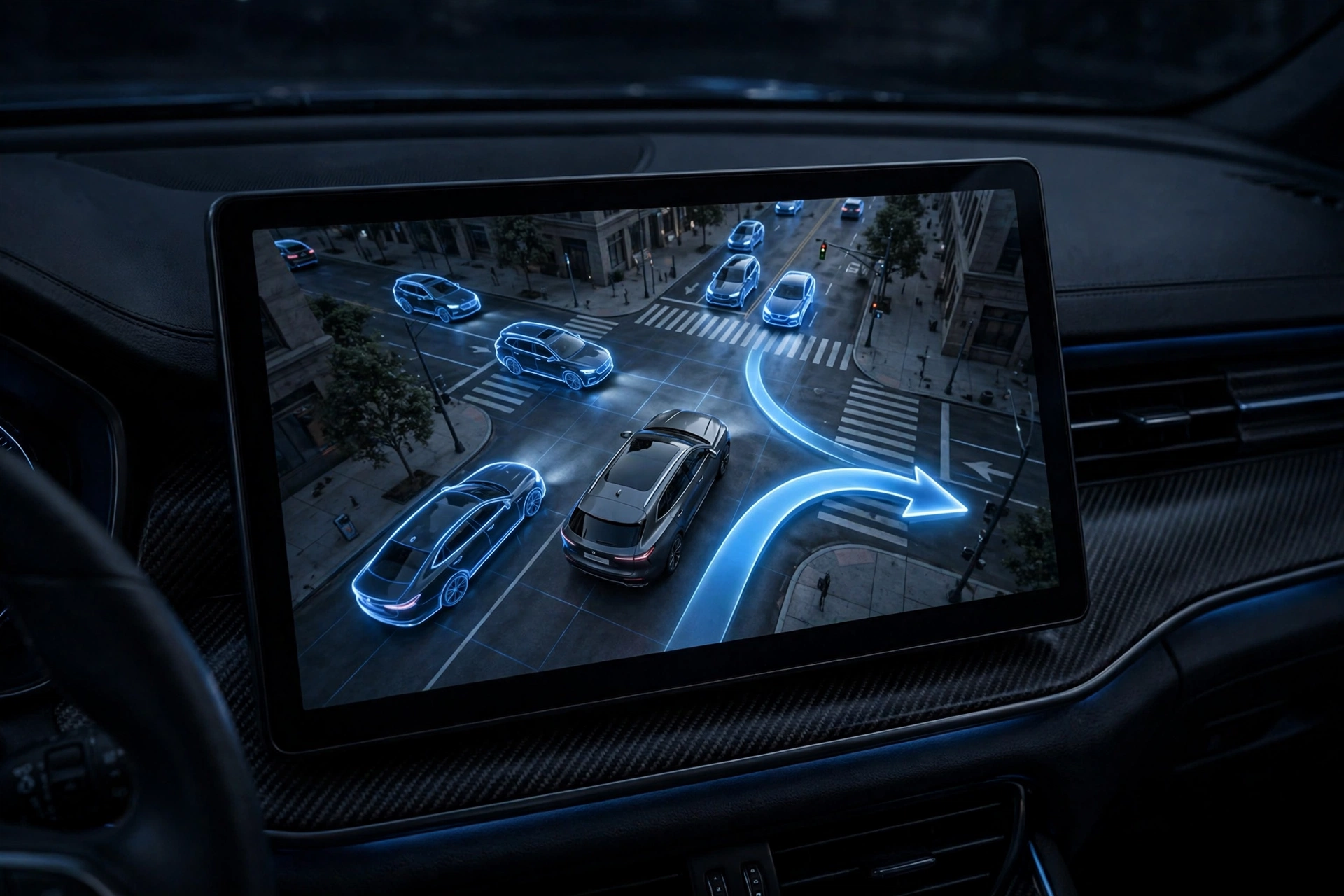
Reality View replaces the simplified driving graphics Tesla owners are used to with a detailed, live rendering of the road and surrounding traffic. Tesla’s release notes describe it as a real-time generative visualization that continuously streams a view from an arbitrary virtual camera situated above the vehicle. Instead of the familiar top-down icons, the center screen shows a photorealistic-looking scene: buildings, sidewalks, pedestrians and other cars, all rendered by the same end-to-end model that steers the car.
The practical point is that the view shows intent, not just perception. Upcoming turns appear directly in the driving visualization, arrows mark the turns FSD plans to take, and pins mark the parking spot it intends to use. Drivers can choose full-screen, map, split-view or a quiet mode for a calmer cabin, and Tesla says the view lets you see and control what FSD is planning to do. Elon Musk has said drivers can tap any point in Reality View to make the car go there — a claim shown in Tesla’s demonstration video, though how far that tap-to-direct control extends in everyday driving is not yet explained in the release notes.
The Safety Claim: 25 Times Better Handling
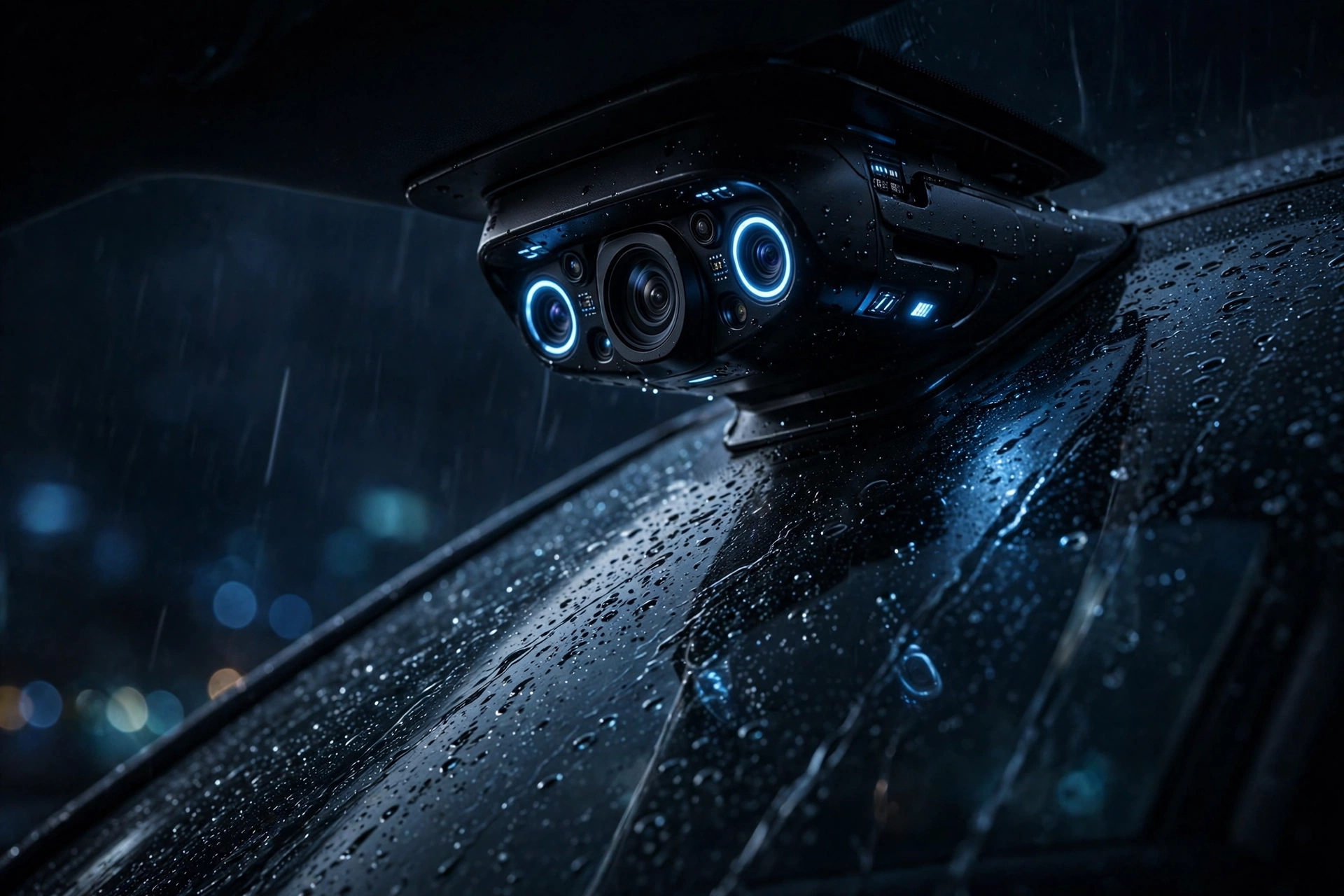
The number Tesla is leading with is a big one: 25 times better handling of safety-critical cases. The release notes tie that claim to a specific change — an upgraded vision encoder shared between FSD, Robotaxi and Optimus, trained on millions of internet videos for better generalization. Tesla says the encoder improves the critical intervention rate by 25 times, which is the metric that matters most to anyone supervising the system: how often a human has to take over when something goes wrong.
That is a company claim, and it deserves the usual caution. There is no independent safety data yet, and Tesla has not published the testing behind the figure. But the direction of the claim is consistent with what the update actually changes: a vision system trained on far more varied video should, in principle, recognize more of the edge cases that trip up driver-assistance systems — the odd road sign, the animal at the roadside, the pothole hidden by a puddle.
Smarter at Signs, Potholes and Speed Cameras
Beyond the headline numbers, v15 targets the small frustrations that have defined FSD’s weaknesses for years. Tesla says the update improves detection of road signs, small animals, road debris, chains and potholes, and is better at avoiding deep standing water. Speed handling gets more natural in school zones and poor weather, and if FSD detects a speed camera, it can now slow the car down on its own.
Navigation gets smarter in two quieter ways. Route preferences for the start and end of trips now learn from fleet data, and FSD uses your parking history to find a spot, with the map able to show multiple parking options at your destination. A new Bike Rack Mode lets drivers use FSD (Supervised) with a bike rack or a similar hitch accessory attached — a small fix for a long-standing annoyance. The update also removes the disengagement menu that appeared when FSD was switched off, adds a Calm Mode previously seen on Robotaxis, and lets drivers hide the FSD visualizations entirely in favor of a full-screen map.
Who Gets FSD v15 — and Who Does Not
The rollout is starting small. The first release, FSD v15.0.1, is arriving with software update 2026.38.6.11, and early reports indicate it is initially limited to the redesigned Model Y — late-2025 and 2026 models in the US and Canada — running Tesla’s HW4 computer. Tesla has previously said the AI4 hardware is enough to run v15, but the company has not announced a firm date or a complete list of eligible vehicles.
The harder news is for owners of older hardware. HW3 vehicles will not receive FSD v15, and v14 Lite is expected to be the end of the road for those cars until a hardware upgrade is available. That split has been coming for a while, but v15 makes it concrete: the newest driving network needs the newest computer.
Elon Musk has said v15 goes to wide release next month, arriving with this year’s holiday update. So for most owners, the wait is measured in weeks rather than months — but the first wave is deliberately narrow.
Still Supervised — and Why Reality View Matters
For all its ambition, FSD v15 is still the supervised system, not the unsupervised driving Tesla has talked about for customer cars that could later join its Robotaxi fleet. The driver remains responsible, hands on the wheel, eyes on the road. That is exactly why Reality View may be the most important part of the release.
Trust is the bottleneck for driver-assistance software, and trust is hard to build when the system is a black box. A visualization that shows what the car sees and what it plans to do next gives the supervising driver something concrete to check — a turn arrow that matches the road, a highlighted car that is actually there, a parking pin that makes sense. If the rendering is accurate, supervision gets easier. If it ever shows the car planning something wrong, the driver sees it before the car does it. That is the theory, at least, and it is one the whole industry is watching: NVIDIA’s Alpamayo 2 Edge, for example, takes the same idea in a different direction, with a driving model that explains its decisions in words.
What This Means for the Self-Driving Race
FSD v15 lands in a crowded field. Toyota and Waymo’s robotaxi partnership is heading to Japan in 2027, Tesla’s own Cybercab is now on sale for personal orders, and open driving models are arriving from chipmakers. Against that backdrop, v15 is Tesla’s answer to a simple question: can the software in a car you already own keep getting meaningfully better?
The honest answer will take weeks of real-world driving to establish. The 25x figure needs independent validation, Reality View needs to prove itself outside Tesla’s polished demo video, and the HW3 cutoff will frustrate a large group of owners. But the shape of the update is clear: bigger vision models, a screen that narrates the car’s thinking, and a steady push toward the car explaining itself to the person supervising it. The same agent logic is appearing everywhere this month, from Gemini Computer Use on the Mac to Databricks Genie ZeroOps fixing data pipelines. That is a direction the whole industry is moving in — Tesla just made it visible on the dashboard.
Sources: Electrek’s coverage, Digital Trends’ report, and Not a Tesla App’s breakdown of the FSD v15 release.