Self-driving cars have long been able to steer, brake, and change lanes. What they have rarely been able to do is explain why. NVIDIA’s Alpamayo 2 Edge changes that. The 2-billion-parameter model, whose open weights NVIDIA published on Hugging Face on November 10, 2026, watches the road through a car’s surround cameras, plans the path ahead, and — when the situation calls for it — writes out its reasoning in plain language. It does all of this inside the vehicle, on NVIDIA’s DRIVE AGX Thor computer, in as little as 160 milliseconds. It is the compact, in-car member of NVIDIA’s Alpamayo family, and it points to a future in which the car does not just drive itself, but can tell you what it is thinking.
A Self-Driving Model That Thinks Out Loud
Alpamayo 2 Edge is a vision-language-action model — a VLA. That means one AI system sees the road, reasons about it in words, and outputs a driving action. It takes in surround-camera video, the car’s recent motion, and the navigation instruction, and it produces two things: a short chain of causal reasoning, which NVIDIA calls Chain-of-Causation, and a planned trajectory the car should follow. Crucially, it does not reason out loud about everything. On a quiet stretch of highway, it can skip the explanation and just drive; when a pedestrian steps toward the curb or a car cuts in, it spells out what it sees and why it is acting. That adaptive reasoning is what makes the model practical — it spends its compute where the driving actually gets hard. The model is built on the Nemotron-based reasoning backbone of NVIDIA’s Cosmos 3 Edge world model, paired with a small diffusion-based action expert that turns decisions into motion. It can also answer free-form questions about a driving scene, so engineers can ask it what it saw and why it chose a particular move.
How Alpamayo 2 Edge Sees, Reasons and Drives
Under the hood, the model is small by frontier-AI standards and deliberately so. NVIDIA describes it as a 2B-class model: a 2.45-billion-parameter backbone — a roughly 2-billion-parameter language model plus a 0.41-billion-parameter vision encoder — topped by a 0.2-billion-parameter diffusion action expert. The action expert predicts acceleration and curvature, and a simple vehicle model turns those into a trajectory of 64 waypoints covering the next 0.1 to 6.4 seconds. The reasoning comes first: the model generates its Chain-of-Causation trace, then the trajectory. That order matters, because it means the driving plan follows from an explicit understanding of the scene rather than from a black-box reflex. The model learned its reasoning from its bigger sibling, the 34-billion-parameter Alpamayo 2 Super, which generated the explanations Alpamayo 2 Edge was trained on — a distillation step that squeezes a cloud-scale teacher into a model small enough to live in a car. NVIDIA says the training data spans roughly 115,000 hours of multi-camera driving video with motion and trajectory annotations.

Fast Enough for the Real Road: 160–190 ms on DRIVE AGX Thor
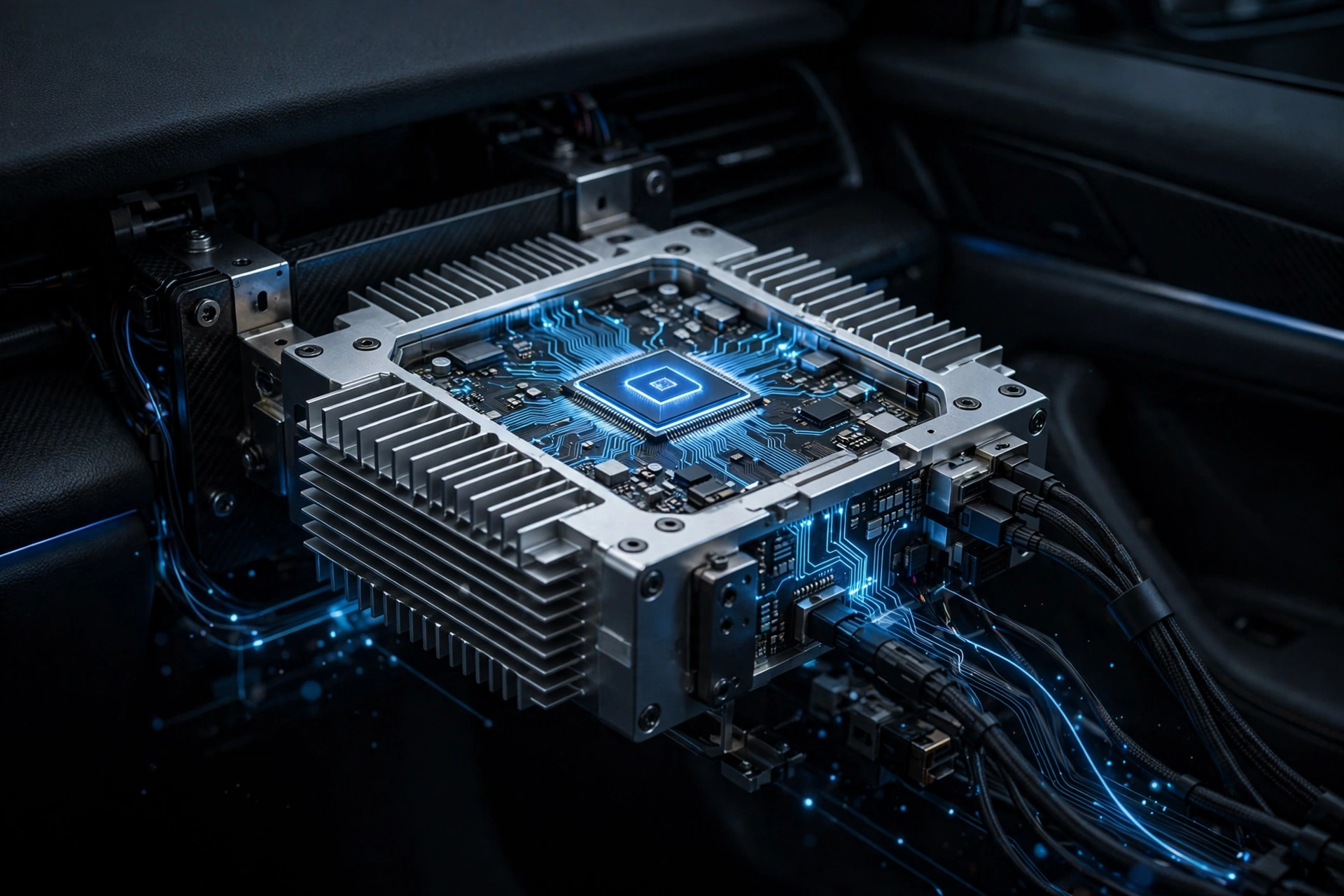
A driving model is useless if it thinks too slowly, and this is where Alpamayo 2 Edge earns its name. With NVIDIA’s optimized FP8 recipe running through TensorRT on DRIVE AGX Thor, the model goes from camera images to a planned trajectory in 160 to 190 milliseconds, depending on how much reasoning it does. The optimized pipeline plans at about 13 times a second in NVIDIA’s AlpaSim simulator, and partner Embedl reported getting it running at 10 plans per second on DRIVE AGX Thor in less than 48 hours. The reference setup is DRIVE AGX Thor-X with DRIVE OS 7.2.7.0, CUDA 13.4, and TensorRT 11.3.1.9. That speed is the whole point of the Edge variant: the same reasoning that the 34-billion-parameter Super model does in the cloud, compressed into a package that fits the power and heat budget of a car’s computer. It is the same on-device AI logic behind NVIDIA’s RTX Spark AI PCs and Microsoft’s Aion Instruct — small models doing useful work locally instead of phoning a data center — applied to the hardest real-time job of all: driving.
Trained in Simulation, Tuned by Reinforcement Learning
Alpamayo 2 Edge was not just trained on recorded driving and left alone. NVIDIA post-trained it with closed-loop reinforcement learning in its AlpaGym simulator, where the model drives, makes mistakes, and learns from them in a loop — and NVIDIA reports that step improved closed-loop driving performance by 128.5% over the best checkpoint trained without it. A second NVIDIA tool, AlpaJudge, is a human-calibrated evaluation and reward model that scores the quality of the model’s reasoning traces, picks the most valuable training data, and supplies the rewards for reinforcement learning. The benchmark numbers NVIDIA publishes are striking, with an honest caveat attached. In AlpaSim, its simulator, Alpamayo 2 Edge drove about 15.15 kilometres between at-fault incidents, against 0.25 kilometres for Alibaba’s 4-billion-parameter Qwen-Drive-1.0 — roughly 60 times farther, despite being half the size. Those are NVIDIA’s own simulation results, not independent road tests, and simulation is not the street. But the direction of travel is clear: a 2-billion-parameter model that reasons is now competitive with models twice its size that do not. Early partners agree. PORT, which tested the model in reconstructions of its own London street recordings, said it kept its lane in more than twice as many runs as the previous Alpamayo 1.5 and planned roughly twice as fast out of the box as its hand-tuned Alpamayo 1.5 server on the same GPU.
Open Weights and a Developer Recipe
Like NVIDIA’s other recent open releases, Alpamayo 2 Edge ships as open weights. The model is available on Hugging Face as nvidia/Alpamayo2-Edge, and NVIDIA has published a step-by-step recipe on its Alpamayo Developer Hub for getting it running in real time on DRIVE AGX Thor, along with the AlpaJudge evaluation tools. That matters because the audience is not car buyers — it is the engineers building driver-assistance and autonomy stacks. A small, open, explainable driving model that runs on a single in-car computer is something a startup, a supplier, or a university lab can actually download and adapt to its own fleet, instead of licensing a black box. It also makes the model auditable: when a car makes a strange decision, the reasoning trace is there to read. For an industry that has spent a decade arguing about whether self-driving systems can ever be trustworthy enough, that transparency is arguably the most important feature in the release. (For the technical detail in this post, see NVIDIA’s own write-up.)
What It Means for the Road Ahead
Alpamayo 2 Edge will not put a self-driving car in your driveway tomorrow. It is a developer model, its headline numbers come from simulation, and the road to production vehicles runs through years of validation. But it captures three shifts happening at once. First, driving AI is becoming reasoning AI — models that explain themselves rather than just react. Second, that reasoning is moving into the vehicle, onto chips like DRIVE AGX Thor, instead of living in the cloud. And third, the models are opening up: open weights, public benchmarks, and published recipes mean the technology is no longer locked inside a handful of robotaxi companies. The same week, the wider self-driving race keeps accelerating — from Tesla’s Cybercab to Toyota and Waymo’s robotaxi plans in Japan. Alpamayo 2 Edge is NVIDIA’s bet that the winning ingredient will not be the biggest model, but the smallest one that can think clearly, explain itself, and keep up with the road.