
AI gets more useful the more it knows about you — your conversations, your documents, your code, your trading strategy. That is also exactly the information you least want leaking. On November 13, 2026, the Solana Foundation launched a new answer to that tension: Solana Confidential Compute, an open-source toolkit that lets developers build private AI applications and then prove, onchain, that the hardware running them is really doing what it claims.
Built by the team at Nito in coordination with the Solana Foundation, the toolkit pairs an SDK with an on-chain verification program. The pitch is simple: “Private AI, verified onchain.” Here is what it actually does, how it works, and the honest limits you should know before building on it.
What Solana Confidential Compute Is
Solana Confidential Compute is built on confidential computing — the practice of protecting data while it is being processed, not just while it is stored or in transit. It uses trusted execution environments (TEEs): hardware-backed enclaves designed to isolate code and data from everything around them, including the host operating system and the infrastructure operator.
That isolation alone is not new. What Solana adds is verifiability. The hardware can produce an attestation — a signed report containing evidence about the environment and measurements of the software running inside it. Solana Confidential Compute checks that report onchain and creates a public record that other applications can consult. The AI computation itself happens offchain; Solana holds the verification record. Publishing that record does not require publishing the conversation or the private inputs.
The toolkit is available now in beta on Solana devnet, with a mainnet release planned. It is open source and free to use.
How It Works: Four Steps From Hardware to Onchain Proof
The Solana Foundation lays out the flow in four steps, and it is worth understanding because the design is what makes the privacy claim checkable rather than a promise:
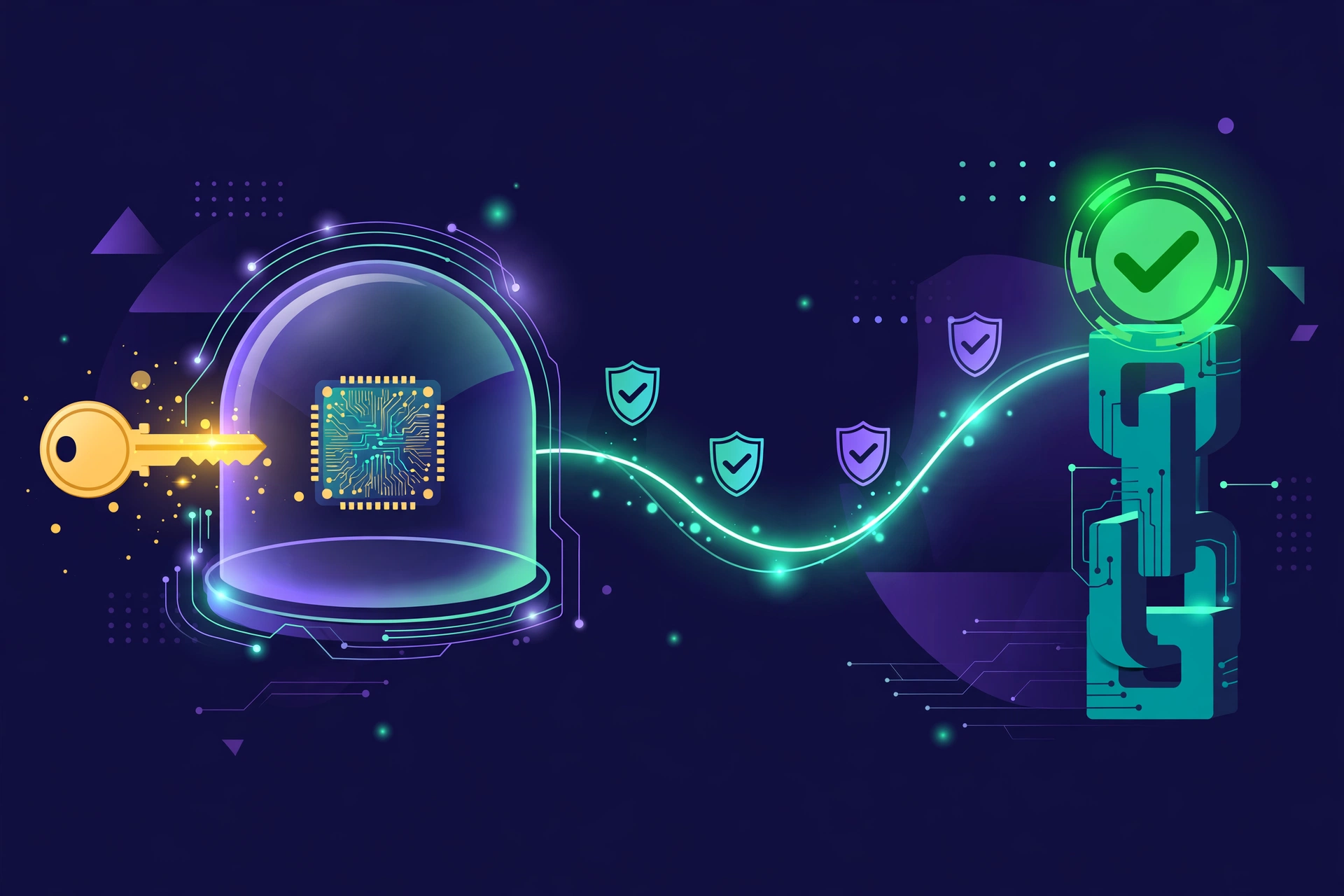
- A machine inside a confidential VM generates a signing key. The key exists only inside that hardware — it never leaves the enclave.
- The hardware signs a report that binds the key to a recent Solana slot, proving the key was created in a genuine trusted environment at a specific point in the chain’s history.
- Solana Confidential Compute’s onchain program verifies the report. It records the key, the hardware type and an expiry date in a public record anyone can inspect.
- The machine signs every answer it produces with that key. Anyone receiving an answer can check the signature, then look up the key’s record on Solana to confirm it came from verified hardware.
In practice, that means an application — or another AI agent — can refuse to act on an answer unless it carries a valid signature from a verified machine. The trust moves from “believe our server” to “check the chain.”
Why Solana? The Agents Are Already There
The Foundation’s reasoning is straightforward: Solana is fast and cheap enough for AI apps and agents to run all day, and it is where many AI agents with wallets already live. Putting the proof on the same chain as those agents and programs means they can check that an answer came from a verified TEE before acting on it — no separate trust layer required.
That matters because the agent economy is moving fast. AI agents are already paying for services with crypto, and ChatGPT Wallet now lets agents make purchases on a user’s behalf. As agents start moving real money, the question of whether the agent on the other end is running the code it claims to run becomes a financial question, not just a technical one. A signed, onchain attestation is one way to answer it.
The hardware angle is evolving too. The beta supports Intel TDX and AMD SEV-SNP attestations today; NVIDIA GPU attestation is still in development. That is a notable gap given how much AI runs on NVIDIA hardware — and it lands in a week when Nvidia’s leadership itself is in transition. On the chip side, the race is heating up as well: AMD’s Instinct MI450X claims 30% faster AI inference than Nvidia’s Vera Rubin, so the hardware that confidential AI runs on is very much contested ground.
What You Can Build With It

Because any Solana program can consult the verification record, the toolkit is a building block rather than a single product. The Foundation highlights several use cases:
- An AI judge for prediction markets or insurance claims — a smart contract pays out only on a ruling signed by a verified machine.
- Trading agents whose orders execute only if they came from the verified model, keeping the strategy itself private.
- AI governance decisions accepted only from a verified model.
- Personal assistants working with sensitive context, and tools processing confidential business information.
The common thread is the same: the model does the work in private, and the chain carries the proof. That combination is what the agent infrastructure boom has been missing — a way to trust an agent you cannot see inside.
Nito’s Confidential Chat: The First App on the Stack
Nito is the first platform built on the new infrastructure. Its Confidential Chat runs open-weight models inside confidential hardware: the user’s device encrypts the prompt, the protected environment decrypts it, and the response is encrypted before it returns to the device. Nito’s gateway relays the encrypted messages without holding the keys to read their contents.
Nito verifies its confidential hardware with Solana Confidential Compute, publishing a record any application can check. Its private AI chat is live at trynito.ai, and the company is building a confidential assistant with a waitlist open now. The Nito team includes engineers who joined from Switchboard, the oracle network.
The Honest Limits: Beta, Devnet, No Audit Yet
For all the promise, this is a beta — and the Foundation says so plainly. The toolkit runs on Solana devnet, the network’s testing environment, so nothing here is handling real money yet. It has not been audited, and the Foundation says it is intended for development use for now. A mainnet release is expected after a security audit is completed, but no timeline has been given for either the audit or the launch.
Verification also has a precise meaning here. It proves that a published software release ran in a given environment — it does not attest that the code is bug-free, and it does not guarantee that the webpage code a developer serves is safe. Developers still need to implement authentication, rate-limiting and bot protection themselves.
That context matters: Solana Privacy Rings, a related privacy effort, went live on mainnet on November 10, 2026 — three days before Confidential Compute arrived on devnet. The Foundation is clearly building a privacy stack in stages, and this piece is still the early, developer-only stage.
What It Means for Private AI
Solana Confidential Compute will not change how most people use AI tomorrow. It is a developer tool, in beta, on a test network. But it points at a real shift: as AI agents start handling money, contracts and sensitive data, “trust us” stops being good enough. A public, checkable record of which hardware produced an answer — without exposing the answer itself — is a genuinely new primitive, and putting it on a chain where the agents already live is a smart place to start.
Developers can start building with it today on devnet via the official product page and the Solana Foundation’s announcement. The rest of us should watch for the audit — that is the milestone that turns a promising beta into something ready for real stakes.
Frequently Asked Questions
What is Solana Confidential Compute?
An open-source SDK and on-chain verification program launched by the Solana Foundation with Nito on November 13, 2026. It verifies hardware attestations from trusted execution environments and publishes a public record on Solana that applications and agents can check.
Is Solana Confidential Compute on mainnet?
Not yet. It is in beta on Solana devnet, and a mainnet release is planned after a security audit. No date has been announced for either.
Which hardware does it support?
The beta supports Intel TDX and AMD SEV-SNP attestations. NVIDIA GPU attestation is still in development, and the product page also lists AWS Nitro Enclaves and Google Confidential Space.
Does it keep my prompts private?
Yes — the AI computation happens offchain inside a trusted execution environment, and only the verification record goes onchain. Publishing that record does not require publishing the conversation or the private inputs.
What can I build with it?
Private AI chats, personal assistants with sensitive context, trading agents whose strategies stay secret, AI judges for prediction markets or insurance claims, and AI governance decisions that are only accepted from a verified model.

