AI agents have moved from demos to production — and the money is following them. On November 13, 2026, LangChain announced a $300 million Series C round at a $3 billion valuation, led by CapitalG, Alphabet’s growth fund. The cash will go into LangSmith, the company’s platform for running, improving and governing AI agents in production. It is one of the largest bets yet that the real money in AI agents will be made not by building the agents, but by operating them safely at scale.
The valuation is more than double the $1.25 billion LangChain reached about a year earlier, when it raised $125 million in a Series B led by IVP. Total funding to date now stands at $460 million, according to Business Wire. The Wall Street Journal first reported the round on November 12; LangChain confirmed it in its official announcement the following day.
What LangChain Announced
LangChain started in 2022 as an open-source project that helped developers wire large language models into real software — searching the web, calling APIs and working with databases, the jobs early language models could not do alone. Its frameworks, LangChain and LangGraph, became some of the most widely used tools for building AI agents.
But as model providers built web search and API calling into their own models, LangChain’s focus shifted to the harder problem: what happens after an agent is built. That is the job of LangSmith, described by the company as a framework-agnostic platform to run, improve and govern agents — whatever framework was used to build them.
LangChain says more than 7,000 organizations now use LangSmith, and that the platform handles over 1 billion events a day. Those are the company’s own figures, and no revenue or profitability numbers were disclosed, so the valuation is a bet on adoption rather than a measurement of it.
Who Put In the Money
CapitalG, an existing LangChain investor, led the round. New investors GIC and DFJ Growth took significant stakes, alongside existing backers IVP and Sapphire Ventures. Additional new investors include Salesforce Ventures, Insight Venture Partners, QuantumLight and MongoDB Ventures, while Sequoia, Amplify and Benchmark increased their participation.
The investor list is itself a signal. CapitalG is Alphabet’s growth fund, so its lead puts LangChain inside Google’s orbit at a moment when Google is building its own agent stack. Salesforce Ventures matters for a different reason: Salesforce sells to the same large enterprises LangChain needs, so its presence is a distribution hint as much as a cheque. When the investors in a round are also the companies that can put a product in front of customers, the money is worth more than its face value.
What LangSmith Actually Does: Three Pillars
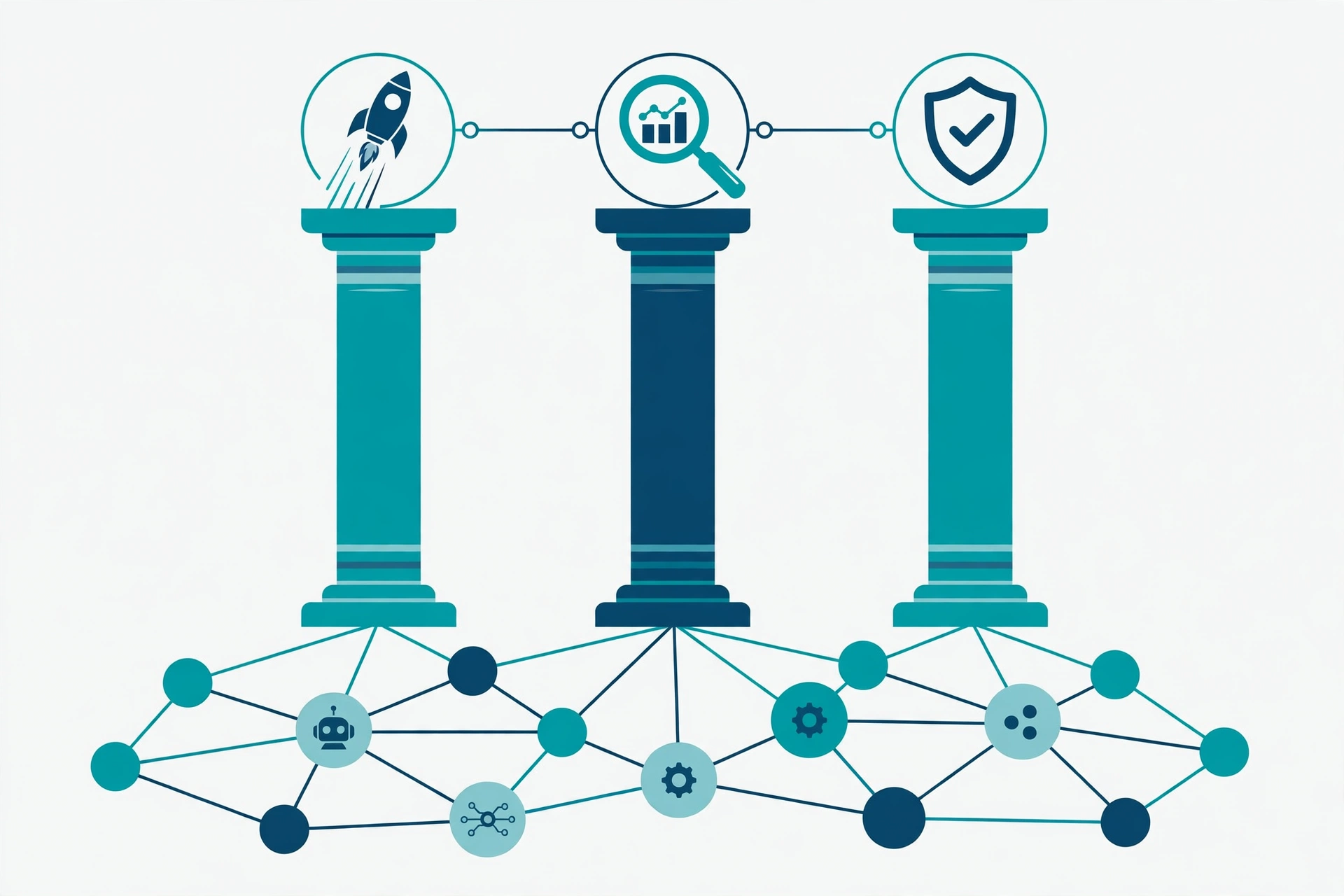
LangChain organises LangSmith around three pillars, and the new funding maps directly onto them:
1. Agent Runtime. The architecture and infrastructure to run agents reliably. Deep Agents, LangGraph and LangChain give developers flexibility across models and control over how context is managed. The LangSmith Agent Server and Sandboxes let teams deploy and run agents securely at scale, in the cloud or in their own environment. Managed Agents and Fleet provide fully managed services to build, deploy and run mission-critical agents in production.
2. Agent Improvement. The testing and observability that shows whether an agent is getting better or worse. LangSmith Observability and Evaluation give teams visibility into how agents behave and measure their quality. LangSmith Engine, an in-platform agent, automates improvement by finding errors, writing code and prompt fixes, and monitoring production traffic for regressions. LangSmith Fine-Tuning turns agent traces into training data to fine-tune and evaluate specialised models.
3. Agent Governance. Centralised control over how agents use models, tools and data. LLM and Tool Gateways help teams manage model budgets and fallbacks, protect sensitive data, and govern tool access and authentication across teams and agents. This is the pillar that matters most to regulated industries — and the one that connects directly to the wider debate over how much access an AI agent should have to sensitive information.
Why the Valuation Doubled in a Year
A $3 billion valuation, more than double a year ago, in a funding market that has been unforgiving to AI companies without real customers, says investors now see LangChain as infrastructure — the layer companies build their agents on — rather than one more tool in a crowded field.
The shift is easy to understand. Building a prototype agent is now a weekend project. Putting that agent in front of real customers, watching what it does, testing whether a new version is better, and stopping it from spending too much or touching the wrong system — that is the hard, unglamorous work, and it is what LangSmith sells. The three pillars in this raise map exactly onto that wall: runtime to run agents, improvement to test them, governance to control them.
The timing also fits a wider pattern. AI agents are moving into real transactions, and agentic payment standards are taking shape. As agents start spending money and touching production systems, the companies that can prove an agent behaved correctly become as important as the companies that built the agent in the first place.
The Enterprise Proof Points

LangChain’s customer list spans chips, cars, software and legal work — Nvidia, Toyota, Salesforce, Workday, Harvey, Rippling and Clay — a sign that agents are no longer a single industry’s experiment.
The most concrete example the company gives is Workday, which it says cut the time to deploy a new agent from about five months to under a day using LangGraph and LangSmith. Clay, meanwhile, uses LangSmith to monitor hundreds of millions of agent runs per month and improve its agents. Both figures are LangChain’s own claims, not independently audited, but they point at the right problem: deploying an agent in under a day instead of five months is the difference between agents as demos and agents as production systems.
For developers, the context is worth knowing. LangChain’s open-source frameworks grew out of the same problems as retrieval-augmented generation (RAG) — connecting language models to live data and tools — and LangSmith is the commercial layer that sits on top of that work, adding tracing, evaluation, prompt management and deployment controls.
What to Watch on November 20
LangChain says it will show several new LangSmith capabilities at a release event on Friday, November 20, 2026. That event is the first chance to see whether the product keeps pace with the price tag. The company has also said it plans to roughly double its workforce to about 850 people by the end of 2027, using the new funding for product development and hiring.
The open questions are the usual ones for a funding announcement of this size: no revenue disclosed, the 7,000-organisation and 1-billion-events figures unaudited, and no word on how many of those organisations are paying customers. Whether enterprise adoption converts into steady software revenue is the key test for sustaining a $3 billion valuation. The November 20 event is where LangChain has to show the product, not just the valuation.
What This Means for Developers and Businesses
For developers, the message is that agent infrastructure is becoming a career skill in its own right. Knowing how to build an agent is table stakes; knowing how to evaluate it, trace its failures and govern its tool access is where the jobs are heading. LangSmith’s three pillars are a useful checklist for any team shipping agents: can you run them reliably, can you measure whether they are improving, and can you control what they touch?
For businesses, the round is a reminder to budget for the operating layer, not just the model. A company that buys into agents without observability and governance is flying blind — and as agents take on more consequential work, from OpenAI’s always-on ChatGPT Dots agents to finance and HR workflows, the cost of a bad agent run keeps rising.
The $300 million does not prove that every agent deployment will be reliable, or that any particular platform will produce a financial return. But it does show where the smart money thinks the agent economy is heading: not to the flashiest demo, but to the platform that keeps a thousand agents running safely once the demo is over.
Frequently Asked Questions
What is LangSmith?
LangSmith is LangChain’s platform for running, testing and governing AI agents in production — the dashboards, evaluations and controls a company uses once an agent is live, rather than the code used to build it. It works with agents built on any framework, not just LangChain’s own.
What is a Series C?
A Series C is a later round of funding from outside investors, after a startup has already raised seed, Series A and Series B rounds. It usually means the company has real customers and is raising money to scale up. LangChain’s Series C was $300 million at a $3 billion valuation.
Why does CapitalG leading the round matter?
CapitalG is Alphabet’s growth fund, so its lead is a vote of confidence from inside Google’s orbit — and a signal that LangChain’s platform is seen as infrastructure, not just a developer tool.
When will we see what the money buys?
LangChain says it will show new LangSmith capabilities at a release event on Friday, November 20, 2026.
Sources: LangChain’s official Series C announcement (November 13, 2026); Unite.AI; Pulse 2.0; GrowthList.