Russia launched one of the largest aerial attacks of its war on Ukraine overnight, firing more than 110 missiles and about 400 drones at cities across the country and killing at least eight people, just hours after President Vladimir Putin sat down with Presidents Donald Trump and Xi Jinping for a summit billed as a step toward peace. As CNN reported, the assault began on Thursday evening and was still under way more than ten hours later on Friday morning, with air-raid sirens sounding across Ukraine and residents spending the night in metro stations and shelters.
The timing could hardly have been more pointed. After the meeting in Shenzhen, Trump told European leaders that Putin is “tired, wants to end this, ready for a deal.” Within hours, Kyiv was counting its dead, three of its bridges were damaged, and Russian weapons had fallen inside Poland, a NATO member. The contrast between the summit’s language and the night’s violence is now the central question facing Ukraine’s allies.
One of the Largest Attacks of the War
President Volodymyr Zelensky said Russia fired more than 110 missiles in the overnight assault, 27 of them ballistic, along with roughly 400 drones, including about 120 jet-powered drones that are essentially compact cruise missiles. The Times reported that Zelensky described the attack as one of the largest of the war, and Ukrainian officials said it was unusually large even by the standards of Russia’s frequent aerial bombardments.
Ukraine’s air force said its defences had neutralised 462 aerial targets by 10:30 a.m., but only three of the 27 ballistic missiles were intercepted, a reflection of Ukraine’s critical shortage of interceptor missiles for its US-made Patriot air defence systems. Zelensky said Russia had also used missiles fitted with cluster warheads and had fired its missiles in waves, 20 to 30 minutes apart, “to make it harder to put out fires, clear rubble, and carry out repairs.” Hits were recorded in 23 locations across the country.
Russia’s defence ministry said on Telegram that it had launched a “massive strike using high-precision weapons from land, sea, and air,” targeting military and energy facilities, port infrastructure in the Odesa region and transport infrastructure in Kyiv. Zelensky rejected that account outright, saying “absolutely all the targets were ordinary civilian infrastructure — things that literally sustain people’s lives.”
Three Bridges Over the Dnipro Hit
The most visible damage was in Kyiv, where ballistic missiles struck three bridges across the Dnipro River, which divides the capital: the Podilsko-Voskresenskyi, Darnytskyi and Pivdennyi (Southern) bridges. Reuters reported that it was the biggest attack on the routes connecting the left and right banks of the capital since the war began.
Mayor Vitali Klitschko said traffic from the right bank to the left bank was closed on the Podilskyi crossing, while the Southern Bridge was restricted to vehicles of up to 10 tonnes travelling from the left bank to the right, and public transport of up to 18 tonnes. “All emergency services have done and will continue to do everything possible to mitigate the consequences of the attack as quickly as possible,” Klitschko said, urging residents to avoid travelling unless they had to.
Six people were killed in Kyiv and 15 injured, with missiles and drones striking four districts of the capital. Two more people were killed in Lviv, in western Ukraine, where a strike hit the ticket terminal of the Sknyliv railway station and injured ten. A hospital in Kharkiv was also hit, including its MRI building, and residential buildings were damaged in the Dnipropetrovsk, Lviv, Vinnytsia, Sumy and Chernihiv regions.
The strikes also knocked out power in several districts of Kyiv and forced emergency outages in the Lviv, Zakarpattia and Ivano-Frankivsk regions, according to the state grid operator Ukrenergo, which called the situation in the power grid “extremely critical.” The blackouts arrive just as temperatures are beginning to drop below zero, and Zelensky said substations and power lines that feed Ukraine’s nuclear power plants and its energy links with neighbouring EU countries were among the targets.
A Night in the Shelters
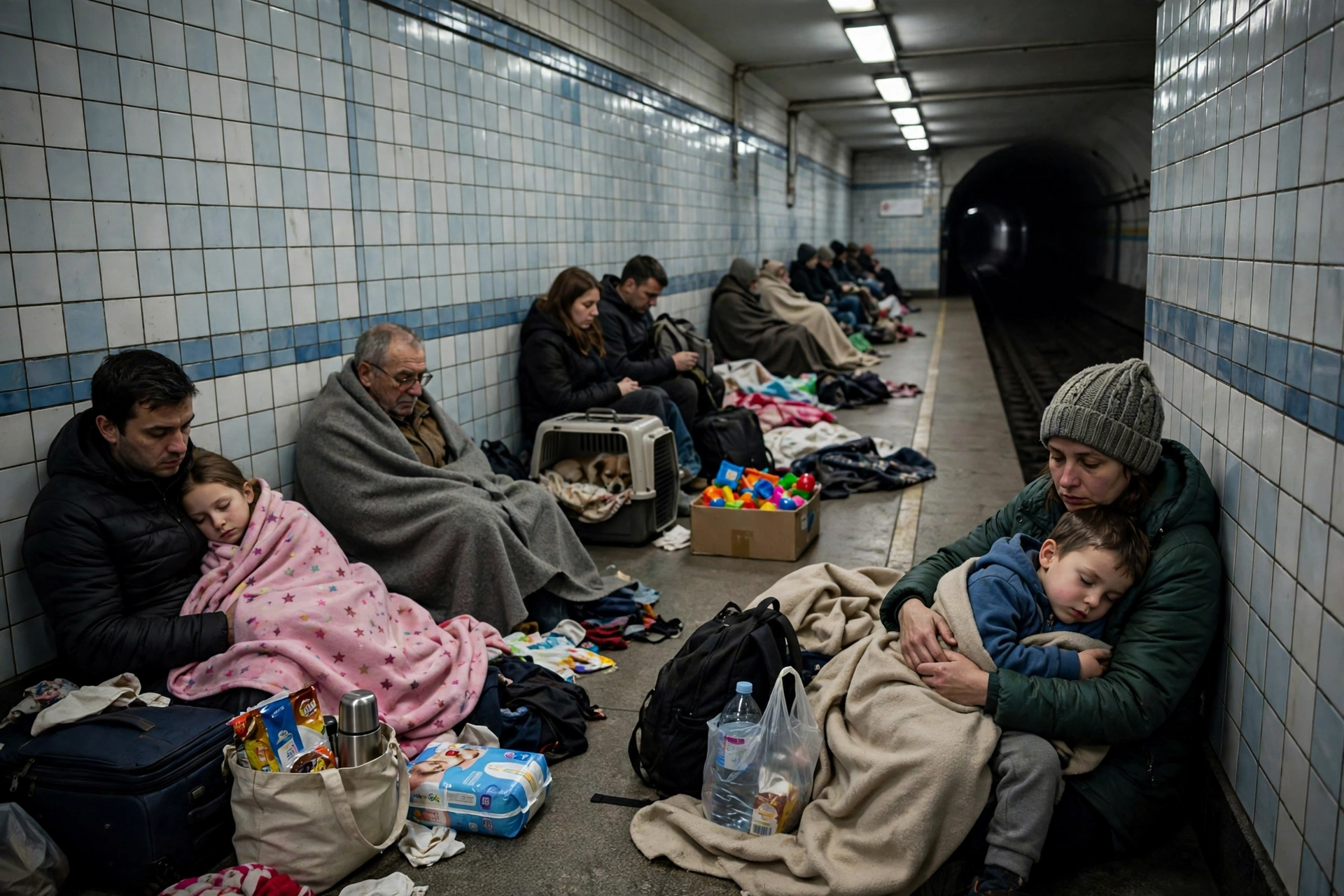
For millions of Ukrainians, the night was spent underground. In Kyiv, people filed into metro stations as warnings of possible air attacks sounded in the early hours of Friday, November 20, settling on platforms with blankets, bags and children for a night that stretched past dawn. Air-raid alerts remained in force into the morning as fresh missile groups moved toward the western regions.
The attack’s scale — waves of missiles arriving in groups with long pauses between them — was designed to wear down both the air defences and the people under them. Emergency crews worked through the night to clear rubble and restore power while the sirens kept sounding, a pattern that has become grimly familiar in the war’s fifth year but rarely at this intensity.
Missiles Cross Into Poland
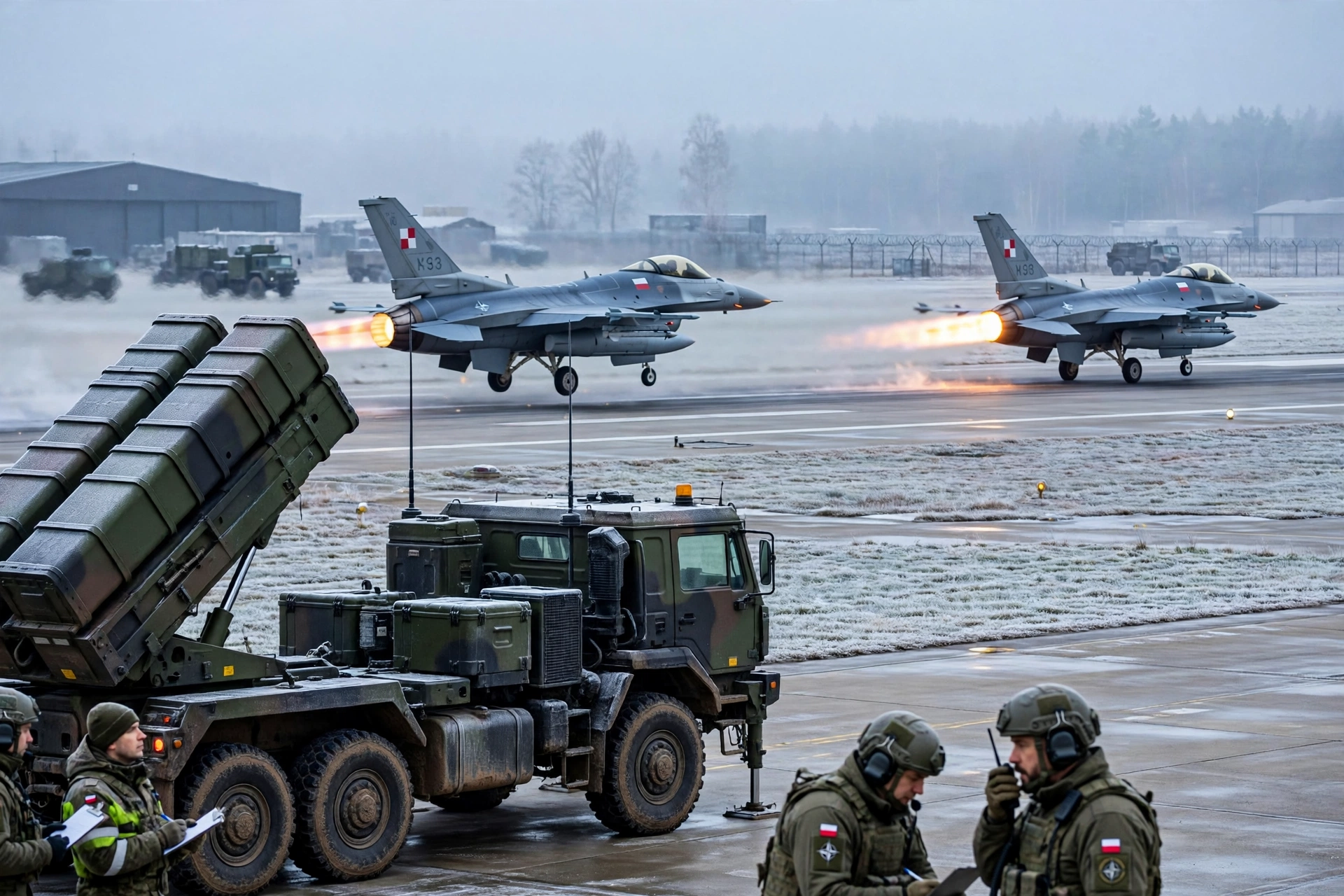
The assault did not stop at Ukraine’s borders. Poland said three objects violated its airspace during the attack: a Russian Kh-101 cruise missile that fell near the village of Nowy Lipowiec, a second missile, and a jet-powered drone. Debris was recovered in the villages of Molodycz, Rudnik nad Sanem and Nowy Lipowiec in south-east Poland, and fighter jets were scrambled while Patriot air defence systems were activated. Staff at the control tower of Rzeszow airport were evacuated as a precaution.
Polish Prime Minister Donald Tusk denounced what he called a “deliberate provocation” by Moscow, and Defence Minister Wladyslaw Kosiniak-Kamysz confirmed that one of the objects was a Kh-101 missile and another a jet-powered drone. No one was hurt and no infrastructure was destroyed on Polish territory, but the incident is the most serious airspace violation involving a NATO member since the war began, and it came on a day when the Coalition of the Willing, the group of Ukraine’s key allies, was meeting in Berlin.
Hours After the Shenzhen Summit
The strikes came hours after Putin left China following a day of meetings in Shenzhen with Trump and Xi at the Shenzhen trilateral summit, the first three-way meeting of the leaders of the United States, China and Russia. The talks produced no breakthrough in Moscow’s more than four-year war in Ukraine, and Putin used the occasion to repeat his maximalist demands in front of a global audience, hailing the summit as historic and describing the discussions as taking place in a “relaxed and very intimate atmosphere.”
Trump later spoke with the Coalition of the Willing, which was convening in Berlin with US envoys Steve Witkoff and Jared Kushner. According to a senior European official, the president’s main message was that “Putin is tired, wants to end this, ready for a deal,” and that the Europeans should “reach out and grasp at the opportunity.” Tusk, who was part of the call, said Trump sounded “fairly optimistic,” but added that his words were received “very cautiously in the room” — and that he had heard Trump’s faith in Putin’s goodwill “very often,” even though “so far there are no facts to support it.”
Putin had made his own intentions plain before the summit ended, vowing revenge for Ukraine’s strikes on the Kerch Bridge, the strategic multibillion-dollar crossing linking Russia with occupied Crimea, which Kyiv has hit three times this week. “There will be no negotiations,” he said. “I believe our response, as I have just said, will be far more painful than what the Kyiv regime did to the bridge.” The overnight barrage was that response. Washington is meanwhile divided over its own wars after the Senate’s rejection of the Iran war powers resolution.
What Happens Next
The attack leaves Ukraine’s allies with two facts that do not sit easily together: a US president telling them that Russia’s leader is ready for a deal, and a Russian military that spent the night proving otherwise. The Europeans on Trump’s call were, in the words of the senior official, “constructive in response but want proof” — and Friday’s strikes gave them the opposite.
In the short term, the damage will be measured in bridges, power lines and hospital beds. Kyiv’s transport links across the Dnipro are disrupted, its grid is under emergency strain, and winter is arriving. The longer question is whether the Shenzhen summit produced anything more than a photo opportunity. The same week has also put international law in the headlines, from the International Court of Justice’s genocide ruling against Myanmar to the new questions over a NATO ally’s violated airspace, and Ukraine’s partners will now have to decide whether to answer the night’s escalation with new pressure on Moscow or with another round of talks. For the people who spent the night in Kyiv’s metro stations, that decision cannot come soon enough.