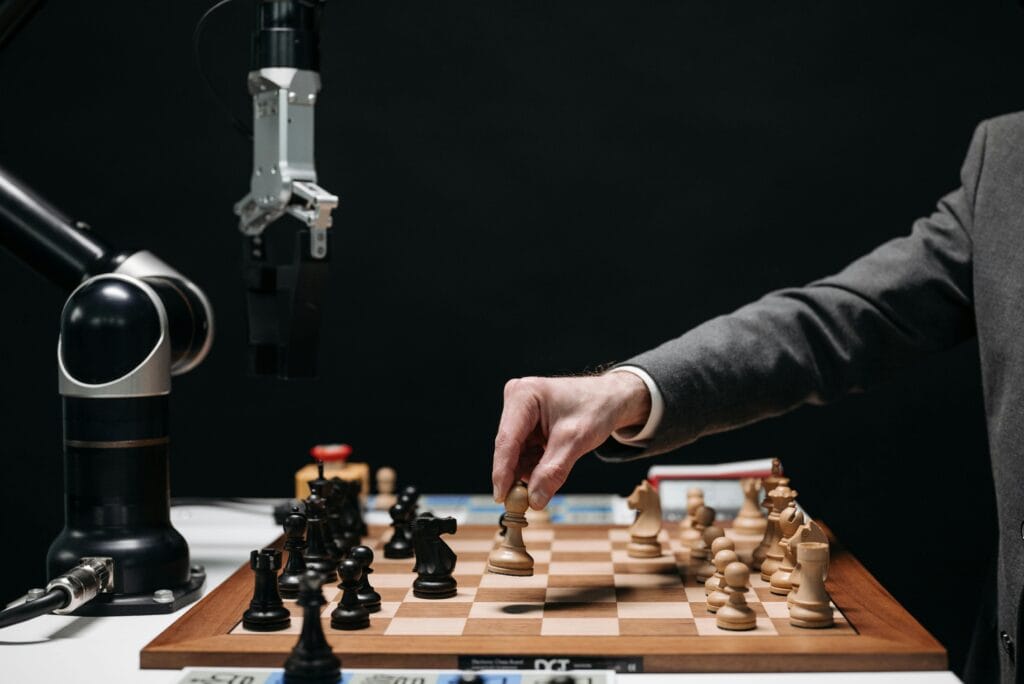
Runway, the company best known for AI video generation, has just given the robotics world a brain it can actually own. On November 11, 2026, Runway released the weights for Praxis-1, its world action model for robots, under the Apache 2.0 license. Anyone can download it, run it on their own hardware, fine-tune it for their own robot, and even use it commercially — no license negotiation, no API gatekeeper.
It is a notable moment for physical AI. For years, the most capable robot models lived behind closed APIs or inside a single company’s labs. Praxis-1 arrives as a fully open-weight model that, according to Runway, already beats every other open robot model on a widely used benchmark. That combination — open and state of the art — is rare, and it is why this release matters beyond the robotics niche.
What Praxis-1 Is
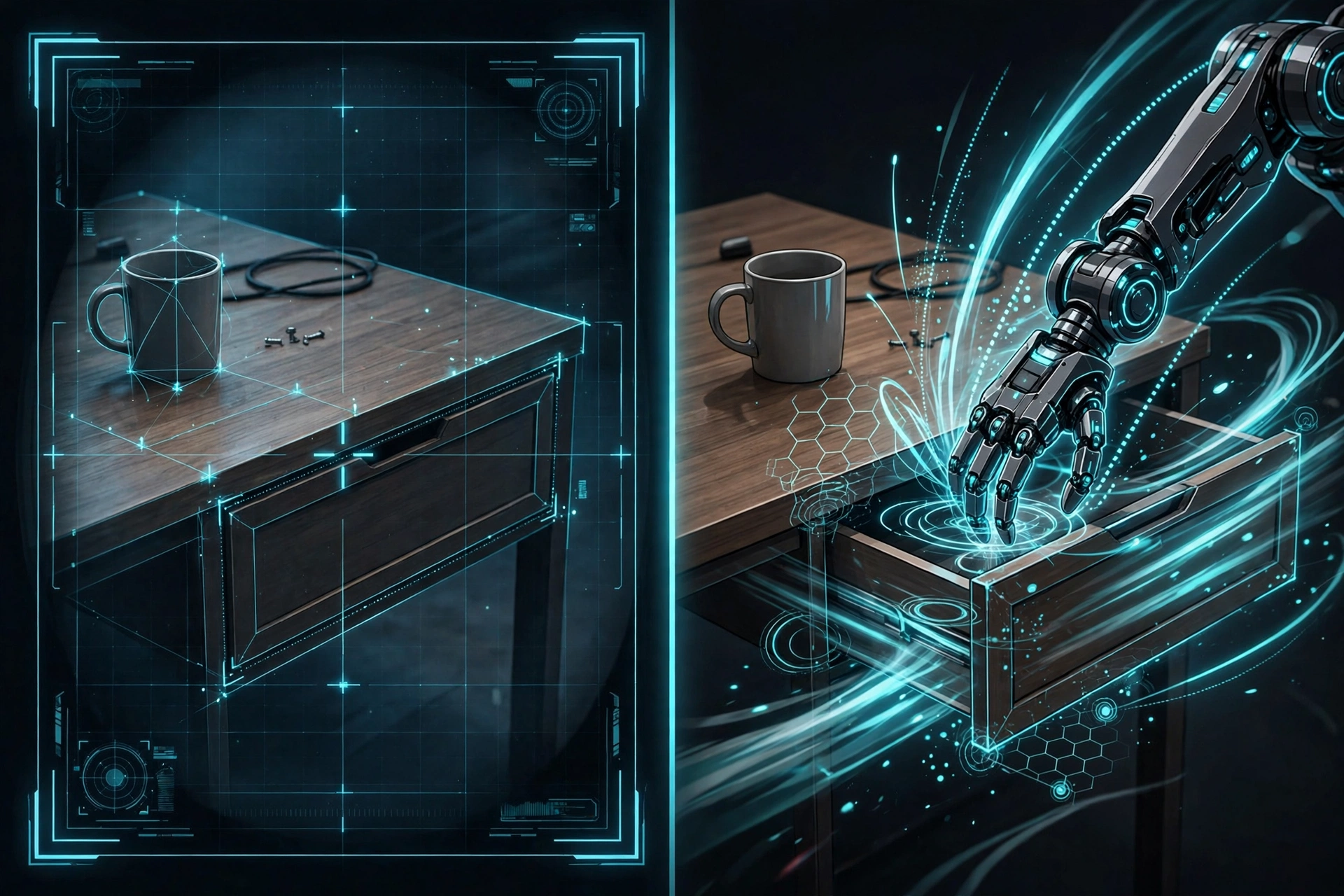
Praxis-1 is what Runway calls a world action model: a 27-billion-parameter mixture-of-experts diffusion transformer that predicts video and actions together. Instead of treating robot control as a separate problem from seeing the world, the model watches a scene, imagines the next few frames of video, and turns that prediction into the motor commands that make the scene happen.
The idea is simple to state and hard to build. A robot that can predict what the world will look like after it moves a mug or opens a drawer has a much better chance of doing the task right than one that only maps camera pixels to joint angles. Runway built Praxis-1 on the same large-scale video pretraining behind its general world models, then added robot-specific training so that video knowledge maps onto physical action.
Runway first introduced Praxis-1 in September 2026 and promised at the time that it would ship as an open model. The November 11 release delivers on that commitment, with the weights plus inference and fine-tuning code all published under Apache 2.0.
How a World Action Model Thinks
The core trick is that Praxis-1 learns how objects behave and how tasks unfold from large-scale video. Runway says its research has shown that ordinary web video works as well as teleoperated robot video as pretraining data for policy performance. If that holds up, the bottleneck for a capable robot policy shifts from collecting expensive robot demonstrations to how much general video a model can learn from — a much cheaper and more scalable resource.
That video-first training gives the model a head start on a new robot body before any fine-tuning. Runway reports that a single Praxis-1 checkpoint has adapted to a variety of embodiments with only light fine-tuning, and with LoRA — a low-cost fine-tuning method — developers can adapt it to their own robot, cameras and tasks without retraining the full 27-billion-parameter model.
The generalisation claim has a concrete test behind it. Fine-tuned on Google’s RT-1 robot, which never appeared in its training data, Praxis-1 reached 80.0% success on the SimplerEnv benchmark, well above the original RT-1 policy’s 52.4%. That is the kind of transfer result that makes robotics researchers pay attention: the model is not just memorising its own hardware.
The Benchmark Numbers
On NVIDIA’s RoboLab-120 leaderboard — 120 tabletop tasks, 10 trials each, 1,200 episodes in total — Praxis-1 reached 46.2% success, the top score among world action models and open-weight robot foundation models. The gap to the field is real but not enormous: FLUX 3 Action scored 42.9%, Cosmos3 Nano 36.8% and pi0.5 28.0%.
Two caveats belong with those numbers. First, 46.2% is a leaderboard high, not a factory floor. Nearly half the episodes still fail, which is why Runway’s launch partners have been running the model on real hardware rather than only in simulation. Second, all of these figures are Runway’s own, reported as data as of November 2026; no independent replication has been published yet. Treat the ranking as a strong signal, not a settled fact.
Even with those caveats, the direction is clear. Open models are now within striking distance of the best closed robot systems on standard benchmarks, and the gap is closing from the open side.
From Lab Partners to Warehouse Floors
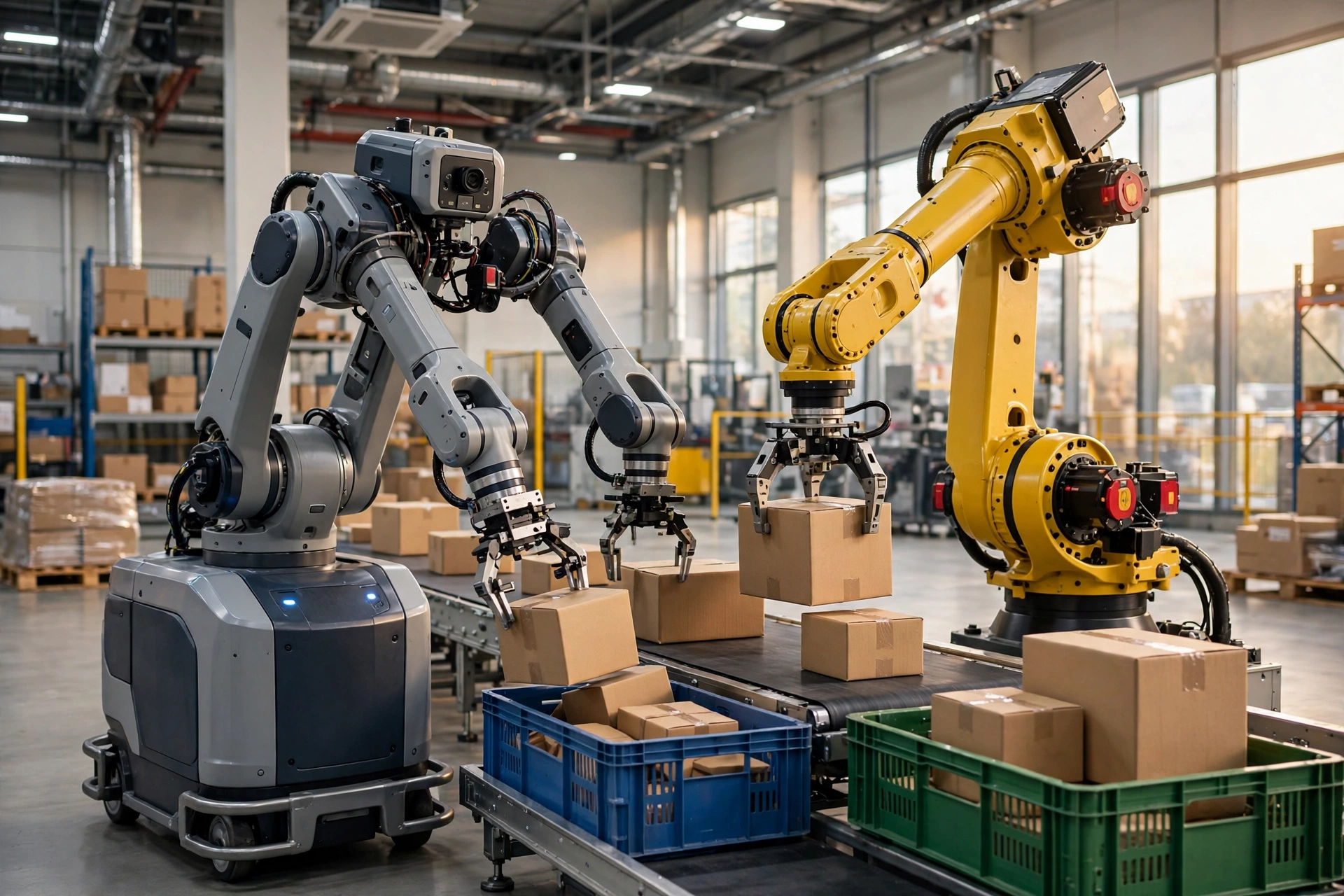
Praxis-1 did not go straight from a research paper to a download link. Runway’s launch partners have been running it on their own hardware for weeks: Noble Machines on a legged humanoid, Standard Bots on a six-axis industrial arm, and Ultra on a dual-arm warehouse robot. That partner testing is the difference between a model that works in a demo video and one that survives contact with a real warehouse.
The release includes three checkpoints on Hugging Face: a base mid-trained model, a version fine-tuned on the DROID dataset, and one fine-tuned for the bimanual YAM robot. The weights, inference code and full or LoRA fine-tuning code are available on GitHub and Hugging Face, with native support for the LeRobot robotics library and integration into the vLLM-Omni serving engine. Hosted inference is available through Reactor for teams that want to try it before deploying.
Hardware requirements are serious but reachable. The full model is 54.4 GB in bfloat16 format, so it fits on a single 80 GB GPU, and Runway says it runs out of the box across NVIDIA hardware from data center GPUs like the H100 and B200 to workstation cards like the RTX 5090 and RTX PRO 6000, all the way down to Jetson Thor on the robot itself. With 4-bit NVFP4 quantization, the weights shrink to 17.5 GB.
Why Open Weights Change the Game
Runway frames the release as a bet on openness in physical AI, arguing that U.S. leadership in the field will depend on investment in both hardware and software, plus a level of interoperability and openness from American models that physical use cases do not have yet. The company is a founding member of the Cosmos Coalition, a group advancing open world models for physical AI, and says it is working with NVIDIA to open frontier technology stacks for developers.
The practical case is easier to see than the geopolitical one. Open weights let hardware developers run, inspect and adapt a world action model on their own terms — on their own robots, in their own facilities, without sending video of their factory floor to a third party’s cloud. For warehouses, hospitals and factories, that control is often the deciding factor, not the benchmark score.
It also changes who can experiment. A university lab, a startup with one robot arm, or a manufacturer testing automation on a single line can now start from a model that tops a public leaderboard instead of building a policy from scratch. That is the same dynamic that made open-weight language models so influential, now arriving in robotics.
What This Means for the Open AI Race
Praxis-1 lands in a week crowded with open model news. Meituan’s open-weights LongCat-2.5, a 1.6-trillion-parameter agent model, arrived just two days earlier, and open-weight releases are becoming the norm rather than the exception across AI. The robotics corner of that race has its own stakes: whoever controls the best open robot brain shapes what thousands of smaller hardware companies build on.
There are real limits to keep in mind. Open model weights do not automatically produce safe robot motion — a model that predicts video well can still make a bad grasp, and physical safety depends on the whole system around the model, not just the weights. Praxis-1 still needs data-center-class GPUs for full-precision inference, and it needs clean, well-structured task data to adapt well. None of that makes the release less significant; it makes the next few months of independent testing more important.
For now, the model is out in the open, the code is on GitHub, and the benchmark bar for open robot models has moved. The robotics community will now do what it always does with a strong open release: try to break it, improve it, and build on it.
Frequently Asked Questions
Is Praxis-1 free to use commercially?
Yes. The weights, inference code and fine-tuning code are released under the Apache 2.0 license, which permits commercial use.
Where can I download Praxis-1?
From Hugging Face, with native LeRobot support, and from GitHub, with integration into vLLM-Omni. Hosted inference is available on Reactor.
What hardware do I need to run Praxis-1?
The full model is 54.4 GB in bfloat16 and fits on a single 80 GB GPU. It runs on NVIDIA H100 and B200 data center GPUs, RTX 5090 and RTX PRO 6000 workstation GPUs, and Jetson Thor on the robot itself. A 4-bit quantized version is 17.5 GB.
How does Praxis-1 compare to other robot models?
On NVIDIA’s RoboLab-120 benchmark, Praxis-1 scored 46.2% success across 1,200 episodes, ahead of FLUX 3 Action at 42.9%, Cosmos3 Nano at 36.8% and pi0.5 at 28.0%, according to Runway.
Can Praxis-1 control my robot?
Possibly, with fine-tuning. Runway says a single checkpoint has adapted to several embodiments with light fine-tuning, including a legged humanoid, a six-axis industrial arm and a dual-arm warehouse robot, and LoRA fine-tuning adapts it to new hardware, cameras and tasks.
Related reading
- Read about Meituan’s open-weights LongCat-2.5 agent model:
- AMD EPYC 6 Venice brings 256-core server CPUs to the AI agent era:
- Google Gemini 4 Carbon is built for long agent work:
- NXP’s unified robotics platform targets physical AI:
- Hedra’s Model Factory automates post-training for physical AI: