Every cell in your body carries the same DNA, yet a heart muscle cell and an immune cell read that identical instruction book in completely different ways. That simple fact has been one of the hardest problems in genetics: a DNA variant that raises the risk of a disease may act in only one cell type, and a model that averages across whole tissues can miss it entirely.
On November 11, 2026, Google DeepMind announced AlphaGenome 2, a next-generation DNA sequence model built to close that gap. Instead of predicting how a variant behaves in a tissue average, it predicts how it behaves in a specific human cell type — a gut macrophage, an activated T cell, a heart muscle cell — and DeepMind says it finds nearly twice as many of the variants that actually change gene activity as its predecessor did.
The model is available from today for non-commercial research through the AlphaGenome API, with commercial research access in a private preview. It is, DeepMind stresses, a research tool: neither AlphaGenome model has been validated or approved for clinical or diagnostic use.
What AlphaGenome 2 Is
AlphaGenome 2 is a DNA sequence model. Give it a stretch of DNA — up to one million letters long — plus a chosen biological condition, and it predicts how that sequence behaves in that condition: gene expression, chromatin accessibility, histone modifications and, new in this version, DNA methylation, a chemical tag linked to genes being switched off.
The original AlphaGenome, previewed in June 2025 and published in Nature in January 2026, worked differently. It produced fixed, parallel predictions for many tissues and cell lines at once. That made it powerful for broad scans, but it could not answer the question a disease researcher actually asks: what does this variant do in the one cell type where the disease starts?
AlphaGenome 2 is built to answer exactly that. It arrives the same week DeepMind also announced Gemini Robotics 2.5, its most capable robot control model, and it shows how far DeepMind’s AI now reaches beyond chatbots and code, into the machinery of biology itself.
Why Cell Type Changes Everything
Most of the DNA variants linked to disease by genome-wide association studies sit outside protein-coding genes, in the non-coding regions that control when and where genes switch on. Their effect depends entirely on context. A variant might do nothing in a skin cell and sharply change gene activity in a brain cell. Averaging across a tissue blends those signals into noise, which is why so many disease-linked variants have stayed unexplained.
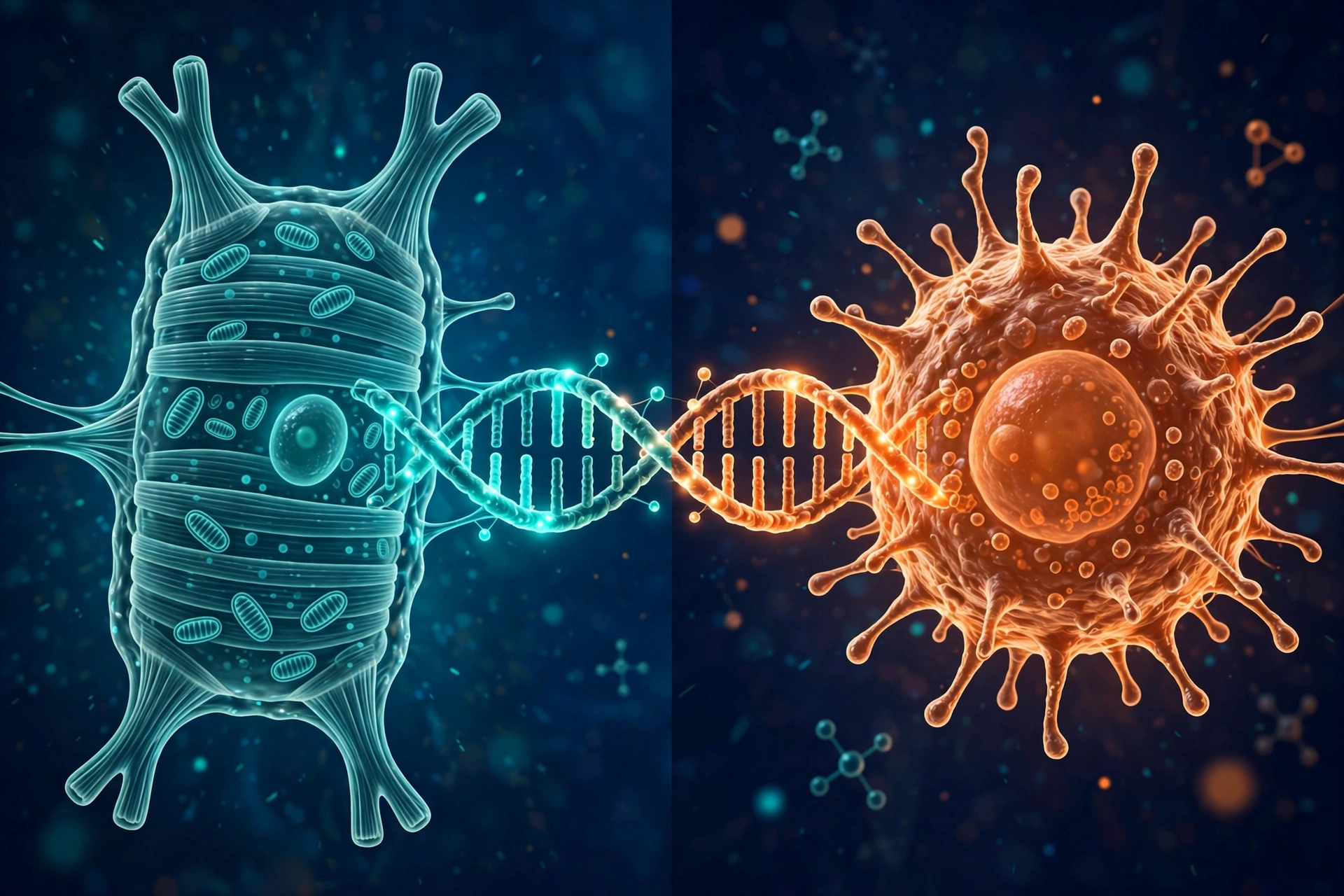
AlphaGenome 2 attacks that problem by conditioning every prediction on a single cell type or state. The same stretch of DNA can be run through the model once for a heart muscle cell and once for an immune cell, and the two answers can differ — which is precisely what happens in real biology. That resolution matters for drug development, where knowing the cell type a variant acts in points researchers at the right tissue, the right pathway and, eventually, the right target.
It also matters for a practical reason: most human genetics data is statistical. Studies flag thousands of variants that are correlated with a disease, but only a fraction are causal — the ones that actually drive the change. Separating the causal few from the correlated many has been slow, expensive work. A model that can do it computationally, cell by cell, changes the economics of the search.
A Conditional Model, Not Just a Bigger One
The key design change in AlphaGenome 2 is that it is a conditional model. Alongside the DNA sequence, it takes one target condition — a tissue, a cell type or a cell state — chosen from a reference catalog or generated on the fly from a scientist’s own single-cell experiment through a cell encoder, and it uses that condition at every stage of the network.
That last detail is important. A researcher studying a rare cell population does not have to wait for DeepMind to add it to the catalog. With as few as a few dozen cells from their own experiment, they can condition the model on their own data without retraining it. Sarah Teichmann of the University of Cambridge, who works with the Human Cell Atlas, noted in DeepMind’s announcement that this ability to adapt directly to new single-cell data is what makes the model practical for working scientists rather than just a demonstration.
The trade-off is compute. Predictions from AlphaGenome 2 cost more than those from the original model, and DeepMind’s genomics lead Ziga Avsec has said that is why a genome-wide atlas built with the new model is impractical. The original AlphaGenome will stay in service for broad, cheap scans; AlphaGenome 2 is for the questions where cell-level detail is worth the extra cost.
The Numbers: Nearly Twice as Many Causal Variants
DeepMind’s headline result comes from TenK10K, a large single-cell map of 28 primary immune cell types. On that benchmark, the company reports that AlphaGenome 2 identified 30% of causal variants, against 16% for the original AlphaGenome fine-tuned on single-cell data and other specialized tools. It also called the direction of a variant’s effect on its gene correctly 43% of the time, against 23% before.
In the technical paper, DeepMind describes this as doubling recall of causal single-cell eQTLs — variants that change how strongly a gene is expressed — at 90% precision. The paper also notes the model still recovers only a minority of the variants that statistics flag as likely causal, and that it learns correlations rather than proven cause and effect. The numbers, in other words, are a large step forward and still far from a solved problem — and they are DeepMind’s own evaluations, not yet independently replicated.
DeepMind has also precomputed scores for 7 million common variants across hundreds of human cell and tissue types, covering traits from height to type 2 diabetes, giving researchers a ready-made resource to explore without running the model themselves.
Trained on 107 Million Cell Profiles
Scale is part of the story. DeepMind trained AlphaGenome 2 on bulk and single-cell data from human and mouse samples, including more than 107 million individual cell profiles across 68 tissues. That is what lets the model learn how the same DNA sequence is read differently in different cellular contexts, rather than memorizing a single average behavior.
The training data also explains the model’s reach: because it has seen so many cell states, it can generalize to cell types and states it was not explicitly trained on, as long as a researcher can supply a small sample of single-cell data to condition it. For labs working on rare diseases or unusual cell populations, that generalization is the difference between a tool they can use and one built for someone else’s problem.
It is worth putting this in context. The same week, AI labs released open-weight models for robots and agents — Runway’s open-weight Praxis-1 robot model and Meituan’s open-weight LongCat-2.5 — and Databricks turned its Genie assistant into an always-on AI coworker. AlphaGenome 2 belongs to a different branch of the same trend: AI moving from general-purpose chat into specialized scientific instruments.
Who Can Use It — and What It Cannot Do
Access is split in two. Non-commercial researchers can use AlphaGenome 2 from today through the AlphaGenome API, with Colab tutorials to get started. Commercial research is available only through a private preview, and DeepMind is running a community spotlight program that may offer API credits — applications close on November 30.
Genomics Limited, led by Peter Donnelly, is already folding the model into its Mystra platform, an early sign that the research community is moving fast to build on it. DeepMind has also said AlphaGenome 2 skills are coming to Google Antigravity, its agentic development platform, which would put the model inside coding-style workflows for scientists.
The limits matter as much as the access. DeepMind states plainly that the AlphaGenome models are intended for research use only and have not been validated or approved for clinical or diagnostic purposes. AlphaGenome 2 will not read your personal genome, diagnose a condition or guide treatment. Its predictions are hypotheses for researchers to test in the lab, not answers about a patient. Anyone evaluating it should also remember that the headline figures come from DeepMind’s own benchmarks, and independent replication will take time.
What This Means for Disease Research
The practical promise of AlphaGenome 2 is narrower and more concrete than a cure for anything. It is a better way to answer three questions that sit at the start of almost every genetics-driven drug program: which variant in a region actually matters, in which cell type does it act, and in which direction does it push the gene?
Answering those questions faster means fewer dead ends in the lab, sharper hypotheses for experimental validation, and a clearer path from a statistical signal in a genome-wide study to a biological mechanism a drug can target. For diseases where the causal cell type has been elusive — many autoimmune conditions, some cancers, neurodevelopmental disorders — a model that resolves activity inside specialized cells could surface leads that tissue-level models buried.
That is also why the Nature coverage of the launch focused on a replication of a real finding: DeepMind researchers used the model to reproduce, without lifting a pipette, aspects of a result that had previously required laboratory work. It is a small demonstration, but it points at the direction of travel — AI models that do not just summarize biology but predict it, cell by cell.
Frequently Asked Questions
What is AlphaGenome 2?
AlphaGenome 2 is Google DeepMind’s next-generation DNA sequence model, announced November 11, 2026. It predicts how DNA variants affect gene activity in specific human cell types and states, rather than in tissue averages.
How is AlphaGenome 2 different from the original AlphaGenome?
The original model predicted for many tissues at once. AlphaGenome 2 is a conditional model: it takes one cell type or state at a time, can adapt to a scientist’s own single-cell data without retraining, and adds DNA methylation to its predicted readouts.
How accurate is AlphaGenome 2?
On the TenK10K immune-cell benchmark, DeepMind reports it identified 30% of causal variants versus 16% for the original model, and called effect direction correctly 43% of the time versus 23%. These are DeepMind’s own figures and have not yet been independently verified.
Who can use AlphaGenome 2?
Non-commercial researchers can use it now through the AlphaGenome API. Commercial research access is in private preview. It is for research only and is not validated or approved for clinical or diagnostic use.
Is AlphaGenome 2 free?
Non-commercial research access through the AlphaGenome API is available from today at no stated charge, and DeepMind is running a community spotlight program that may offer API credits. Commercial access is by private preview, with pricing not publicly stated.
The Bottom Line
AlphaGenome 2 is not a chatbot, a gadget or a productivity tool — it is a scientific instrument, and it arrives at a moment when AI is rapidly becoming one. By predicting how DNA variants behave in individual cell types, trained on more than 107 million cell profiles, it nearly doubles the rate at which researchers can find the variants that actually change gene activity.
The caveats are real: the headline numbers are DeepMind’s own, the model is research-only, and it still finds a minority of causal variants. But the direction is unmistakable. The same week that ElevenLabs showed how far custom AI models have come for voice and agents, DeepMind showed the same idea applied to the genome. The cell, it turns out, is the right unit of analysis — and AI has finally learned to read DNA at that resolution.
Sources: Google DeepMind’s AlphaGenome 2 announcement, Nature’s coverage of the launch, and SiliconANGLE’s report on DeepMind’s double launch.