Fortinet has added a new layer of security to the place where enterprise AI traffic already passes through: the firewall. Its new FortiGuard Inline AI Security Service, announced on November 2, 2026, brings AI-specific inspection and guardrails to FortiGate customers through a cloud-delivered service, so organisations do not have to deploy and manage a separate AI security stack to get started. The idea is simple, and timely. Employees and agents are already using AI tools, often faster than security teams can track them. Fortinet is betting that the firewall, already sitting in the traffic path, is the most practical place to see that activity, enforce policy, and stop sensitive data from leaving.
What Fortinet announced for FortiGate customers
Fortinet describes the service as delivering AI-specific inspection and guardrails to FortiGate customers via a cloud-delivered service. It is powered by FortiAIGate, Fortinet’s AI gateway technology, and builds on technology from Fortinet’s recent acquisition of Virtue AI, an innovator in AI runtime protection, automated AI validation, and security for autonomous AI systems. Founder, President and CTO Michael Xie said Fortinet is making AI security available through the infrastructure customers already use, with FortiAIGate as the foundation for a broader strategy. The pitch is distribution as much as technology: Fortinet’s broad FortiGate footprint gives organisations a simpler path to adopt AI security, because they can enable the service on firewalls they already run instead of standing up new infrastructure. That matters for mid-sized organisations that cannot easily run a standalone AI gateway, and for large enterprises that want consistent policy across many sites.
For further reading, see Fortinet’s announcement coverage, independent analysis of the announcement, and TechHerald’s report on the launch.
How inline AI inspection works
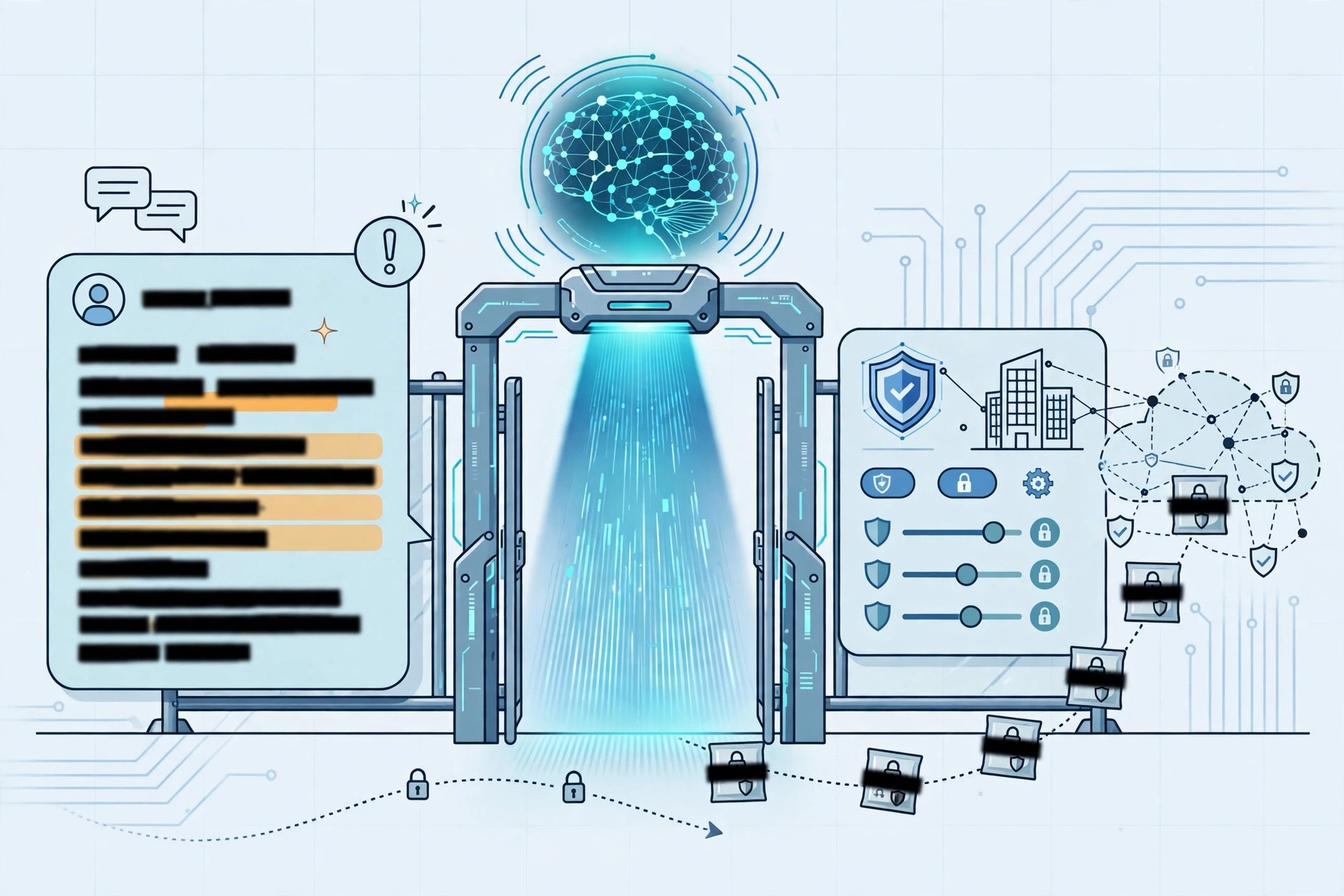
Unlike tools that only log which AI services are used, FortiAIGate-based guardrails inspect prompts and data in real time and enforce security, compliance, and data protection policies across interactions with agents, large language models (LLMs), and Model Context Protocol (MCP) tools. That includes prompts sent to a model, responses coming back, traffic between agents and tools, API calls, and the actions agents take. Fortinet says the engine handles five content types: text, image, audio, video, and code. In practice, that means a guardrail can sit between an AI application and a model, check what is being said inside the session, and act before exposure happens — alerting, denying, or redacting — rather than merely recording that a leak occurred.
Shadow AI, data protection and spend controls
The service goes beyond discovering shadow AI usage and applying data loss prevention (DLP) policies to AI traffic. It extends protection from identifying AI use and sensitive data movement to inspecting the content of AI interactions and masking sensitive data. The expanded DLP engine detects 35 types of personally identifiable information (PII) and confidential data, and administrators can block requests, generate alerts, or redact sensitive information before it is exposed. The governance layer is equally detailed. Fortinet has added controls for AI model permissions, usage limits and spending: businesses can set budgets and rate limits for individual users, teams and projects, and the system can block malicious prompts designed to consume excessive AI tokens and computing resources — the so-called denial-of-wallet attack. The FortiAIGate platform includes more than 50 predefined policies covering AI governance, data privacy and security compliance, and provides visibility into AI agents and how they touch enterprise applications, APIs and data. That agent visibility is becoming essential as agents start more work on their own: read our report on how AI agents now start over 40% of GitHub pull requests. The same shift toward AI that acts, not just chats, is why on-device and inline inspection are both gaining ground: see our coverage of an edge AI chip built for on-device inference.
Cloud service or self-hosted FortiAIGate
Fortinet offers two deployment paths built on the same FortiAIGate foundation. Most FortiGate customers can enable the FortiGuard Inline AI Security Service as a cloud-delivered subscription with no extra AI security stack to stand up or run. Organisations with stricter data privacy and sovereignty requirements can instead self-host FortiAIGate on-premises or in their own cloud environments using Kubernetes and NVIDIA GPUs, keeping prompts, responses, data, and logs inside their own environment. Fortinet frames the choice as one of cost, performance, privacy, and sovereignty, and ties the service into its Security Fabric, connecting AI controls to the network, cloud, application, data, identity, and security-operations sides of the platform. For security teams weighing this against other AI security approaches, the contrast with a gated, defender-first model is instructive: read our coverage of Google’s Gemini 4 Carbon cybersecurity model.

What Fortinet has not disclosed yet
A fair reading also notes what is still missing. Fortinet has not disclosed accuracy or false-positive rates for the inspection engine, though it claims minimal false positives and low latency. It has also not detailed how the inspection models themselves were built, trained, or updated. Those gaps do not invalidate the announcement, but they do mean buyers should test the service on their own traffic, measure false positives and latency in their environment, and check how it handles the specific models, agents, and MCP tools they actually use before rolling it out broadly. Pricing and availability details for individual customers were also not the focus of the announcement coverage, so prospective buyers should confirm commercial terms directly with Fortinet or a partner.
The bottom line for security teams
Fortinet’s move is less about inventing a new security category than about putting AI inspection where the network already is. If your organisation already standardises on FortiGate, this is the fastest path to AI guardrails: turn on a service, apply policies, and gain visibility into prompts, agents, and data flows without a new platform to run. If your AI traffic cannot leave your environment, the self-hosted FortiAIGate option addresses that constraint directly. Either way, the direction is clear: inline inspection of prompts, agents, and tool calls is becoming a standard line item in the security platform, and the firewall is now one of its front doors.