What Atsign EdgeAI is
Atsign introduced EdgeAI on November 3, 2026, as a packaged way to link distributed systems securely across different networks. It is aimed at Edge AI, Physical AI, the Internet of Things and operational technology, along with smart transportation, robotics, critical infrastructure and remote operations. The idea is grounded in a familiar deployment problem: running a pilot in one location is often straightforward, while expanding it to dozens or hundreds of sites — each with its own network setup and security requirements — is where progress stalls. EdgeAI is intended to take away much of that friction, while keeping internal systems away from public exposure. Details are set out in Atsign’s EdgeAI announcement.
Why exposed edge systems are a growing risk
As autonomous systems multiply, attackers are increasingly using AI to find and exploit infrastructure that is visible online. A robot, sensor gateway or roadside unit that can be discovered on the public internet can become a foothold, even when it was never intended to be public. Atsign’s response is to make protected systems invisible by default, so they can be reached only by authorised participants. That means no open inbound ports for scanners to find, and no dependence on static IP addresses or repeated firewall changes at every site.
Inside Control Center: identity policies and a kill switch
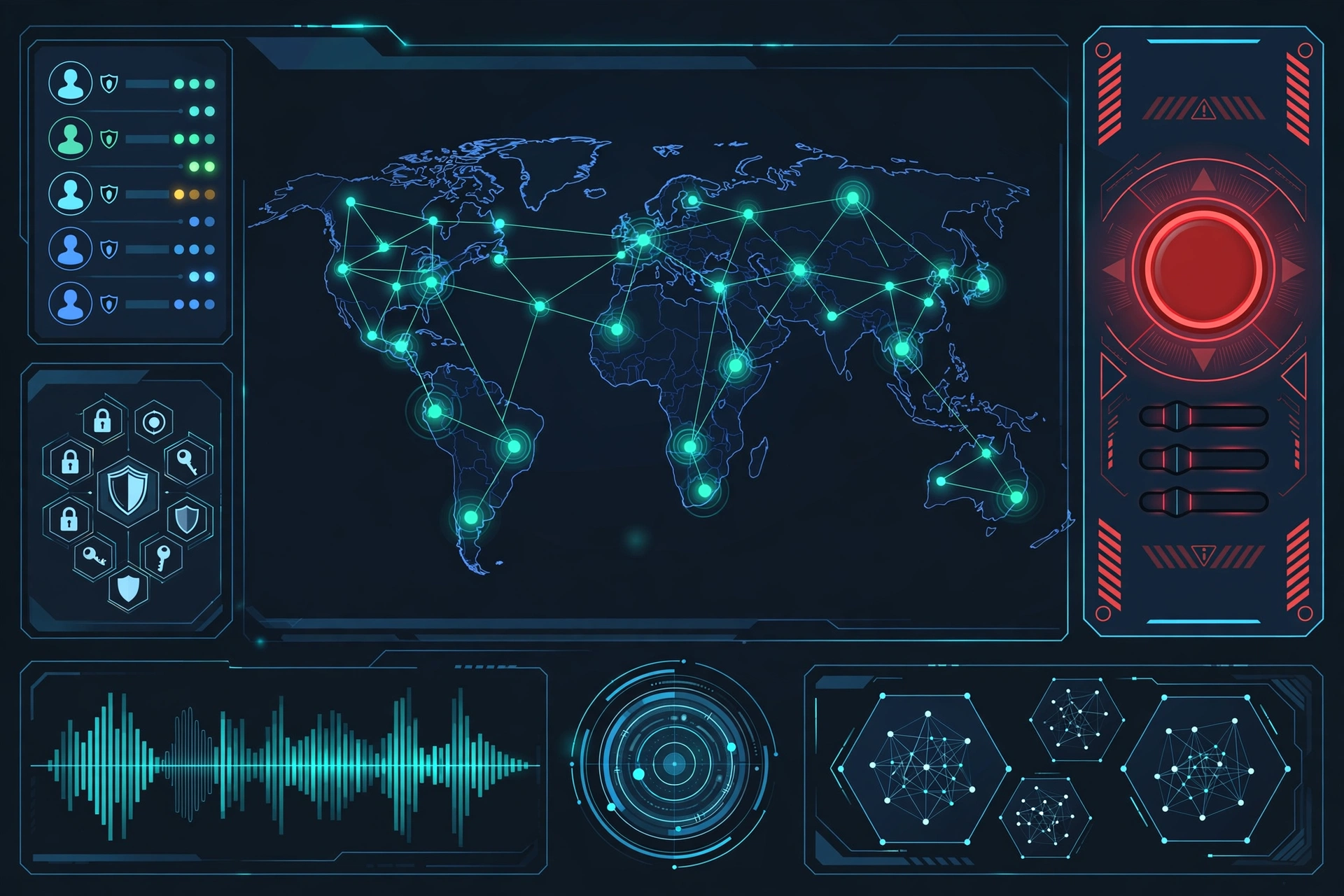
EdgeAI pairs software on devices, gateways, applications and edge systems with Atsign Control Center, giving teams central visibility and control. Rather than granting access based on an IP address or network location, administrators set identity-based communication policies that decide which devices, applications and AI agents are allowed to talk to each other. Control Center also provides an identity-based Kill Switch that can cut off or restrict communication from a compromised or misbehaving device, application or agent, without waiting for firewall changes or network reconfiguration. That containment matters, because one compromised edge node should not become a route into the rest of the system. The same thinking is visible elsewhere, as AI kill switches are becoming a broader security pattern.
Intel hardware makes encrypted edge AI fast

Encryption is often the bottleneck for edge AI, because strong end-to-end protection can slow traffic sharply on constrained hardware. Working with Intel, Atsign says its agent-to-agent communication gains from hardware-backed security, including faster encryption, hardware-backed key generation and protected key storage. In Atsign’s own testing, this delivered up to 60 times higher encryption throughput on Intel Core Ultra processors, reaching 6 Gbps, and up to 88 times on Intel Xeon processors, reaching 5 Gbps, against software-only baselines of about 100 Mbps and 57 Mbps respectively. Those should be read as vendor-reported figures: they explain why hardware acceleration matters for encrypted edge traffic, but they are not independent benchmarks, and real-world results will vary with workload and configuration. The background to this work is described in the earlier Atsign and Intel encryption work.
Where EdgeAI fits first
The most natural early uses are places where systems are already spread out and difficult to rewire: smart transportation networks, city infrastructure, industrial sites and remote operations. Atsign will showcase EdgeAI at Smart City Expo World Congress in Barcelona, November 3-5, 2026, in Intel’s booth, Stand 151, in the USA Pavilion. The underlying Atsign Platform is described as a zero-trust networking fabric that keeps protected systems from public exposure, protects data end to end, and gives policy-based control over which participants may communicate. Customers can use it through packaged solutions such as EdgeAI, or build with Atsign SDKs and AI Architect. This context also matters because enterprise AI spending is surging as agents take over more workloads, while AI regulation is moving toward full-lifecycle safety rules. The wider security model is explained in Atsign’s chain-of-trust approach.
What to watch next
The launch is as much a packaging and positioning move as a technology move: it turns platform capabilities into a product that teams can deploy without redesigning every network. Whether it matters will depend on evidence from production deployments — named customers, measured performance outside vendor tests, and how the identity-based model holds up when thousands of agents, devices and services are communicating at once. For now, EdgeAI is a clear signal of where edge security is heading: away from perimeter defences and open ports, and toward identity, encryption and central control for systems that were never designed to live on the public internet. That caution is reinforced by how far AI agents still are from expert-level work.