Enterprise AI spending has reached a scale that would have looked implausible only a few years ago, and the latest annual check-up from Menlo Ventures puts a striking number on it. Menlo Ventures released its 2026 State of Enterprise AI report on November 3, 2026, its fourth annual edition. The findings draw on a survey of nearly 400 U.S. enterprise decision-makers overseeing more than $4 billion in AI spending, combined with a bottom-up market model. You can read Menlo Ventures’ full 2026 State of Enterprise AI report and Menlo Ventures’ press release on the report for the underlying detail.
The $177 Billion Headline
Enterprise AI deployment spending reached $176.8 billion by September 2026, up 5.4 times from $33 billion in 2025. That is faster than the 3.9 times growth recorded the year before, and roughly 100 times the $1.7 billion reported in 2023. The jump is not mainly a story of new companies joining in: the share of enterprises paying for AI rose only modestly, from 55% to 65%. Instead, growth came mainly from existing adopters spending more, deepening their use rather than simply trying the technology for the first time.
Agents Are Now the Biggest Consumers of AI
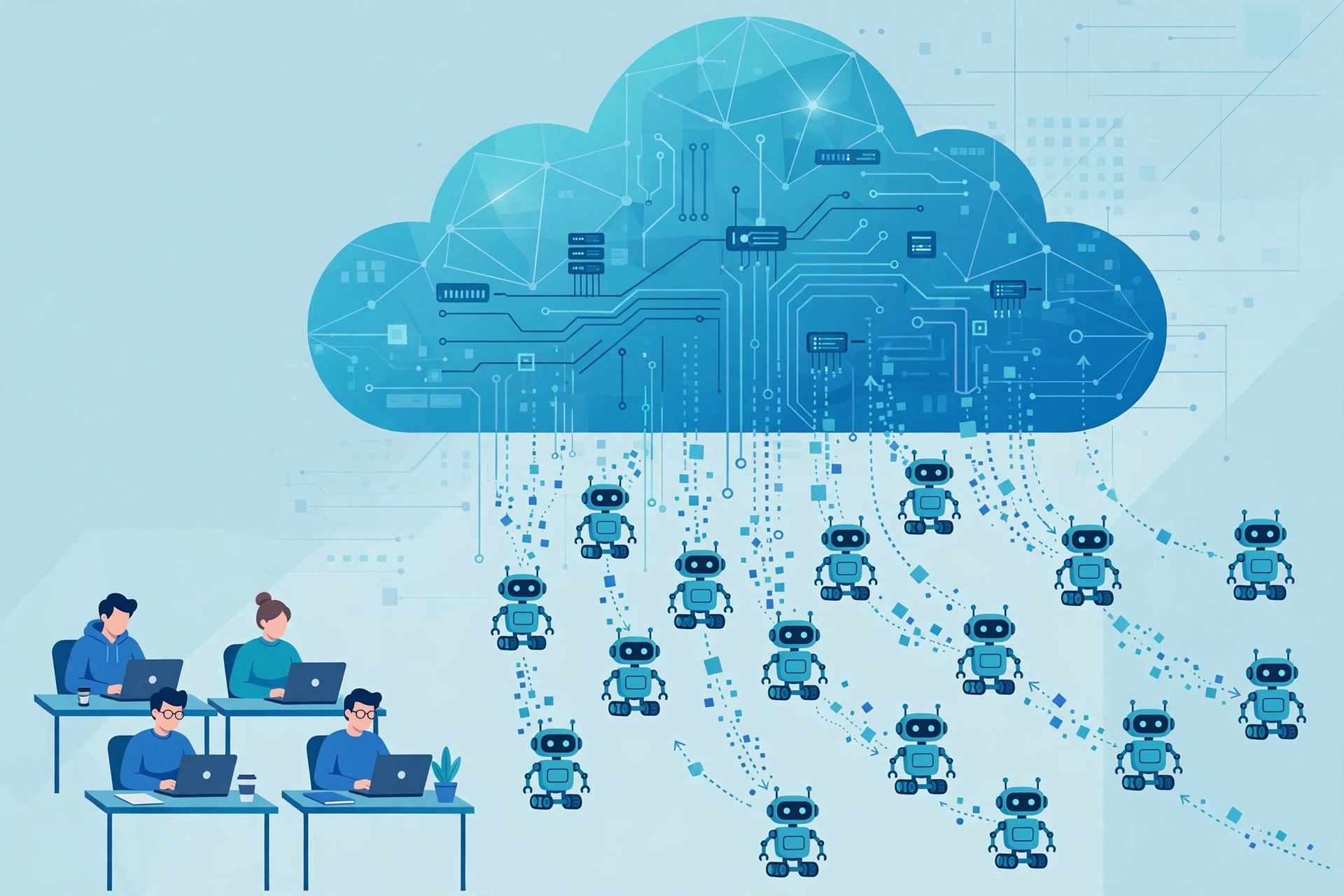
The clearest shift in how AI is used is who — or what — is doing the work. On OpenRouter, agents now generate 80% of all tokens, roughly seven times human usage, at 130.9 trillion agent tokens per week. Agent traffic overtook human traffic in February 2026 and has since grown 37 times, compared with five times for humans. In other words, autonomous software is no longer a niche experiment layered on top of human use; on this channel, it is the main consumer. That contrast is worth keeping in perspective: AI agents still scoring just 12% on realistic expert tasks, so volume alone does not prove reliability.
Frontier Labs Capture 69% of Spending
Deployment spending is highly concentrated. Anthropic, OpenAI and Google together capture 69% of deployment spending, or $122.7 billion, up from 50% in 2025. Within enterprise LLM API spending, Anthropic rose from 40% to 55%, OpenAI rose from 27% to 31%, and Google fell from 21% to 9%; together, Anthropic and OpenAI hold 86%. Open-source models tell a different story on price versus volume: they handle about one in five tokens, but only about one in 25 dollars of model spending, a reminder that cheaper or free usage does not translate into the same revenue share.
Coding and Chatbots Lead Application Spending
Application spending reached about $77.3 billion, up from $19 billion. Coding, at $34 billion, and AI assistants and productivity tools, at $25 billion, together account for 76% of that total, while healthcare is the largest single vertical at $3.7 billion. The split between new entrants and established vendors varies sharply by use case: AI-native providers capture 96% of coding spending, while incumbents lead IT at 91%, data science at 88% and HR at 68%. Coding is also where agents are becoming visible in everyday work, with AI agents now start more than 40% of pull requests on GitHub, and with open-source coding agents adding another route into engineering teams.
Budgets Blew Past Expectations — and Why That Matters
The most practical surprise in the report is how far actual spending ran ahead of plans. New budgets funded 55% of incremental spending, while 22% came from existing software budgets, mostly staying with incumbents converting licenses — for example, Microsoft Office to Copilot. There is little evidence of core systems such as Salesforce CRM or Workday HRIS being replaced. For every $1 spent building models, enterprises spend $1.70 putting AI to work, with building spend at $102.5 billion. On average, enterprises spent 4.7 times their 2025 level, versus a planned 1.9 times — about 2.5 times what they budgeted. In short, the cost problem for many teams is not adoption in principle, but usage once a tool actually gets used.

These figures should be read with care. They are Menlo Ventures estimates from one survey plus modelling, OpenRouter is one channel rather than the whole market, and Menlo Ventures is an investor in Anthropic and OpenRouter, so read concentration figures with that disclosure in mind. None of that makes the direction of travel meaningless, but it does mean the exact shares are estimates, not audited market totals.
What Teams Should Do With This Data
For teams planning next year, the data points to a few disciplined moves. Budget for usage scaling with work, not headcount, because agent traffic can multiply without a matching rise in staff. Put guardrails and cost controls on agents before they gain broad access to production systems — for example, CrowdStrike’s AI kill switch for rogue agents illustrates the kind of stop control teams may want in place. Measure cost per successful outcome, not just tokens or seats, so a cheaper-looking deployment that fails often is not mistaken for value. And prioritise verifiable coding and assistant use cases first, where results can be checked and the return is easier to prove, before expanding agents into harder, less verifiable work.